




Klotho protein: From an anti-aging factor to a key regulator of kidney protection
Author: Senior Product Manager of UA Views:7 


This article systematically elaborates on the molecular characteristics and biological functions of the Klotho protein, focusing on its structural features as an anti-aging gene-encoded product, its high expression patterns in the kidneys, and its mechanisms of renal protection through regulating phosphate metabolism, inhibiting oxidative stress, and suppressing inflammatory responses. It also analyzes its potential applications in ischemia-reperfusion injury, immunosuppressant-induced nephrotoxicity, and the protection of transplant kidney function.
- Recent Advances
- Product Information
Recent Advances
Klotho Protein: From Anti-Aging Factor to Key Regulator of Renal Protection
Summary
This article systematically elaborates on the molecular characteristics and biological functions of Klotho protein, highlighting its structural features as a product of the anti-aging gene, its high expression pattern in the kidneys, and its mechanisms of renal protection through regulating phosphate metabolism, inhibiting oxidative stress, and suppressing inflammatory responses. It also analyzes its potential applications in ischemia-reperfusion injury, immunosuppressant nephrotoxicity, and transplant kidney function protection.
This article systematically elaborates on the molecular characteristics and biological functions of Klotho protein, highlighting its structural features as a product of the anti-aging gene, its high expression pattern in the kidneys, and its mechanisms of renal protection through regulating phosphate metabolism, inhibiting oxidative stress, and suppressing inflammatory responses. It also analyzes its potential applications in ischemia-reperfusion injury, immunosuppressant nephrotoxicity, and transplant kidney function protection.
I. Discovery and Molecular Structure of Klotho Protein
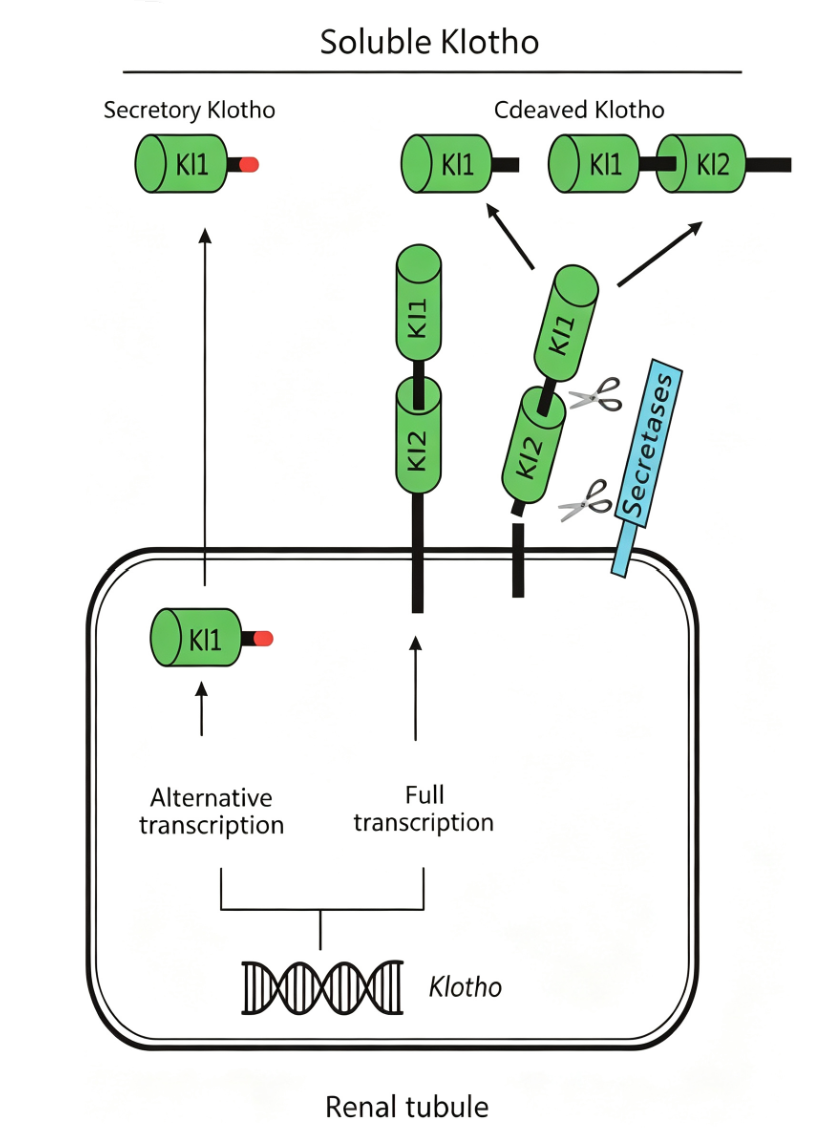
The Klotho gene was first identified in a salt-sensitive hypertensive mouse model as an anti-aging gene highly expressed in the kidneys. In both humans and mice, the Klotho gene is located on chromosome 13, with a coding region consisting of 5 exons and 4 introns. Its translation product, Klotho protein, exists in two isoforms: membrane-bound Klotho is a single-pass transmembrane protein composed of 1012 amino acids, primarily expressed in the distal tubules of the kidneys, with a relative molecular mass of approximately 130 kDa and two glycosidase domains (KL1 and KL2). Secreted Klotho is produced through selective splicing of membrane-bound Klotho by secretases, with a relative molecular mass of about 62 kDa and 549 amino acids, containing only the KL1 domain and lacking transmembrane and intracellular structures. Secreted Klotho is mainly distributed in the blood, with small amounts present in urine and cerebrospinal fluid. As a humoral regulatory factor, secreted Klotho can act throughout the body, exerting various cytoprotective functions such as anti-aging, anti-apoptosis, anti-oxidative stress, and anti-inflammatory responses.
II. Expression and Secretion Regulation of Klotho Protein in the Kidneys
Klotho is expressed in the kidneys, choroid plexus of the brain, pituitary gland, parathyroid glands, pancreas, ovaries, testes, and placenta of humans and rodents, with the highest expression levels observed in the distal tubule epithelial cells of the kidneys. The expression level in proximal tubules is about one-third of that in distal tubules, with a significant distribution of membrane-bound Klotho on the brush border apex. Recent studies have found low levels of Klotho expression in the renal medulla, glomeruli, renal arterioles, and podocytes. The kidneys are the primary source of circulating Klotho, which can be transported from the basolateral membrane to the brush border apex via transcytosis in proximal tubule epithelial cells and secreted into the tubular lumen, regulating tubular transporters and ion channels in an autocrine or paracrine manner. The half-life of exogenous Klotho in nephrectomized rats is significantly prolonged, about 4 to 5 times that of normal rats, indicating that the kidneys are the main organs for uptake and clearance of circulating Klotho.
III. Mechanisms of Renal Protection by Klotho Protein
Klotho protein exerts renal protective effects through multiple mechanisms. In phosphate metabolism regulation, membrane-bound Klotho acts as a specific co-receptor for FGF-23, forming a ternary complex with FGF-23 and its receptor to downregulate the expression of type II sodium-phosphate cotransporters in proximal tubules, promoting phosphate excretion and participating in calcium metabolism and active vitamin D synthesis. Klotho deficiency limits FGF-23's ability to regulate phosphate homeostasis, leading to hyperphosphatemia. In oxidative stress and apoptosis, Klotho inhibits MAPK signaling pathway activation, reduces caspase-3 expression, and increases the Bcl-2/Bax ratio, mitigating oxidative damage and apoptosis. In inflammation regulation, Klotho stabilizes the p50/p65 heterodimer and suppresses the NF-κB pathway to alleviate renal inflammation. In autophagy regulation, Klotho upregulates autophagic flux to reduce oxidative stress-induced renal cell damage. In high glucose-induced diabetic nephropathy mouse models, exogenous Klotho alleviates glomerular endothelial cell injury and inhibits TRPC-6-mediated Ca²⁺ influx in podocytes.
IV. Potential Value of Klotho in Transplant Kidney Function Protection
Ischemia-reperfusion injury (IRI) is an inevitable pathophysiological process in kidney transplantation. Multiple studies have confirmed that IRI reduces Klotho expression in the kidneys, while Klotho protein or increased Klotho expression can improve IRI-related renal damage. Research shows that Klotho gene overexpression enhances the resistance of mouse kidneys to IRI, reduces pathological injury scores, and promotes renal function recovery. In allogeneic kidney transplantation, donor serum Klotho levels are negatively correlated with age, and high donor serum Klotho levels predict short-term renal function recovery in recipients post-transplantation. Delayed graft function (DGF) patients exhibit significantly reduced Klotho expression in transplanted kidneys compared to pre-operation, and serum Klotho levels decrease markedly two years post-operation, suggesting Klotho deficiency may be associated with chronic allograft dysfunction secondary to DGF. Urinary Klotho protein levels may serve as a novel indicator for early tubular injury evaluation in kidney transplantation. Regarding immunosuppressant nephrotoxicity, Klotho upregulates PDLIM2 expression, inhibits the NF-κB/p65 pathway, ameliorates CsA-induced renal inflammation, and attenuates CsA-induced renal fibrosis by suppressing the epithelial-mesenchymal transition (EMT) process.
V. Conclusion
As an anti-aging protein highly expressed in the kidneys, Klotho plays an irreplaceable central role in renal protection through its multiple mechanisms, including regulating phosphate metabolism, inhibiting oxidative stress and inflammation, and modulating autophagy. Its potential value in ischemia-reperfusion injury, immunosuppressant nephrotoxicity, and transplant kidney function protection makes it a promising new target for kidney disease treatment and transplant kidney protection. Mouse-derived recombinant Klotho protein provides critical tools for in-depth analysis of Klotho signaling networks and its protective mechanisms in kidney diseases.
In Klotho-related basic research and drug screening, high-quality mouse-derived recombinant Klotho protein is a core tool for signal pathway analysis, renal function studies, and animal model construction. To meet this research demand, UniLove offers Klotho Protein, Mouse, suitable for applications such as mouse kidney ischemia-reperfusion injury studies, Klotho/FGF-23 signaling pathway exploration, and the construction and therapeutic evaluation of aging-related kidney disease models.
This article is reviewed and published by the technical expert team of UA
Disclaimer: This article partially utilizes artificial intelligence assistance in its creation. If any content involves copyright or intellectual property issues, please let us know and we promise to verify and remove it as soon as possible.
Purchase recombinant protein, choose Nanjing UA-Bio
UA protein focuses on providing various protein reagents, raw materials, and services required for drug research and development, cell therapy, gene therapy, and basic scientific research, including drug target proteins, immune checkpoint proteins, cytokines, tool enzymes, customized protein expression, and full-length transmembrane protein development. Youai is committed to providing customers with high-quality products and professional services, and building a High-tech Biological Enterprise with International Competitiveness.
Target proteins | membrane proteins | cytokines | enzymes | viral antigens | protein customization
Nanjing UA Biotechnology Co., Ltd. Email:order@ua-bio.com Phone:+86-25-56221161

Product Information

Link:





©2021-2026 all rights reserved UA Biotechnology Co.,Ltd.
Privacy Policy 
网站备案号 浙ICP备2022019033号-2 浙公网安备33010202004867号
 Business license (three certificates in one)
 Tel:+86-25-56221161
E-mail:order@ua-bio.com
All products sold on this website shall not be used for clinical diagnosis or treatment of humans or animals, and shall only be used for non-medical purposes such as industrial or scientific research.
