




Th1 cell polarization: from molecular mechanisms to standardized strategies for in vitro induction
Author: Senior Product Manager of UA Views:8 


This article systematically elucidates the molecular mechanisms underlying the directional differentiation of naive CD4+ T cells into the Th1 subset driven by IL-12 and IFN-γ signaling, focusing on the molecular characteristics and polarization regulation of Th1 cells. It analyzes the pivotal roles of Th1 cells in anti-tumor immunity, anti-infection defense, and autoimmune diseases through the secretion of effector molecules such as IFN-γ, IL-2, and TNF-α.
- Recent Advances
- Product Information
Recent Advances
Th1 Cell Polarization: From Molecular Mechanisms to Standardized Strategies for In Vitro Induction
Overview
This article systematically elucidates the molecular characteristics and polarization regulation of Th1 cells, detailing the molecular mechanisms by which naive CD4⁺ T cells differentiate into the Th1 subset under the guidance of IL-12 and IFN-γ signaling. It analyzes the core functions of Th1 cells in anti-tumor immunity, anti-infection defense, and autoimmune diseases through the secretion of effector molecules such as IFN-γ, IL-2, and TNF-α.
This article systematically elucidates the molecular characteristics and polarization regulation of Th1 cells, detailing the molecular mechanisms by which naive CD4⁺ T cells differentiate into the Th1 subset under the guidance of IL-12 and IFN-γ signaling. It analyzes the core functions of Th1 cells in anti-tumor immunity, anti-infection defense, and autoimmune diseases through the secretion of effector molecules such as IFN-γ, IL-2, and TNF-α.
I. Developmental Origin and Polarization Regulation of Th1 Cells
Th1 cells are a critical subset of CD4⁺ helper T cells, playing an indispensable role in cellular immune responses. After completing their development in the thymus, naive CD4⁺ T cells migrate to peripheral lymphoid tissues, where they differentiate into Th0 cells (naive T cells) upon receiving dual activation signals from antigen-presenting cells. Th0 cells further polarize into distinct effector subsets under the influence of specific microenvironmental signals. Th1 cell polarization is synergistically driven by IL-12 and IFN-γ signaling pathways—IFN-γ activates signal transducer and activator of transcription 1 (STAT1), while IL-12 activates STAT4, both inducing the expression of the lineage-defining transcription factor T-bet to initiate Th1 differentiation. T-bet, as the master transcription factor for Th1 cell differentiation, transactivates the IFN-γ gene while suppressing the activity of Th2- and Th17-associated transcription factors GATA3 and RORγt, ensuring the irreversibility of Th1 polarization. During this process, IL-12 activates the JAK2/TYK2-STAT4 pathway via its receptor complex to induce T-bet expression, while IFN-γ activates the JAK1/JAK2-STAT1 pathway through the IFN-γ receptor, further enhancing T-bet expression and promoting an autocrine positive feedback loop of IFN-γ, thereby reinforcing Th1 differentiation.
II. Effector Functions and Molecular Mechanisms of Th1 Cells
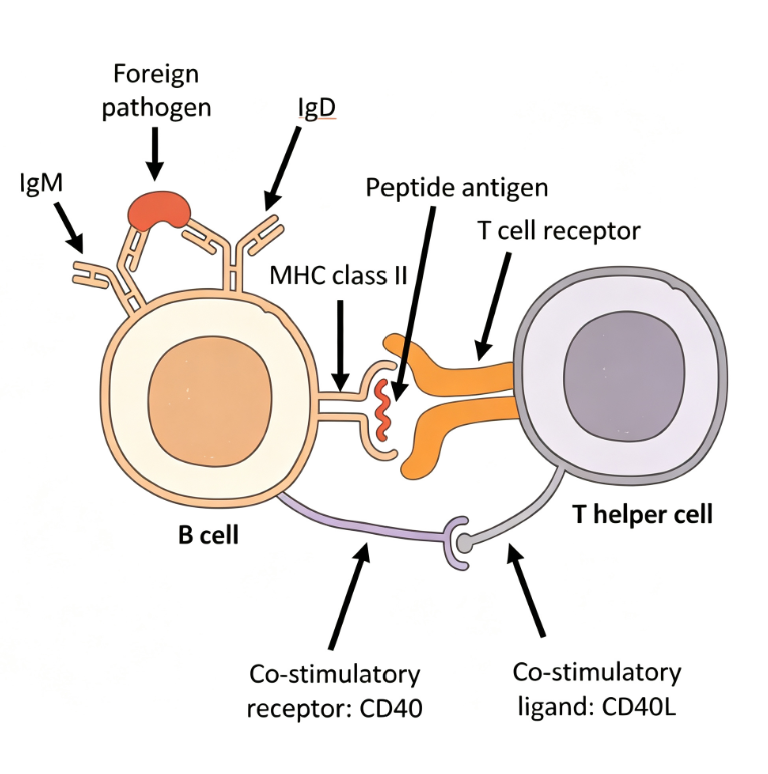
Th1 cells exert their effector functions through the secretion of characteristic cytokines. IFN-γ is the most representative effector molecule of Th1 cells, with diverse biological roles: activating macrophage phagocytosis and bactericidal activity, enhancing their antigen-presenting capacity; promoting B cell class switching to IgG2a, augmenting antibody-dependent cellular cytotoxicity; inducing the expression of chemokines CXCL9, CXCL10, and CXCL11 to recruit Th1 cells to inflammatory sites; and upregulating MHC class I and II molecule expression to improve antigen presentation efficiency. IL-2 is a key growth factor for T cells, supporting the proliferation and survival of Th1 cells and CD8⁺ T cells. TNF-α exerts anti-tumor and anti-infection effects by directly acting on target cells or inducing inflammatory responses. Th1 cells also engage CD40L with CD40 on macrophages to cooperatively activate their bactericidal function and induce target cell apoptosis via the Fas/FasL pathway.
III. Surface Markers and Identification Methods for Th1 Cells
Traditional flow cytometry identifies Th1 cells using the marker combination CD3⁺CD4⁺CXCR3⁺, along with nuclear transcription factor T-bet and intracellular cytokine IFN-γ expression. CXCR3 is a characteristic chemokine receptor on Th1 cells, mediating their migration to inflammatory sites. T-bet, as the lineage-defining factor for Th1 differentiation, serves as the core criterion for Th1 cell identification. Advances in single-cell transcriptomics enable simultaneous detection of surface markers, intracellular transcription factors, and effector molecules at the transcriptome level, with common markers including CD3D/CD3E/CD3G, CD4, CXCR3, TBX21, and IFNG.
IV. Dual Roles of Th1 Cells in Disease
Th1 cells play a central protective role in anti-tumor immunity. The presence of Th1 cells and their secreted IFN-γ in tumor-infiltrating lymphocytes is closely associated with favorable patient outcomes. Th1 cells enhance anti-tumor immune responses by activating the cytotoxic activity of CD8⁺ T cells and NK cells, promoting M1 macrophage polarization, and inducing MHC class I expression on tumor cells. In anti-infection immunity, Th1 cells are essential for combating intracellular pathogens—IFN-γ activates macrophages to clear intracellular pathogens and promotes granuloma formation to encapsulate them. However, in autoimmune diseases and transplant rejection, excessive Th1 cell activation drives pathological damage—Th1 cells and their IFN-γ mediate tissue injury in rheumatoid arthritis, type 1 diabetes, and multiple sclerosis, and promote acute rejection in organ transplantation.
V. Conclusion
As a pivotal subset of CD4⁺ helper T cells, Th1 cells, through their T-bet-dominated differentiation network and multifunctional effector molecules such as IFN-γ, IL-2, and TNF-α, play an irreplaceable dual role in anti-tumor immunity, anti-infection defense, and autoimmune disease regulation. Standardized in vitro Th1 polarization systems provide essential experimental tools for elucidating the regulatory mechanisms of Th1 differentiation and their functional networks in diseases.
In Th1 cell differentiation and functional studies, standardized in vitro induction systems are critical for experimental reproducibility. To meet this research need, U-Antibody offers a human Th1 polarization kit, suitable for the directional in vitro induction of naive CD4⁺ T cells into the Th1 subset. This kit can be used for Th1 differentiation mechanism studies, tumor immune microenvironment analysis, and vaccine adjuvant evaluation. It ensures high-efficiency and stable Th1 differentiation through optimized IL-12/STAT4 and IFN-γ/STAT1 signaling pathways, applicable to Th1 differentiation mechanism research, tumor immune microenvironment analysis, and vaccine adjuvant assessment.
This article is reviewed and published by the technical expert team of UA
Disclaimer: This article partially utilizes artificial intelligence assistance in its creation. If any content involves copyright or intellectual property issues, please let us know and we promise to verify and remove it as soon as possible.
Purchase recombinant protein, choose Nanjing UA-Bio
UA protein focuses on providing various protein reagents, raw materials, and services required for drug research and development, cell therapy, gene therapy, and basic scientific research, including drug target proteins, immune checkpoint proteins, cytokines, tool enzymes, customized protein expression, and full-length transmembrane protein development. Youai is committed to providing customers with high-quality products and professional services, and building a High-tech Biological Enterprise with International Competitiveness.
Target proteins | membrane proteins | cytokines | enzymes | viral antigens | protein customization
Nanjing UA Biotechnology Co., Ltd. Email:order@ua-bio.com Phone:+86-25-56221161

Product Information

Link:





©2021-2026 all rights reserved UA Biotechnology Co.,Ltd.
Privacy Policy 
网站备案号 浙ICP备2022019033号-2 浙公网安备33010202004867号
 Business license (three certificates in one)
 Tel:+86-25-56221161
E-mail:order@ua-bio.com
All products sold on this website shall not be used for clinical diagnosis or treatment of humans or animals, and shall only be used for non-medical purposes such as industrial or scientific research.
