




B Cell Polarization: From Functional Heterogeneity to Standardized Strategies for Directed Induction In Vitro
Author: Senior Product Manager of UA Views:8 


This article systematically elucidates the differentiation pathways of effector B cells and regulatory B cells, as well as their dual functions in immune responses, focusing on the functional heterogeneity of B cells and their polarization regulation in vitro. It analyzes the pivotal roles of key cytokines (IL-2, IL-10, IL-21) in B cell survival, proliferation, differentiation, and the directional induction of functional subsets.
- Recent Advances
- Product Information
Recent Advances
B Cell Polarization: From Functional Heterogeneity to Standardized Strategies for Directed Induction In Vitro
Overview
This article systematically explores the functional heterogeneity of B cells and their polarization regulation in vitro, detailing the differentiation pathways of effector B cells and regulatory B cells (Bregs) and their dual roles in immune responses. It analyzes the pivotal roles of key cytokines (IL-2, IL-10, IL-21) in B cell survival, proliferation, differentiation, and the directed induction of functional subsets.
This article systematically explores the functional heterogeneity of B cells and their polarization regulation in vitro, detailing the differentiation pathways of effector B cells and regulatory B cells (Bregs) and their dual roles in immune responses. It analyzes the pivotal roles of key cytokines (IL-2, IL-10, IL-21) in B cell survival, proliferation, differentiation, and the directed induction of functional subsets.
I. Functional Heterogeneity and Polarized Subsets of B Cells
Traditionally, B cells were thought to mediate humoral immune responses primarily by differentiating into plasma cells and producing antibodies. However, recent studies have revealed a broader functional spectrum of B cells, which can be categorized into two major groups: effector B cells and regulatory B cells (Bregs).
Effector B cells promote immune responses through multiple mechanisms: acting as antigen-presenting cells to present antigens to CD4⁺ T cells, facilitating Th1 and Th17 differentiation, and secreting pro-inflammatory cytokines such as IL-6 and TNF-α. These effector functions play protective roles in anti-infection immunity but may also contribute to tissue damage in autoimmune diseases.
Regulatory B cells (Bregs) are a subset of B cells with immunosuppressive functions, primarily mediated through the secretion of inhibitory cytokines like IL-10 and TGF-β. Bregs can suppress effector T cell proliferation, promote Treg differentiation, and inhibit dendritic cell function, playing a critical role in maintaining immune tolerance and curbing excessive inflammatory responses. Deficiencies in Breg quantity or function are associated with various autoimmune diseases.
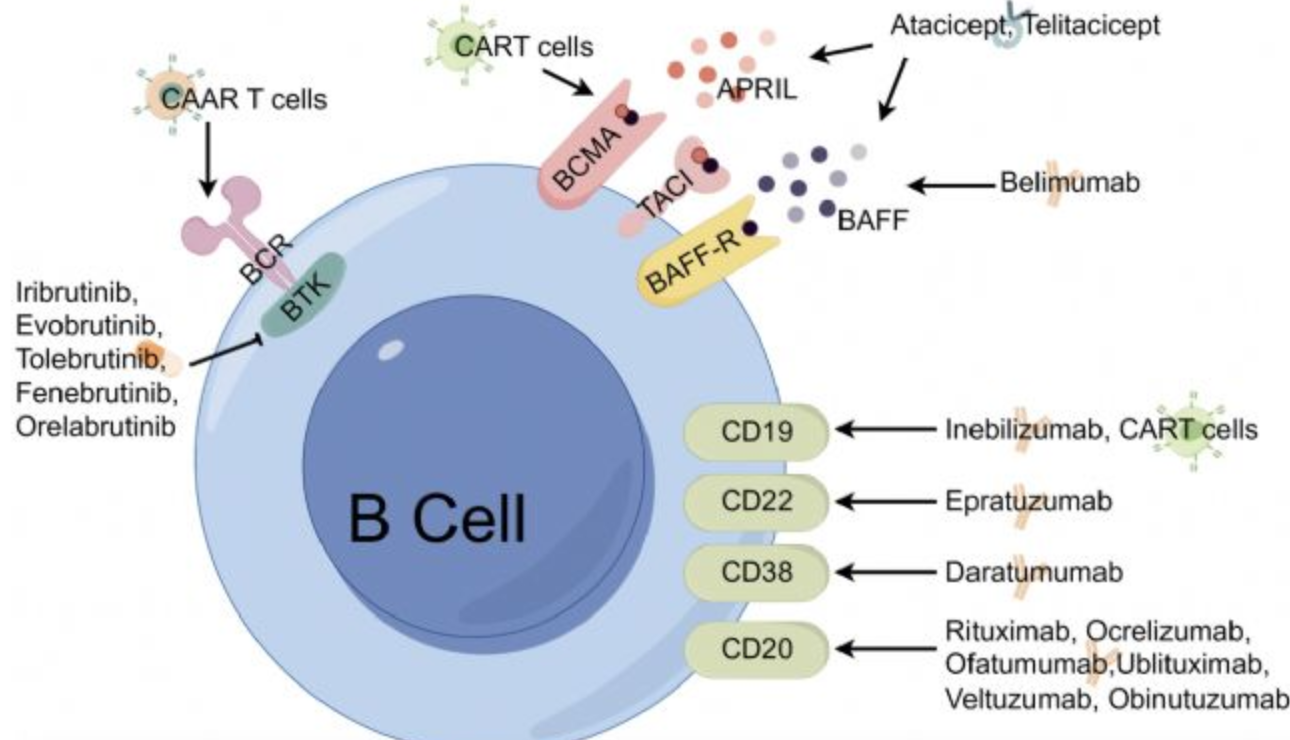
II. Cytokine Regulatory Network in B Cell Polarization
The differentiation of B cell functional subsets is precisely regulated by the cytokine network in the microenvironment, with different cytokine combinations directing B cells toward specific functional polarizations. Studies have confirmed that upon initial exposure to antigens and T cells, B cells stimulated by varying cytokine environments can differentiate into two effector subsets, Be1 and Be2, each producing distinct cytokine profiles. These subsets, in turn, regulate the differentiation of naïve CD4⁺ T cells into Th1 and Th2 through the secretion of polarized cytokines such as IL-4 and IFN-γ.
Key functions of polarization cytokines include: IL-21 is a critical factor promoting B cell differentiation toward effector phenotypes, inducing B cell proliferation, plasma cell differentiation, and enhancing antibody production and affinity maturation. IL-2 supports B cell survival and proliferation. IL-10 promotes B cell survival, proliferation, and induces regulatory B cells or the production of specific antibodies (IgA/IgG). IFN-γ can induce B cells to acquire migratory and polarized morphologies, though its effects are weaker and slower compared to IL-4.
III. Experimental Strategies for B Cell Polarization In Vitro
In vitro experiments can rapidly induce directed B cell differentiation from human PBMCs using specific cytokine combinations. Research shows that IL-4 is the strongest cytokine for inducing polarized morphology and migratory capacity in B cells—at an optimized concentration of 3 ng/mL, IL-4 can polarize 10%-20% of B cells within 30 minutes, with overnight exposure increasing this to up to 40%. IL-21 drives B cell differentiation into plasma cells, promoting antibody secretion and affinity maturation.
A standardized experimental protocol typically involves: seeding PBMCs at a density of 5×10⁴–2×10⁵/mL in RPMI-1640 supplemented with 10% heat-inactivated human serum and 55 μM β-mercaptoethanol, adding 100 ng/mL IL-2, 100 ng/mL IL-10, 100 ng/mL IL-21, and feeder cells, followed by a 5-day culture period. Polarization efficiency is then assessed via flow cytometry.
IV. Conclusion
B cells, as multifunctional regulators of the immune system, exhibit roles far beyond those of classical antibody-secreting cells. The differentiation of B cell functional subsets is precisely controlled by the cytokine network in the microenvironment, with key cytokines like IL-2, IL-10, and IL-21 playing indispensable synergistic roles in B cell survival, proliferation, and functional polarization. Standardized in vitro B cell polarization systems provide a vital experimental platform for in-depth exploration of B cell functional heterogeneity in immune responses, investigation of Breg regulatory mechanisms in immune tolerance, and the development of B cell-targeted immunotherapies.
In B cell polarization research, standardized cytokine combinations are essential for ensuring experimental reproducibility and directed differentiation efficiency. To meet this research need, UniCell offers a human B cell polarization cytokine kit. This kit includes recombinant human IL-2 (promoting B cell survival and proliferation), recombinant human IL-10 (promoting B cell survival, proliferation, and inducing Bregs or specific antibody production), and recombinant human IL-21 (driving B cell differentiation into plasma cells and enhancing antibody secretion and affinity maturation). The cytokines are optimized for synergistic effects, with protein purity >95% and endotoxin levels <1.0 EU/μg. The kit is suitable for in vitro polarization induction of human PBMC-derived B cells, Breg differentiation studies, and exploration of B cell immune regulatory mechanisms.
This article is reviewed and published by the technical expert team of UA
Disclaimer: This article partially utilizes artificial intelligence assistance in its creation. If any content involves copyright or intellectual property issues, please let us know and we promise to verify and remove it as soon as possible.
Purchase recombinant protein, choose Nanjing UA-Bio
UA protein focuses on providing various protein reagents, raw materials, and services required for drug research and development, cell therapy, gene therapy, and basic scientific research, including drug target proteins, immune checkpoint proteins, cytokines, tool enzymes, customized protein expression, and full-length transmembrane protein development. Youai is committed to providing customers with high-quality products and professional services, and building a High-tech Biological Enterprise with International Competitiveness.
Target proteins | membrane proteins | cytokines | enzymes | viral antigens | protein customization
Nanjing UA Biotechnology Co., Ltd. Email:order@ua-bio.com Phone:+86-25-56221161

Product Information

Link:





©2021-2026 all rights reserved UA Biotechnology Co.,Ltd.
Privacy Policy 
网站备案号 浙ICP备2022019033号-2 浙公网安备33010202004867号
 Business license (three certificates in one)
 Tel:+86-25-56221161
E-mail:order@ua-bio.com
All products sold on this website shall not be used for clinical diagnosis or treatment of humans or animals, and shall only be used for non-medical purposes such as industrial or scientific research.
