




IL-21: A Pleiotropic Regulator Bridging Innate and Adaptive Immunity
Author: Senior Product Manager of UA Views:12 


This article systematically elaborates on the molecular characteristics and biological functions of interleukin-21 (IL-21), focusing on its structural features as a member of the IL-15/IL-21 family and its mechanism of activating the JAK-STAT signaling pathway through the IL-21R/γc receptor complex. It also analyzes its pivotal role in regulating the functions of CD8+ T cells, NK cells, and CD4+ T cell subsets.
- Recent Advances
- Product Information
Recent Advances
IL-21: A Pleiotropic Regulator Bridging Innate and Adaptive Immunity
Overview
This article systematically elucidates the molecular characteristics and biological functions of interleukin-21 (IL-21), detailing its structural features as a member of the IL-15/IL-21 family and its mechanism of activating the JAK-STAT signaling pathway through the IL-21R/γc receptor complex. It analyzes its central role in regulating the functions of CD8⁺ T cells, NK cells, and CD4⁺ T cell subsets.
This article systematically elucidates the molecular characteristics and biological functions of interleukin-21 (IL-21), detailing its structural features as a member of the IL-15/IL-21 family and its mechanism of activating the JAK-STAT signaling pathway through the IL-21R/γc receptor complex. It analyzes its central role in regulating the functions of CD8⁺ T cells, NK cells, and CD4⁺ T cell subsets.
I. Molecular Structure and Receptor System of IL-21
Interleukin-21 (IL-21) is a secreted cytokine belonging to the IL-15/IL-21 family, characterized by a four-α-helix bundle structure. The human IL-21 gene is located on chromosome 4q26-q27, encoding a mature protein of 133 amino acid residues with a molecular weight of approximately 15.4 kDa. IL-21 exerts its biological functions by binding to its specific receptor complex, composed of the private receptor IL-21R (also known as CD360) and the common cytokine receptor γ-chain (γc, CD132). IL-21R is a type I transmembrane protein of the class I cytokine receptor family, with an extracellular domain containing two fibronectin type III domains responsible for high-affinity ligand binding. The intracellular domain contains Box1 and Box2 motifs, which are essential for JAK kinase binding and signal initiation. The γc chain is a shared subunit among receptors for multiple cytokines, including IL-2, IL-4, IL-7, IL-9, and IL-15, ensuring synergistic and cross-regulatory interactions between IL-21 and other γc family cytokines. The expression of IL-21R is highly cell lineage-specific—it is widely expressed in lymphoid hematopoietic cells, including T cells, B cells, NK cells, dendritic cells, and macrophages, but exhibits minimal expression in non-hematopoietic cells.
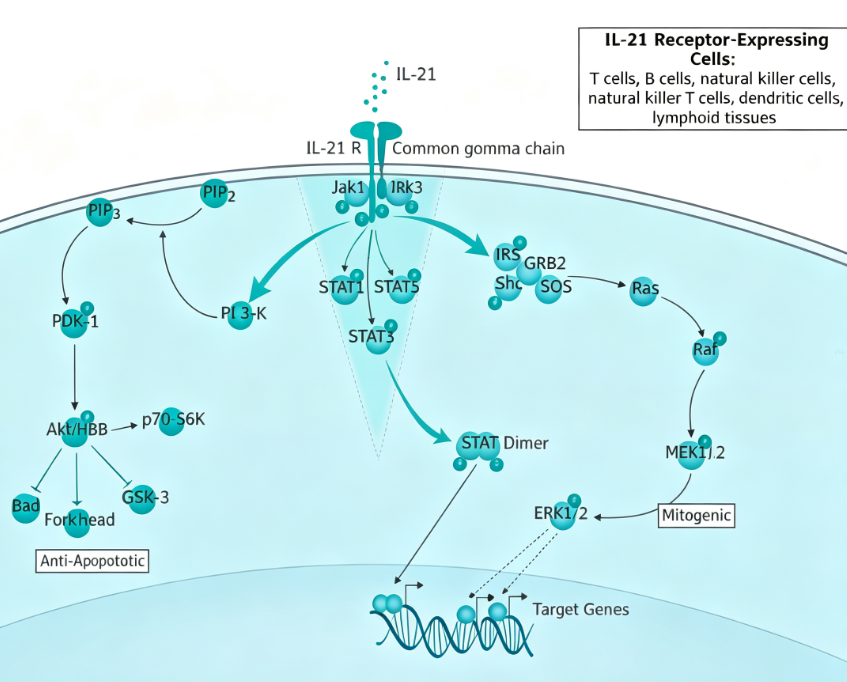
II. Signal Transduction Mechanism and Functional Diversity of IL-21
The interaction between IL-21 and IL-21R triggers a cascade of signaling events. Upon binding, IL-21R and γc phosphorylate and activate JAK1 and JAK3, respectively, leading to the recruitment and phosphorylation of STAT family members, primarily STAT3, with partial activation of STAT1 and transient activation of STAT5a/b. Phosphorylated STAT3 forms homodimers that translocate to the nucleus, binding to interferon-γ-activated sequences in the promoter regions of target genes to initiate transcription. These target genes include granzyme A, granzyme B, B-cell lymphoma 6 protein (Bcl6), orphan nuclear receptor γt (RORγt), the tumor suppressor Bim, Prdm1, and IL-10. Through this signaling network, IL-21 achieves precise regulation of the functional states of various immune cells.
III. Functional Regulation of IL-21 on Multiple Immune Cells
In CD8⁺ T cells, IL-21 promotes the proliferation of memory and naive CD8⁺ T cells and enhances their secretion of IL-2, IFN-γ, and perforin. In NK cells, IL-21 facilitates proliferation, differentiation, and maturation through its receptor, stimulating the production of IFN-γ and perforin. IL-21 synergizes with IL-15 to augment NK cell proliferation and cytotoxicity. In CD4⁺ T cells, IL-21 promotes the differentiation and maintenance of Th17 cells and plays a role in the development and functional regulation of follicular helper T cells. In B cells, IL-21 drives proliferation, differentiation, and antibody secretion, playing a critical role in germinal center reactions and affinity maturation.
IV. Potential of IL-21 in Cancer Immunotherapy
IL-21 has demonstrated significant anti-tumor activity in preclinical models of solid tumors such as melanoma and renal cell carcinoma, promoting the infiltration and cytotoxic functions of CD8⁺ T cells and NK cells. Leveraging its ability to enhance T cell persistence and functionality, IL-21 has been utilized to optimize CAR-T cell products—adding IL-21 during in vitro expansion yields cells with reduced exhaustion phenotypes and a higher proportion of central memory T cells. The clinical translational value of IL-21 lies in its capacity to amplify anti-tumor immune responses without significantly expanding regulatory T cells, making it a promising combinatorial factor in cancer immunotherapy.
V. Conclusion
As a core member of the IL-2 cytokine superfamily, IL-21 plays an indispensable role in anti-tumor immune responses and humoral immunity through its broad regulatory effects on CD8⁺ T cells, NK cells, and B cells. Its unique advantages in enhancing CAR-T cell anti-tumor activity, promoting memory T cell formation, and improving treatment safety provide critical insights for optimizing next-generation immunotherapy strategies. Recombinant human IL-21 protein, as a vital tool for basic research and preclinical development, will continue to support in-depth exploration in the field of immunotherapy.
In IL-21-related basic research and cell therapy development, high-quality recombinant human IL-21 protein is a cornerstone tool for immune cell expansion and functional studies, signaling pathway analysis, and combinatorial therapy optimization. To meet these research needs, U-Research offers IL-21 Protein, Human, suitable for applications such as CAR-T cell expansion and functional modulation, NK cell proliferation and activation studies, and exploration of JAK/STAT signaling mechanisms.
This article is reviewed and published by the technical expert team of UA
Disclaimer: This article partially utilizes artificial intelligence assistance in its creation. If any content involves copyright or intellectual property issues, please let us know and we promise to verify and remove it as soon as possible.
Purchase recombinant protein, choose Nanjing UA-Bio
UA protein focuses on providing various protein reagents, raw materials, and services required for drug research and development, cell therapy, gene therapy, and basic scientific research, including drug target proteins, immune checkpoint proteins, cytokines, tool enzymes, customized protein expression, and full-length transmembrane protein development. Youai is committed to providing customers with high-quality products and professional services, and building a High-tech Biological Enterprise with International Competitiveness.
Target proteins | membrane proteins | cytokines | enzymes | viral antigens | protein customization
Nanjing UA Biotechnology Co., Ltd. Email:order@ua-bio.com Phone:+86-25-56221161

Product Information

Link:





©2021-2026 all rights reserved UA Biotechnology Co.,Ltd.
Privacy Policy 
网站备案号 浙ICP备2022019033号-2 浙公网安备33010202004867号
 Business license (three certificates in one)
 Tel:+86-25-56221161
E-mail:order@ua-bio.com
All products sold on this website shall not be used for clinical diagnosis or treatment of humans or animals, and shall only be used for non-medical purposes such as industrial or scientific research.
