




IL-13: A Core Driver and Therapeutic Target in the Pathogenesis of Atopic Dermatitis
Author: Senior Product Manager of UA Views:12 


This article systematically elucidates the molecular characteristics and pathological functions of interleukin-13 (IL-13) in atopic dermatitis (AD), highlighting its role as a core effector molecule in Th2-type immune responses that drives key processes such as skin barrier disruption, pruritus, and amplification of inflammatory cascades. It also analyzes the complex regulatory networks of IL-13 across multiple layers of AD pathophysiology.
- Recent Advances
- Product Information
Recent Advances
IL-13: A Core Driver and Therapeutic Target in the Pathogenesis of Atopic Dermatitis
Summary
This article focuses on the molecular characteristics and pathological functions of interleukin-13 (IL-13) in atopic dermatitis (AD), systematically elaborating its role as a core effector molecule of Th2-type immune responses in driving skin barrier disruption, pruritus, and inflammatory cascade amplification, while analyzing its complex regulatory network across multiple aspects of AD pathophysiology.
This article focuses on the molecular characteristics and pathological functions of interleukin-13 (IL-13) in atopic dermatitis (AD), systematically elaborating its role as a core effector molecule of Th2-type immune responses in driving skin barrier disruption, pruritus, and inflammatory cascade amplification, while analyzing its complex regulatory network across multiple aspects of AD pathophysiology.
I. Pathological Features and Immunological Basis of Atopic Dermatitis
Atopic dermatitis is a chronic inflammatory skin disease characterized by skin barrier dysfunction and immune dysregulation, clinically presenting as dry skin, erythema, lichenification, and intense pruritus. Approximately 10% to 20% of children and 2% to 10% of adults worldwide are affected by AD, with prevalence rates continuing to rise. The pathological mechanisms of AD involve three main aspects: genetic predisposition, defects in epidermal barrier genes, and abnormal immune responses. Among these, the overactivation of Th2-type immune responses is the most central immunological feature of AD. In acute-phase AD lesions, the expression levels of Th2-type cytokines (including IL-4, IL-5, IL-13, and IL-31) are significantly elevated, with IL-13 being the primary pathogenic mediator driving multiple aspects of AD pathophysiology.
II. Molecular Characteristics and Receptor Signal Transduction Mechanisms of IL-13
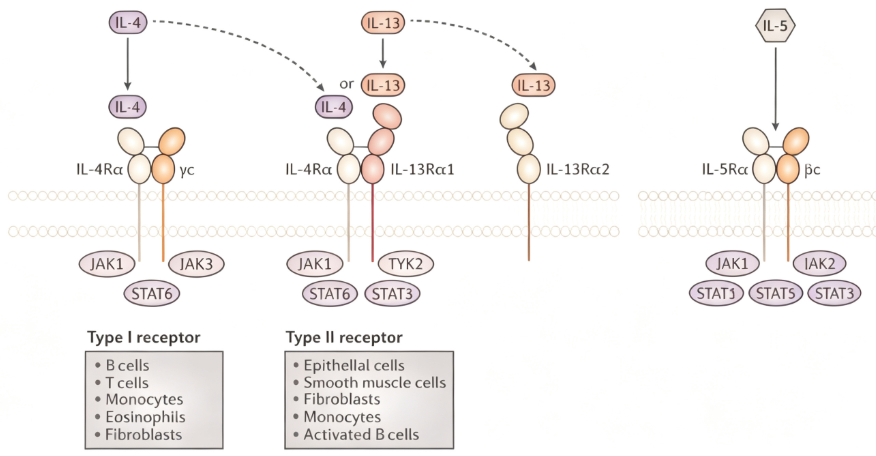
Interleukin-13 (IL-13) is a secreted glycoprotein composed of approximately 132 amino acid residues, with a molecular weight of about 12 to 16 kDa. Its gene is located on human chromosome 5q31.1, closely linked to the IL-4 gene. IL-13 and IL-4 share high homology in gene structure and amino acid sequence, both adopting a four-α-helix bundle folding pattern. IL-13 is produced by activated Th2 cells, mast cells, eosinophils, and ILC2 cells. IL-13 initiates signal transduction by binding to the IL-13 receptor complex on target cell surfaces. In the functional type II receptor complex, IL-13 binds to IL-13Rα1 and recruits IL-4Rα to form a high-affinity heterodimer, activating JAK1 and TYK2, which then phosphorylate STAT6. Phosphorylated STAT6 forms homodimers that translocate to the nucleus, initiating transcription of downstream target genes. STAT6 activation drives the majority of IL-13's biological effects, including promoting B cell class switching to IgE, inducing epithelial cells to produce chemokines and mucus, and downregulating the expression of barrier-related proteins. IL-13Rα2, a high-affinity decoy receptor, is expressed at low levels in normal skin but upregulated in AD lesions, possibly serving as part of a negative feedback regulatory mechanism.
III. Multifaceted Mechanisms by Which IL-13 Drives AD Pathology
IL-13 acts on multiple key nodes in the progression of AD pathology, forming a complex pathological network. At the skin barrier level, IL-13 downregulates the expression of barrier-related proteins such as filaggrin, involucrin, and loricrin in keratinocytes, directly disrupting epidermal barrier function. At the inflammatory signal amplification level, IL-13 induces keratinocytes to secrete epithelial-derived cytokines such as thymic stromal lymphopoietin, IL-25, and IL-33, further activating downstream Th2 immune responses and forming a positive feedback inflammatory loop. At the pruritus level, IL-13 can directly act on sensory neurons, lowering their activation threshold, and indirectly exacerbate itching by promoting the secretion of pruritogenic factors like IL-31. At the tissue remodeling level, IL-13 promotes fibroblast proliferation and collagen deposition, contributing to lichenification and skin thickening. At the infection susceptibility level, IL-13 inhibits the production of antimicrobial peptides by keratinocytes, increasing the risk of microbial colonization and infection by pathogens such as Staphylococcus aureus.
IV. Conclusion
As a core effector molecule of Th2-type immune responses, IL-13 occupies an irreplaceable central position in the pathogenesis of atopic dermatitis by simultaneously driving multiple pathological processes, including skin barrier disruption, inflammatory cascade amplification, pruritus signal transduction, and tissue remodeling. Its broad biological effects make it one of the most promising intervention targets for AD treatment. Human recombinant IL-13 protein, as a critical tool for basic research and drug development, will continue to provide essential support for in-depth exploration of the fine regulatory mechanisms of IL-13 in the AD pathological network and the optimization of related therapeutic strategies.
In basic research and drug screening for atopic dermatitis and related Th2-type inflammatory diseases, high-quality human recombinant IL-13 protein is a core tool for signal pathway analysis, cellular function studies, and drug activity evaluation. To meet this research need, Uni offers IL-13 Protein, Human, suitable for applications such as IL-13/STAT6 signaling pathway mechanism exploration, keratinocyte barrier function studies, and in vitro activity evaluation of anti-IL-13 antibody drugs.
This article is reviewed and published by the technical expert team of UA
Disclaimer: This article partially utilizes artificial intelligence assistance in its creation. If any content involves copyright or intellectual property issues, please let us know and we promise to verify and remove it as soon as possible.
Purchase recombinant protein, choose Nanjing UA-Bio
UA protein focuses on providing various protein reagents, raw materials, and services required for drug research and development, cell therapy, gene therapy, and basic scientific research, including drug target proteins, immune checkpoint proteins, cytokines, tool enzymes, customized protein expression, and full-length transmembrane protein development. Youai is committed to providing customers with high-quality products and professional services, and building a High-tech Biological Enterprise with International Competitiveness.
Target proteins | membrane proteins | cytokines | enzymes | viral antigens | protein customization
Nanjing UA Biotechnology Co., Ltd. Email:order@ua-bio.com Phone:+86-25-56221161

Product Information

Link:





©2021-2026 all rights reserved UA Biotechnology Co.,Ltd.
Privacy Policy 
网站备案号 浙ICP备2022019033号-2 浙公网安备33010202004867号
 Business license (three certificates in one)
 Tel:+86-25-56221161
E-mail:order@ua-bio.com
All products sold on this website shall not be used for clinical diagnosis or treatment of humans or animals, and shall only be used for non-medical purposes such as industrial or scientific research.
