




ActRIIB: The Core Receptor in Muscle Homeostasis and Metabolic Regulation, and Its Prospects in Drug Development
Author: Senior Product Manager of UA Views:10 


This article focuses on the molecular characteristics and biological functions of activin receptor type IIB (ActRIIB), systematically elaborating its high expression features in skeletal muscle, cardiac muscle, and adipose tissue as a TGF-β superfamily receptor, as well as its high sensitivity to myostatin and activin B. It analyzes its therapeutic potential in muscle atrophy diseases, cancer cachexia, and metabolic disorders, along with the advantages and challenges in the development of targeted drugs.
- Recent Advances
- Product Information
Recent Advances
ActRIIB: The Core Receptor in Muscle Homeostasis and Metabolic Regulation and Its Prospects in Drug Development
Summary
This article systematically elaborates on the molecular characteristics and biological functions of Activin Receptor Type IIB (ActRIIB) as a TGF-β superfamily receptor, highlighting its high expression in skeletal muscle, cardiac muscle, and adipose tissue, as well as its high sensitivity to myostatin and activin B. It analyzes its therapeutic potential in muscle-wasting diseases, cancer cachexia, and metabolic disorders, along with the advantages and challenges of targeted drug development.
This article systematically elaborates on the molecular characteristics and biological functions of Activin Receptor Type IIB (ActRIIB) as a TGF-β superfamily receptor, highlighting its high expression in skeletal muscle, cardiac muscle, and adipose tissue, as well as its high sensitivity to myostatin and activin B. It analyzes its therapeutic potential in muscle-wasting diseases, cancer cachexia, and metabolic disorders, along with the advantages and challenges of targeted drug development.
I. Molecular Characteristics and Tissue Distribution of ActRIIB
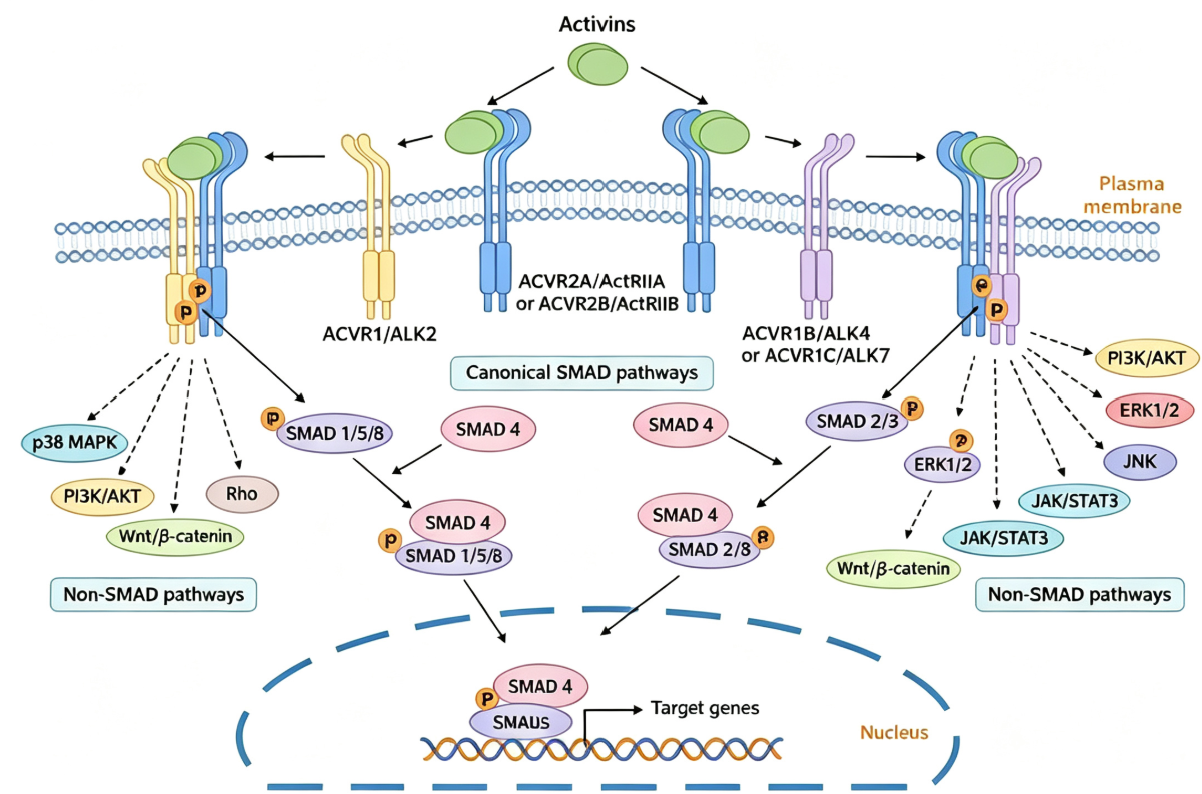
Activin Receptor Type IIB (ActRIIB) is a type I single-pass transmembrane protein encoded by the ACVR2B gene, belonging to the TGF-β superfamily of serine/threonine kinase receptors. The gene is located on human chromosome 3p22.2, and the encoded receptor protein consists of an extracellular ligand-binding domain, a single transmembrane helix, and an intracellular serine/threonine kinase domain. ActRIIB exhibits a biased tissue distribution—it is highly expressed in skeletal muscle, cardiac muscle, and adipose tissue, which underlies its central role in muscle growth, energy metabolism, and cardiovascular regulation. The extracellular ligand-binding domain, composed of approximately 120 amino acid residues, contains multiple cysteine-rich regions that stabilize the receptor's three-dimensional conformation through disulfide bonds, forming the structural basis for ligand recognition and binding. The intracellular kinase domain mediates downstream signaling via both the SMAD2/3-dependent canonical pathway and non-canonical pathways such as MAPK, ultimately regulating target gene transcription and cellular functions.
II. Ligand-Binding Properties and Signal Transduction of ActRIIB
ActRIIB can bind with high affinity to multiple ligands of the TGF-β superfamily, including activin A/B, myostatin (GDF-8), and growth differentiation factor 11 (GDF-11). In terms of ligand-binding selectivity, ActRIIB exhibits significantly higher sensitivity to activin B than to activin A, giving it unique signaling output characteristics under specific physiological and pathological conditions. In muscle tissue, ActRIIB is the primary signaling receptor for myostatin. Upon ligand binding, ActRIIB undergoes conformational changes and dimerization, recruiting and phosphorylating type I receptors (e.g., ALK4) to activate the downstream SMAD2/3 signaling pathway, ultimately regulating target gene transcription. Compared to ActRIIA, ActRIIB-mediated signaling is typically stronger in muscle tissue, a difference that forms the molecular basis for its role as a core regulator of muscle homeostasis.
III. Physiological Functions and Disease Associations of ActRIIB
The ActRIIB signaling pathway exerts a negative regulatory effect on skeletal muscle mass maintenance—its activation inhibits the activation of muscle satellite cells and the hypertrophy of muscle fibers. Therefore, inhibiting ActRIIB can significantly increase muscle mass and strength, making it an important target for muscle-wasting diseases. In metabolic regulation, ActRIIB signaling influences lipid metabolism and energy balance, participating in systemic metabolic regulation. In erythropoiesis, ActRIIB is involved in regulating iron metabolism and red blood cell production. Based on these functions, ActRIIB has become a therapeutic target in multiple disease areas, including amyotrophic lateral sclerosis (ALS), Duchenne muscular dystrophy (DMD), cancer cachexia, obesity and type 2 diabetes, and anemia associated with myelodysplastic syndromes.
IV. Advantages and Challenges in ActRIIB-Targeted Drug Development
The successful approval of luspatercept, an ActRIIB ligand trap, validates the druggability of the ActRIIB pathway. However, systemic inhibition of ActRIIB may carry risks such as excessive muscle growth leading to increased joint burden, impacts on cardiac structure and function, and polycythemia. Tissue selectivity remains the greatest challenge, long-term safety data still need to be accumulated, and the influence of individual differences on efficacy requires further study.
V. Conclusion
As a key receptor of the TGF-β superfamily, ActRIIB plays a central role in muscle homeostasis regulation due to its predominant expression in skeletal and cardiac muscle and its high sensitivity to myostatin and activin B. Its therapeutic potential in muscle-wasting diseases, cancer cachexia, and metabolic disorders has been preliminarily validated, and the successful approval of luspatercept further confirms the druggability of this target. Human ACVR2B recombinant protein, as a critical tool for basic research and drug development, will continue to provide essential support for in-depth analysis of the ActRIIB signaling network and optimization of related disease treatment strategies.
In ActRIIB-related basic research and drug screening, high-quality human ACVR2B recombinant protein is a key tool for ligand-binding analysis, inhibitor screening, and signaling pathway studies. To meet this research need, Ubi offers ACVR2B GST Tag Protein, Human, suitable for applications such as ActRIIB-ligand (e.g., activin B, myostatin) binding activity analysis, SMAD2/3 signaling pathway mechanism studies, and in vitro screening and evaluation of antibodies or small-molecule drugs targeting ActRIIB.
This article is reviewed and published by the technical expert team of UA
Disclaimer: This article partially utilizes artificial intelligence assistance in its creation. If any content involves copyright or intellectual property issues, please let us know and we promise to verify and remove it as soon as possible.
Purchase recombinant protein, choose Nanjing UA-Bio
UA protein focuses on providing various protein reagents, raw materials, and services required for drug research and development, cell therapy, gene therapy, and basic scientific research, including drug target proteins, immune checkpoint proteins, cytokines, tool enzymes, customized protein expression, and full-length transmembrane protein development. Youai is committed to providing customers with high-quality products and professional services, and building a High-tech Biological Enterprise with International Competitiveness.
Target proteins | membrane proteins | cytokines | enzymes | viral antigens | protein customization
Nanjing UA Biotechnology Co., Ltd. Email:order@ua-bio.com Phone:+86-25-56221161

Product Information

Link:





©2021-2026 all rights reserved UA Biotechnology Co.,Ltd.
Privacy Policy 
网站备案号 浙ICP备2022019033号-2 浙公网安备33010202004867号
 Business license (three certificates in one)
 Tel:+86-25-56221161
E-mail:order@ua-bio.com
All products sold on this website shall not be used for clinical diagnosis or treatment of humans or animals, and shall only be used for non-medical purposes such as industrial or scientific research.
