




IFN-γ: The Central Signaling Hub Linking T-cell Immune Response to Immune Checkpoint Efficacy
Author: Senior Product Manager of UA Views:5 


This article systematically elucidates the molecular characteristics and biological functions of IFN-γ, focusing on its role as a key effector molecule driving anti-tumor immune responses following T cell activation, and analyzes the value of its downstream signaling features as predictive biomarkers for the clinical efficacy of immune checkpoint inhibitors.
- Recent Advances
- Product Information
Recent Advances
IFN-γ: The Central Signaling Hub Linking T Cell Immune Responses to Immune Checkpoint Therapy Efficacy
Overview
This article systematically elucidates the molecular characteristics and biological functions of IFN-γ, focusing on its role as a key effector molecule driving anti-tumor immune responses following T cell activation. It also analyzes the value of its downstream signaling features as predictive biomarkers for the clinical efficacy of immune checkpoint inhibitors.
This article systematically elucidates the molecular characteristics and biological functions of IFN-γ, focusing on its role as a key effector molecule driving anti-tumor immune responses following T cell activation. It also analyzes the value of its downstream signaling features as predictive biomarkers for the clinical efficacy of immune checkpoint inhibitors.
I. Molecular Characteristics and Immunological Significance of IFN-γ
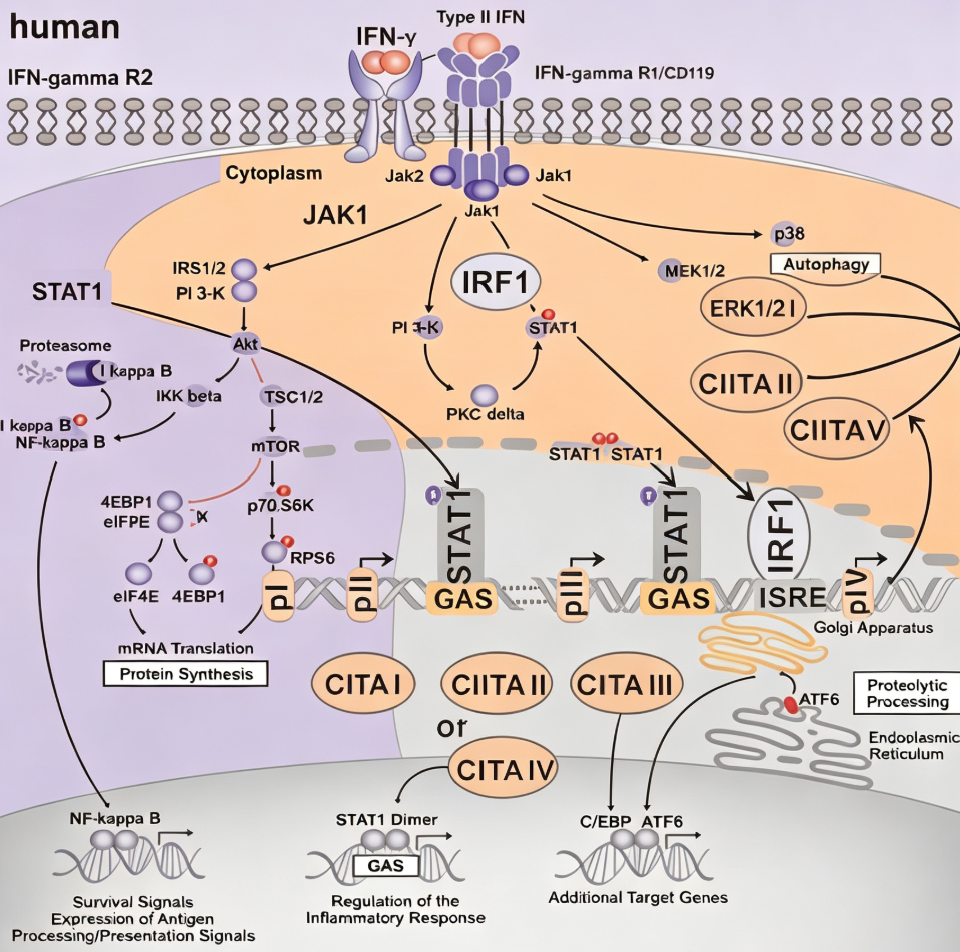
Interferon-γ (IFN-γ) is the sole member of the type II interferon family, composed of 143 amino acid residues with a molecular weight of approximately 17 kDa, functioning as a homodimer. IFN-γ is primarily produced by activated T cells (including CD8⁺ cytotoxic T cells and CD4⁺ Th1 helper T cells) and natural killer cells, playing a pivotal role in antiviral, antitumor, and immunoregulatory activities. IFN-γ binds to the IFN-γ receptor complex (comprising IFNGR1 and IFNGR2 subunits) on target cell surfaces, activating the JAK1/JAK2-STAT1 signaling pathway and thereby regulating the expression of hundreds of interferon-stimulated genes.
In the tumor immune microenvironment, IFN-γ serves as a critical molecular link between adaptive immune responses and antitumor effects. IFN-γ enhances the efficiency of tumor antigen presentation by upregulating MHC class I and II molecules on tumor cells and antigen-presenting cells, promoting CD8⁺ T cell recognition and killing of tumor cells. IFN-γ also induces the expression of chemokines CXCL9, CXCL10, and CXCL11, facilitating the recruitment of effector T cells to the tumor microenvironment and enhancing the antitumor activity of innate immune cells through various mechanisms.
II. Association Between IFN-γ Signaling and Clinical Efficacy of Immune Checkpoint Inhibitors
Researchers analyzed transcriptomic data from baseline and on-treatment tumor biopsy samples of 101 advanced melanoma patients treated with either nivolumab (anti-PD-1 monoclonal antibody) alone or in combination with ipilimumab (anti-CTLA-4 monoclonal antibody). They found that the degree of T cell infiltration and IFN-γ signaling signatures in tumor tissues were highly consistent with clinical treatment responses, serving as key predictive indicators. In samples from responders, IFN-γ-related gene sets were significantly enriched, whereas no such changes were observed in non-responders. Correspondingly, in biopsy samples from patients who responded effectively during treatment, the expression of genes related to cell cycle and WNT signaling pathways was reduced.
III. Conserved Features of IFN-γ Transcriptional Responses
By modeling interactions in 58 human cell lines, researchers found that unless the IFN-γ receptor of cells was functionally altered, exposure to IFN-γ in vitro induced a conserved transcriptional response. This conserved IFN-γ transcriptional response in melanoma cells could effectively amplify antitumor immune responses. The functional integrity of the IFN-γ signaling pathway is a prerequisite for tumor responsiveness to immune checkpoint inhibitors. Loss-of-function mutations in key genes of the IFN-γ signaling pathway (e.g., JAK1, JAK2, IFNGR1) can lead to primary resistance to PD-1/PD-L1 blockade therapy. The study confirmed that the strength of antitumor T cell responses and the corresponding downstream IFN-γ signaling are the primary drivers of clinical response or resistance to immune checkpoint blockade therapy.
IV. Translational Implications of IFN-γ Signaling as a Predictive Biomarker
The study proposes a novel method based on IFN-γ signaling signatures to predict patient responses to immunotherapy. Transcriptomic analysis of baseline and on-treatment tumor biopsy samples can assess the strength and dynamics of IFN-γ signaling in the tumor microenvironment, providing a basis for clinical decision-making. Within the framework that the strength of antitumor T cell responses and corresponding downstream IFN-γ signaling are the primary drivers of clinical response or resistance to immune checkpoint blockade therapy, IFN-γ signaling signatures can serve as potential biomarkers for identifying patients who may benefit from immune checkpoint inhibitors and guide the development of combination therapies. This discovery provides an important theoretical foundation for the precision immunotherapy of melanoma and other solid tumors.
V. Conclusion
As a core effector molecule in antitumor immune responses, the strength of IFN-γ signaling is closely associated with the clinical efficacy of immune checkpoint inhibitors. Evidence from studies in advanced melanoma patients demonstrates that transcriptional signatures of IFN-γ signaling in the tumor microenvironment can serve as important biomarkers for predicting treatment responses, providing a scientific basis for precision immunotherapy. As a critical tool for fundamental research and drug development, murine recombinant IFN-γ protein will continue to support in-depth exploration of the IFN-γ signaling network and optimization of immunotherapy strategies.
In IFN-γ-related basic research and drug screening, high-quality murine recombinant IFN-γ protein is an essential tool for T cell function studies, signaling pathway analysis, and animal model construction. To meet this research demand, Uni offers IFN-γ Protein, Mouse, suitable for applications such as activation and functional studies of murine immune cells (e.g., T cells, NK cells, and macrophages), mechanistic exploration of the IFN-γ/JAK-STAT signaling pathway, and immunomodulation studies in animal models.
This article is reviewed and published by the technical expert team of UA
Disclaimer: This article partially utilizes artificial intelligence assistance in its creation. If any content involves copyright or intellectual property issues, please let us know and we promise to verify and remove it as soon as possible.
Purchase recombinant protein, choose Nanjing UA-Bio
UA protein focuses on providing various protein reagents, raw materials, and services required for drug research and development, cell therapy, gene therapy, and basic scientific research, including drug target proteins, immune checkpoint proteins, cytokines, tool enzymes, customized protein expression, and full-length transmembrane protein development. Youai is committed to providing customers with high-quality products and professional services, and building a High-tech Biological Enterprise with International Competitiveness.
Target proteins | membrane proteins | cytokines | enzymes | viral antigens | protein customization
Nanjing UA Biotechnology Co., Ltd. Email:order@ua-bio.com Phone:+86-25-56221161

Product Information

Link:





©2021-2026 all rights reserved UA Biotechnology Co.,Ltd.
Privacy Policy 
网站备案号 浙ICP备2022019033号-2 浙公网安备33010202004867号
 Business license (three certificates in one)
 Tel:+86-25-56221161
E-mail:order@ua-bio.com
All products sold on this website shall not be used for clinical diagnosis or treatment of humans or animals, and shall only be used for non-medical purposes such as industrial or scientific research.
