




VEGF165: The Core Regulator of Angiogenesis and a Key Biomarker for Pan-Cancer Screening
Author: Senior Product Manager of UA Views:4 


This article focuses on the molecular characteristics and biological functions of VEGF165, systematically elaborating on its structural features as the predominant subtype of the vascular endothelial growth factor family and its mechanisms in promoting angiogenesis. It analyzes its central role in the development and progression of solid tumors and explores its clinical application value as a broad-spectrum tumor biomarker in early screening, efficacy evaluation, and recurrence monitoring.
- Recent Advances
- Product Information
Recent Advances
```html
```
VEGF165: The Core Regulator of Angiogenesis and a Key Biomarker for Pan-Cancer Screening.
Summary
This article systematically elaborates on the molecular characteristics and biological functions of VEGF165, the predominant isoform of the vascular endothelial growth factor family, analyzing its structural features and pro-angiogenic mechanisms. It explores its central role in the development and progression of solid tumors and discusses its clinical application value as a pan-cancer biomarker for early screening, efficacy evaluation, and recurrence monitoring.1. Discovery of VEGF and Overview of Its Molecular Family
Vascular Endothelial Growth Factor (VEGF) was first purified and identified by American scientists in 1989. Its gene is located at the 6p21.3 locus of the human genome, with a total length of approximately 14 kb. The VEGF family includes VEGF-A, VEGF-B, VEGF-C, VEGF-D, VEGF-E, and Placental Growth Factor (PIGF). Among these, VEGF-A (commonly referred to as VEGF) is the most functionally significant isoform mediating tumor angiogenesis. Due to alternative mRNA splicing, VEGF-A can produce at least five protein isoforms, including VEGF121, VEGF145, VEGF165, VEGF185, and VEGF206. VEGF165, the predominant functional isoform, consists of 165 amino acid residues with a molecular weight of approximately 45 kDa (in homodimeric form). It exists as a soluble secreted protein that directly acts on vascular endothelial cells to promote their proliferation, migration, and lumen formation.
2. Biological Functions and Pro-Angiogenic Mechanisms of VEGF165
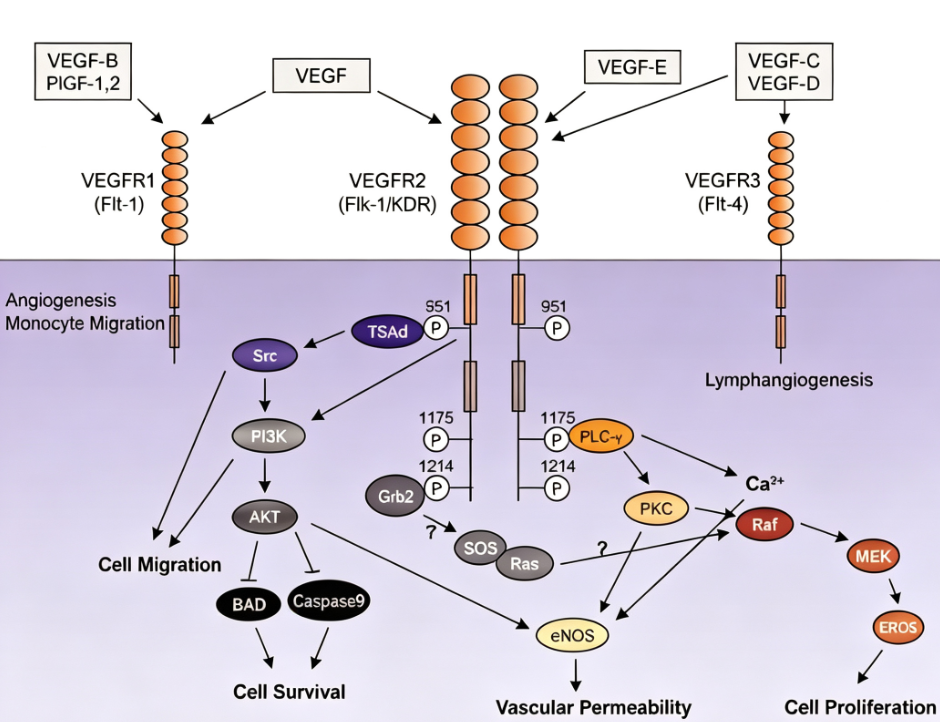
VEGF165 is a heparin-binding growth factor that specifically targets vascular endothelial cells. It exerts its biological functions by binding to VEGFR-1 and VEGFR-2 receptors on the surface of endothelial cells. VEGFR-2 is the primary receptor mediating VEGF's pro-angiogenic effects. Upon binding, it activates downstream signaling pathways such as PLCγ/PKC, PI3K/AKT, and RAS/MAPK, driving endothelial cell proliferation, survival, migration, and lumen formation. VEGF165 also increases capillary permeability, promoting plasma protein extravasation and fibrin deposition to provide a temporary matrix for new blood vessels. The tumor research pioneer Folkman proposed in 1971 that, without angiogenesis, solid tumors can only rely on diffusion for oxygen and nutrients, limiting their growth to 1–2 mm³. Beyond this threshold, tumors must depend on angiogenesis to sustain rapid growth. VEGF165 is the most critical angiogenic stimulator in this process, occupying a central position in the "switch" regulation of tumor angiogenesis.
3. Clinical Application Value of VEGF165 as a Pan-Cancer Biomarker
VEGF165 can be detected at abnormally elevated levels early in tumor development. When tumor cell clusters transition into solid tumors, VEGF production increases significantly, typically during the Tis or T1 stage—the optimal window for tumor screening. In contrast, traditional tumor biomarkers often show significant changes only in stage III or IV tumors, limiting their utility for early detection. VEGF detection has a lower limit of detection (LOD) at the picogram level, making it one of the most sensitive tumor biomarkers available. Clinical studies indicate that VEGF positivity rates exceed 70% in kidney cancer, brain cancer, colorectal cancer, endometrial cancer, lung cancer, ovarian cancer, cervical cancer, and breast cancer, with a sensitivity of 79.4% and specificity of 97.3%. The unique advantage of VEGF as a tumor biomarker lies in its broad-spectrum applicability—covering nearly all solid tumors rather than being limited to a single cancer type. Additionally, dynamic VEGF monitoring effectively reflects changes in tumor burden. Whether for primary tumors or recurrent/metastatic lesions, VEGF levels correlate with tumor growth trends, providing valuable insights for post-surgical and post-treatment efficacy evaluation.
4. Clinical Applications and Considerations for VEGF Testing
VEGF testing is suitable for initial cancer risk screening in healthy populations during physical examinations. For individuals with elevated values, results should be interpreted in conjunction with comprehensive test reports, with follow-up retesting to observe dynamic trends if necessary. For known cancer patients, VEGF testing can aid in efficacy evaluation and recurrence monitoring. It is important to note that elevated VEGF levels are not tumor-specific; they may also occur in physiological or pathological conditions such as menstruation, rheumatoid arthritis, diabetic retinopathy, active tuberculosis, and psoriasis. Therefore, abnormal VEGF results should be rechecked after an interval, with further imaging studies if needed to clarify the underlying cause.
5. Conclusion
As the most biologically active isoform of the VEGF family, VEGF165 has transitioned from basic research to clinical applications due to its irreplaceable role in tumor angiogenesis and its value as a pan-cancer biomarker. Its widespread use in early screening, efficacy evaluation, and recurrence monitoring provides critical technical support for early tumor detection and precision management. Recombinant human VEGF165 serves as a foundational tool for related research and assay development, facilitating deeper exploration and expanded clinical applications in the VEGF field.
In VEGF-related basic research and assay development, high-quality recombinant human VEGF165 is essential for antibody screening, ligand binding analysis, and the preparation of detection standards. To meet this research need, U-Share offers VEGF165 Protein, Human, suitable for in vitro screening and activity evaluation of anti-VEGF antibodies, VEGF receptor binding analysis, and the establishment and validation of VEGF immunoassays.
This article is reviewed and published by the technical expert team of UA
Disclaimer: This article partially utilizes artificial intelligence assistance in its creation. If any content involves copyright or intellectual property issues, please let us know and we promise to verify and remove it as soon as possible.
Purchase recombinant protein, choose Nanjing UA-Bio
UA protein focuses on providing various protein reagents, raw materials, and services required for drug research and development, cell therapy, gene therapy, and basic scientific research, including drug target proteins, immune checkpoint proteins, cytokines, tool enzymes, customized protein expression, and full-length transmembrane protein development. Youai is committed to providing customers with high-quality products and professional services, and building a High-tech Biological Enterprise with International Competitiveness.
Target proteins | membrane proteins | cytokines | enzymes | viral antigens | protein customization
Nanjing UA Biotechnology Co., Ltd. Email:order@ua-bio.com Phone:+86-25-56221161

Product Information

Link:





©2021-2026 all rights reserved UA Biotechnology Co.,Ltd.
Privacy Policy 
网站备案号 浙ICP备2022019033号-2 浙公网安备33010202004867号
 Business license (three certificates in one)
 Tel:+86-25-56221161
E-mail:order@ua-bio.com
All products sold on this website shall not be used for clinical diagnosis or treatment of humans or animals, and shall only be used for non-medical purposes such as industrial or scientific research.
