




The Multifaceted Roles of B Cells: From Antibody Secretion to Cytokine-Mediated Immune Regulatory Networks
Author: Senior Product Manager of UA Views:4 


This article systematically elucidates the multifaceted roles of B cells in antibody-independent functions, focusing on their secretion of various cytokines to participate in secondary lymphoid organ development, regulation of CD4+ T cell responses, and immune negative regulation. It analyzes the critical contributions of B cell-derived cytokines such as lymphotoxin, IL-6, IFN-γ, GM-CSF, and IL-10 in maintaining tissue homeostasis and modulating inflammatory responses.
- Recent Advances
- Product Information
Recent Advances
The Multifaceted Roles of B Cells: From Antibody Secretion to Cytokine-Mediated Immune Regulatory Networks
Abstract
This article focuses on the central role of B cells in antibody-independent functions, systematically elaborating their multi-layered roles in secondary lymphoid organ development, CD4⁺ T cell response regulation, and immune negative regulation through the secretion of various cytokines. It analyzes the key contributions of B cell-derived cytokines such as lymphotoxin, IL-6, IFN-γ, GM-CSF, and IL-10 in tissue homeostasis and inflammatory regulation.
This article focuses on the central role of B cells in antibody-independent functions, systematically elaborating their multi-layered roles in secondary lymphoid organ development, CD4⁺ T cell response regulation, and immune negative regulation through the secretion of various cytokines. It analyzes the key contributions of B cell-derived cytokines such as lymphotoxin, IL-6, IFN-γ, GM-CSF, and IL-10 in tissue homeostasis and inflammatory regulation.
I. Traditional and Expanded Understanding of B Cell Functions
B cells are a core component of the adaptive immune system, with their most classic function being differentiation into plasma cells and secretion of specific antibodies to mediate humoral immune responses. However, the functions of B cells extend far beyond this. As professional antigen-presenting cells, B cells can efficiently uptake antigens via B cell receptors and present them to T cells, participating in T cell activation. More importantly, B cells are also a significant source of various cytokines. Through these cytokines, B cells play an irreplaceable regulatory role in secondary lymphoid organ development, T cell response polarization, inflammatory regulation, and tissue repair.
II. The Critical Role of B Cells in Lymphoid Tissue Development and Remodeling
The normal development of secondary lymphoid organs (including the spleen, lymph nodes, and Peyer's patches) relies on signal interactions between lymphoid tissue inducer cells and stromal cells, with B cells playing an indispensable role in this process. B cells provide lymphotoxin α1β2 (LTα1β2) and tumor necrosis factor, driving the development of follicular dendritic cells and the formation of T cell zone stroma. In the spleen, B cells are the first lymphocytes to colonize, and the LTα1β2 and TNF they provide are essential for FDC development. B cells also play a crucial role in the maturation of Peyer's patches and isolated lymphoid follicles, with mechanisms differing from those in the spleen. B cells express TNF rather than LTα1β2. In the formation of tertiary lymphoid tissues, LTα1β2-expressing B cells localized at ectopic sites are sufficient to trigger the formation of lymphoid structures with organized B and T cell zones. In tissue repair, B cells play a key role in mouse prostate regeneration by providing LTα1β2.
III. Regulation of Effector CD4⁺ T Cell Responses by B Cell-Derived Cytokines
B cells profoundly influence the differentiation and function of CD4⁺ T cells through the secretion of various cytokines. In terms of pro-inflammatory cytokine secretion, B cells promote Th1 cell differentiation via TNF and CCL3, while IFN-γ-producing B cells support Th1 and macrophage responses, and GM-CSF-producing B cells enhance dendritic cell IL-12 production. In humoral immune support, B cell-derived IL-2 supports Th2 cell responses and memory formation, while IL-6 supports TFH, Th1, and Th17 cell responses. Additionally, in specific infection models, B cell-derived IL-17 can promote the accumulation of IL-10-producing neutrophils, suggesting that B cells may indirectly influence the inflammatory regulatory functions of innate immune cells through cytokine networks.
IV. Immune Negative Regulatory Functions of B Cells
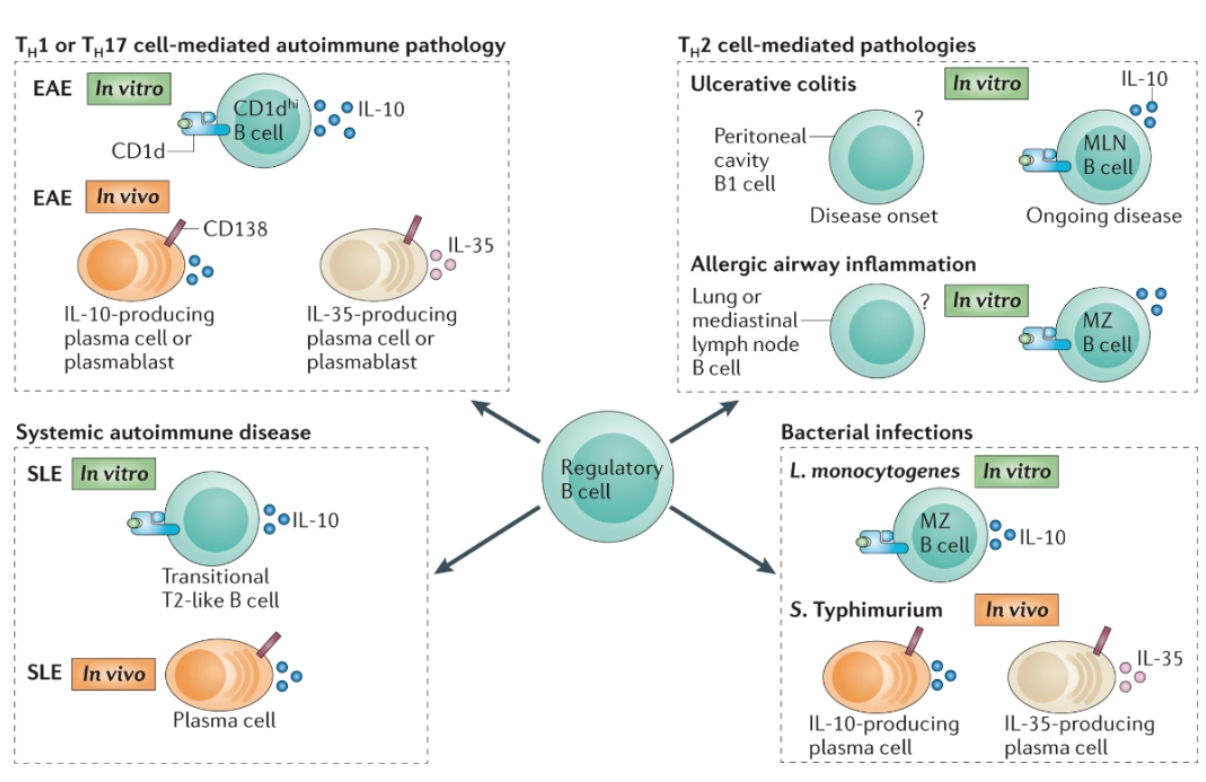
B cells exert negative regulatory effects in various inflammatory and autoimmune diseases by secreting inhibitory cytokines such as IL-10 and IL-35. Regulatory B cells are the primary source of these inhibitory cytokines, suppressing pathogenic T cell responses through IL-10-dependent or independent mechanisms. In experimental autoimmune encephalomyelitis, CD1dhi B cells activated in vitro produce IL-10 and protect mice from EAE in an IL-10-dependent manner upon adoptive transfer. Under co-stimulation of BCR and CD40 signals, naive B cells can express IL-35, a heterodimeric cytokine closely associated with immune suppression.
V. Conclusion
As multifunctional regulators of the immune system, B cells have far surpassed the traditional scope of antibody-secreting cells. Through LTα1β2 and TNF, B cells participate in the development and remodeling of lymphoid tissues. Through cytokines such as IL-6, IFN-γ, and GM-CSF, they regulate the polarization and memory formation of CD4⁺ T cell responses. Through IL-10 and IL-35, they mediate immune negative regulation to limit excessive inflammation, also playing significant roles in tissue repair and the tumor microenvironment. A deeper understanding of the B cell-derived cytokine network will provide new theoretical foundations and intervention strategies for autoimmune diseases, inflammatory diseases, and vaccine development.
In B cell-related basic research and immune regulatory mechanism exploration, high-quality recombinant cytokines are essential tools for signal pathway analysis and functional studies. To meet this research demand, UniLove offers RANK L/TNFSF11(178aa) Protein, Human, suitable for B cell differentiation and function studies, TNF superfamily signal pathway analysis, and immune regulation-related experiments.
This article is reviewed and published by the technical expert team of UA
Disclaimer: This article partially utilizes artificial intelligence assistance in its creation. If any content involves copyright or intellectual property issues, please let us know and we promise to verify and remove it as soon as possible.
Purchase recombinant protein, choose Nanjing UA-Bio
UA protein focuses on providing various protein reagents, raw materials, and services required for drug research and development, cell therapy, gene therapy, and basic scientific research, including drug target proteins, immune checkpoint proteins, cytokines, tool enzymes, customized protein expression, and full-length transmembrane protein development. Youai is committed to providing customers with high-quality products and professional services, and building a High-tech Biological Enterprise with International Competitiveness.
Target proteins | membrane proteins | cytokines | enzymes | viral antigens | protein customization
Nanjing UA Biotechnology Co., Ltd. Email:order@ua-bio.com Phone:+86-25-56221161

Product Information

Link:





©2021-2026 all rights reserved UA Biotechnology Co.,Ltd.
Privacy Policy 
网站备案号 浙ICP备2022019033号-2 浙公网安备33010202004867号
 Business license (three certificates in one)
 Tel:+86-25-56221161
E-mail:order@ua-bio.com
All products sold on this website shall not be used for clinical diagnosis or treatment of humans or animals, and shall only be used for non-medical purposes such as industrial or scientific research.
