




PTK7: From Embryonic Development Regulator to Multifunctional Receptor Tyrosine Kinase as a Therapeutic Target in Cancer
Author: Senior Product Manager of UA Views:4 


This article systematically elucidates the molecular characteristics and biological functions of protein tyrosine kinase 7 (PTK7), focusing on its role as an inactive receptor tyrosine kinase in the co-receptor mechanisms of the Wnt and VEGF signaling pathways. It analyzes its low-level expression in normal tissues and its aberrant overexpression in various malignant tumors.
- Recent Advances
- Product Information
Recent Advances
PTK7: From Embryonic Development Regulator to Multifunctional Receptor Tyrosine Kinase as a Novel Therapeutic Target in Tumors
Summary
This article systematically elaborates on the molecular characteristics and biological functions of Protein Tyrosine Kinase 7 (PTK7), focusing on its mechanism as an inactive receptor tyrosine kinase in the Wnt and VEGF signaling pathways. It analyzes its low expression in normal tissues and its aberrant overexpression in various malignant tumors.
This article systematically elaborates on the molecular characteristics and biological functions of Protein Tyrosine Kinase 7 (PTK7), focusing on its mechanism as an inactive receptor tyrosine kinase in the Wnt and VEGF signaling pathways. It analyzes its low expression in normal tissues and its aberrant overexpression in various malignant tumors.
I. Molecular Structure and Family Classification of PTK7
Protein Tyrosine Kinase 7 (PTK7), also known as Colon Carcinoma Kinase 4 (CCK4), is a receptor tyrosine kinase initially identified in colon cancer cells and belongs to the receptor tyrosine kinase (RTK) superfamily. The human PTK7 gene is located on chromosome 6p21.1-p12.2, encoding a protein composed of 1070 amino acid residues with a molecular weight of approximately 120 kDa. Unlike classical receptor tyrosine kinases, PTK7's intracellular tyrosine kinase domain lacks intrinsic kinase activity due to amino acid substitutions at key catalytic sites, classifying it as a "pseudokinase" receptor. Its signal transduction relies on interactions with other signaling molecules.
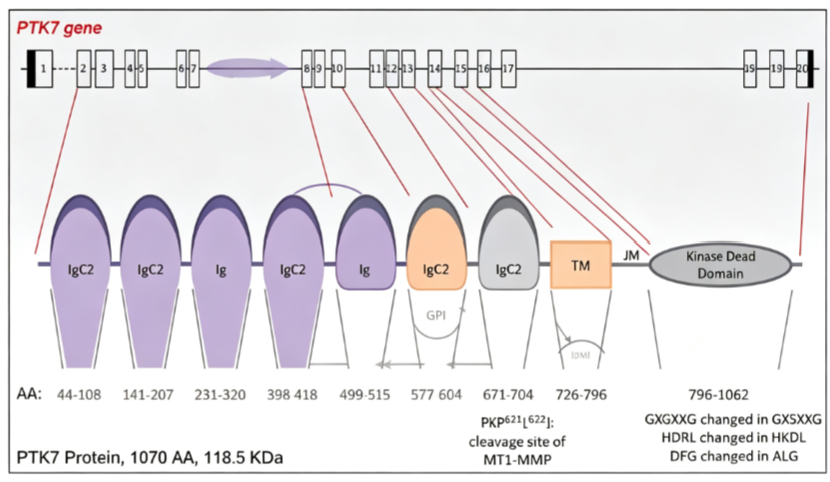
From a structural biology perspective, PTK7 is a type I single-pass transmembrane protein. Its extracellular region consists of seven immunoglobulin-like domains responsible for recognizing and binding signaling molecules such as Wnt ligands. The transmembrane domain is a single-pass helix connecting the extracellular and intracellular regions. The intracellular region includes a juxtamembrane domain and a tyrosine kinase-like domain, which lacks catalytic residues and thus lacks kinase activity but serves as a protein-protein interaction platform for binding other signaling molecules.
II. Signal Transduction Networks Involving PTK7
PTK7 is located at the intersection of Wnt signaling, VEGF signaling, and stem cell biology, playing a critical coreceptor role in multiple signaling pathways. In the non-canonical Wnt signaling pathway, PTK7 collaborates with ROR2 and Frizzled receptors to mediate the transduction of non-canonical Wnt signaling cascades. Upon Wnt ligand binding to the receptor complex, downstream Rho-ROCK, Rac-JNK, IP3-Ca²⁺, DAG-PKC, and PI3K-AKT signaling cascades are activated. These pathways coordinately regulate cell polarity, directional movement, invasion, and survival. PTK7 plays a central role in establishing cell polarity and directional migration by converting canonical Wnt signals into non-canonical Wnt/PCP signaling cascades. In the VEGF signaling pathway, PTK7 and VEGF jointly participate in the transduction of vascular endothelial growth factor cascades, activating downstream IP3-Ca²⁺, DAG-PKC, PI3K-AKT, MEK-ERK, and FAK-Paxillin signaling cascades to promote endothelial cell angiogenesis and tumor cell proliferation. PTK7's unique position at the crossroads of Wnt signaling, VEGF signaling, and stem cell biology makes it an important target in tumor biology research.
III. Physiological Functions and Normal Tissue Expression of PTK7
PTK7 plays an irreplaceable regulatory role in embryonic development, participating in key processes such as tube formation, epithelial tissue assembly, neural tube closure, neural crest formation, and axon guidance. In adult tissues, PTK7 is generally expressed at low levels in normal epithelial, endothelial, and hematopoietic tissues, remaining negative in most normal tissues and detectable only at low levels in certain specific cell types.
IV. Aberrant Overexpression of PTK7 in Malignant Tumors
PTK7 was initially discovered in melanoma cells and subsequently detected as overexpressed in various epithelial cancers, sarcomas, and hematologic malignancies. Studies show that PTK7 overexpression rates can exceed 50% in breast, ovarian, and lung cancers. In non-small cell lung cancer, high PTK7 expression is significantly associated with lymph node metastasis and poor overall survival. In ovarian cancer, PTK7 expression levels negatively correlate with tumor stage and patient prognosis. Multiple studies have classified PTK7 expression levels using immunohistochemical scoring and quantitative evaluation based on positive cell rates and staining intensity, confirming that PTK7 overexpression is closely linked to poor prognosis in various cancers.
V. Conclusion
As a unique functional member of the receptor tyrosine kinase family, PTK7, with its "pseudokinase" structural features and multifaceted regulatory roles as a coreceptor in Wnt/VEGF signaling pathways, plays an indispensable central role in embryonic development and tumorigenesis. Its aberrant overexpression in various malignancies and close association with poor prognosis make it a promising new target for cancer diagnosis and immunotherapy. Mouse-derived recombinant PTK7 protein provides essential tools for in-depth analysis of PTK7 signaling networks and their mechanisms in tumor progression.
In PTK7-related basic research and drug screening, high-quality recombinant PTK7 protein is a critical tool for target validation, antibody screening, and signaling pathway studies. To meet this research demand, U-Antibody offers PTK7/CCK4 His Tag Protein, Mouse, suitable for applications such as PTK7-Wnt ligand binding activity analysis, in vitro screening and activity evaluation of anti-PTK7 antibody drugs, and PTK7 signaling pathway mechanism studies.
This article is reviewed and published by the technical expert team of UA
Disclaimer: This article partially utilizes artificial intelligence assistance in its creation. If any content involves copyright or intellectual property issues, please let us know and we promise to verify and remove it as soon as possible.
Purchase recombinant protein, choose Nanjing UA-Bio
UA protein focuses on providing various protein reagents, raw materials, and services required for drug research and development, cell therapy, gene therapy, and basic scientific research, including drug target proteins, immune checkpoint proteins, cytokines, tool enzymes, customized protein expression, and full-length transmembrane protein development. Youai is committed to providing customers with high-quality products and professional services, and building a High-tech Biological Enterprise with International Competitiveness.
Target proteins | membrane proteins | cytokines | enzymes | viral antigens | protein customization
Nanjing UA Biotechnology Co., Ltd. Email:order@ua-bio.com Phone:+86-25-56221161

Product Information

Link:





©2021-2026 all rights reserved UA Biotechnology Co.,Ltd.
Privacy Policy 
网站备案号 浙ICP备2022019033号-2 浙公网安备33010202004867号
 Business license (three certificates in one)
 Tel:+86-25-56221161
E-mail:order@ua-bio.com
All products sold on this website shall not be used for clinical diagnosis or treatment of humans or animals, and shall only be used for non-medical purposes such as industrial or scientific research.
