




CD24: An Emerging Target of Macrophage Immune Checkpoint and Its Application Prospects in Refractory Tumors
Author: Senior Product Manager of UA Views:4 


This article systematically elaborates on the molecular characteristics and immune functions of the CD24/Siglec-10 signaling axis, highlighting its pivotal role as a "don't eat me" signal in tumor immune evasion. It analyzes its complementary value in CD47 inhibitor-resistant tumors and introduces the application of human CD24 recombinant protein in related research.
- Recent Advances
- Product Information
Recent Advances
CD24: An Emerging Target as a Macrophage Immune Checkpoint and Its Application Prospects in Refractory Tumors
Summary
This article systematically elucidates the molecular characteristics and immune functions of the CD24/Siglec-10 signaling axis, its core role as a "don't eat me" signal in tumor immune evasion, and its complementary value in CD47 inhibitor-resistant tumors. Additionally, it introduces the application of human CD24 recombinant protein in related research.
This article systematically elucidates the molecular characteristics and immune functions of the CD24/Siglec-10 signaling axis, its core role as a "don't eat me" signal in tumor immune evasion, and its complementary value in CD47 inhibitor-resistant tumors. Additionally, it introduces the application of human CD24 recombinant protein in related research.
I. Immune Checkpoints and Macrophage-Mediated Tumor Immunity
In the field of tumor immunotherapy, targeting T-cell immune checkpoints (such as PD-1/PD-L1 and CTLA-4) has achieved breakthrough progress. However, not all patients benefit from these therapies, especially in "cold tumors" like ovarian cancer and triple-negative breast cancer, where response rates are limited. The innate immune system, particularly macrophages, plays an irreplaceable role in tumor immune surveillance. Tumor cells evade phagocytic clearance by expressing specific "don't eat me" signal molecules on their surfaces, which bind to inhibitory receptors on macrophages and transmit inhibitory signals. The CD47/SIRPα axis is one of the most extensively studied signaling pathways in this field. However, in CD47 inhibitor-resistant tumors, other independently functioning "don't eat me" signals still exist.
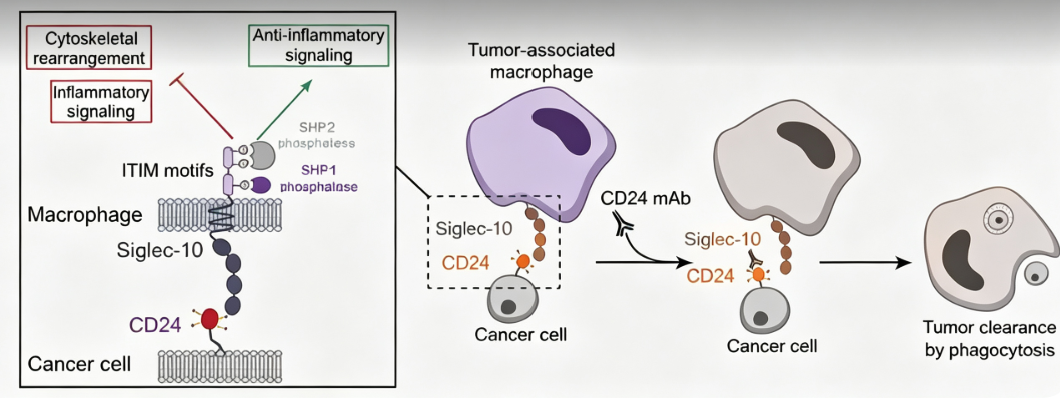
II. Molecular Structure and Tissue Expression Characteristics of CD24
CD24 is a highly glycosylated glycosylphosphatidylinositol (GPI)-anchored protein encoded by the CD24 gene. The protein has a molecular weight of approximately 30-70 kDa, with a core polypeptide chain of only about 30 amino acids. However, through extensive glycosylation and GPI anchoring modifications, it forms a functionally mature molecule. Under normal physiological conditions, CD24 is expressed on hematopoietic cells (especially B cells, granulocytes, and dendritic cells) and certain epithelial cells. In pathological states, CD24 is abnormally overexpressed in various solid tumors, and its expression level is closely associated with tumor progression and poor prognosis.
III. Immune Evasion Mechanism of the CD24/Siglec-10 Signaling Axis
The CD24 protein on the surface of tumor cells binds to the Siglec-10 (sialic acid-binding immunoglobulin-like lectin 10) receptor on macrophages, transmitting inhibitory signals that prevent macrophages from recognizing and phagocytosing tumor cells. This signaling axis operates independently of the CD47/SIRPα pathway. In ovarian and breast cancers, the high expression of CD24 and Siglec-10 on tumor-infiltrating macrophages collectively forms an effective immunosuppressive microenvironment. In mouse tumor models, blocking the interaction between CD24 and Siglec-10 restored macrophage phagocytic activity, significantly inhibiting tumor growth. This effect was also observed in CD47 inhibitor-resistant tumor models.
IV. Advantages of CD24 as a Therapeutic Target in Refractory Tumors
Ovarian cancer and triple-negative breast cancer are two highly aggressive solid tumors with limited treatment options. For example, in ovarian cancer, over 70% of patients relapse after initial chemotherapy. In CD24-targeted therapy, CD24 expression levels in ovarian cancer tissues are significantly higher than in normal ovarian tissues, and its high expression is associated with poorer overall survival and progression-free survival in patients. The main advantages of CD24-targeted strategies include: inducing macrophage-mediated phagocytosis even in CD47 inhibitor-resistant tumors, significant tumor suppression effects observed in animal models of ovarian cancer and triple-negative breast cancer, and limited CD24 expression in normal tissues, providing a safety window.
V. Conclusion
As an emerging "don't eat me" signal molecule, CD24 has become a highly promising new target in tumor immunotherapy due to its immune evasion mechanism independent of the CD47/Siglec-10 pathway and its high relevance to immunotherapy-refractory tumors. Its outstanding therapeutic potential in ovarian cancer and triple-negative breast cancer offers new hope for patients with these refractory tumors. Human CD24 recombinant protein, as a critical tool for basic research and drug development, will continue to provide essential support for exploring immune therapy strategies targeting macrophage checkpoints.
In CD24-related basic research and drug development, high-quality human CD24 recombinant protein is a key tool for target validation, antibody screening, and mechanistic studies. To meet this research demand, Uni offers CD24 Fc Chimera Protein, Human, suitable for analyzing CD24-Siglec-10 binding activity, screening anti-CD24 antibody drugs in vitro, evaluating their activity, and studying the CD24/Siglec-10 signaling pathway mechanism.
This article is reviewed and published by the technical expert team of UA
Disclaimer: This article partially utilizes artificial intelligence assistance in its creation. If any content involves copyright or intellectual property issues, please let us know and we promise to verify and remove it as soon as possible.
Purchase recombinant protein, choose Nanjing UA-Bio
UA protein focuses on providing various protein reagents, raw materials, and services required for drug research and development, cell therapy, gene therapy, and basic scientific research, including drug target proteins, immune checkpoint proteins, cytokines, tool enzymes, customized protein expression, and full-length transmembrane protein development. Youai is committed to providing customers with high-quality products and professional services, and building a High-tech Biological Enterprise with International Competitiveness.
Target proteins | membrane proteins | cytokines | enzymes | viral antigens | protein customization
Nanjing UA Biotechnology Co., Ltd. Email:order@ua-bio.com Phone:+86-25-56221161

Product Information

Link:





©2021-2026 all rights reserved UA Biotechnology Co.,Ltd.
Privacy Policy 
网站备案号 浙ICP备2022019033号-2 浙公网安备33010202004867号
 Business license (three certificates in one)
 Tel:+86-25-56221161
E-mail:order@ua-bio.com
All products sold on this website shall not be used for clinical diagnosis or treatment of humans or animals, and shall only be used for non-medical purposes such as industrial or scientific research.
