




VEGF165: A Core Regulator of Angiogenesis and a Broad-Spectrum Tumor Screening Marker
Author: Senior Product Manager of UA Views:28 


This article systematically elaborates on the molecular characteristics and biological functions of VEGF165, focusing on its structural features as the predominant isoform of the vascular endothelial growth factor family, its mechanisms in promoting angiogenesis, and its diverse physiological roles across multiple systems. It also analyzes its central role in tumor angiogenesis and its clinical application value as a broad-spectrum tumor marker.
- Recent Advances
- Product Information
Recent Advances
VEGF165: The Core Regulator of Angiogenesis and a Broad-Spectrum Tumor Screening Marker
Overview
This article systematically elaborates on the molecular characteristics and biological functions of VEGF165, the most predominant isoform of the vascular endothelial growth factor family, including its structural features, mechanisms of angiogenesis promotion, and multi-system physiological roles. It also analyzes its central role in tumor angiogenesis and its clinical value as a broad-spectrum tumor marker.
This article systematically elaborates on the molecular characteristics and biological functions of VEGF165, the most predominant isoform of the vascular endothelial growth factor family, including its structural features, mechanisms of angiogenesis promotion, and multi-system physiological roles. It also analyzes its central role in tumor angiogenesis and its clinical value as a broad-spectrum tumor marker.
I. Molecular Composition of the VEGF Family and the Role of VEGF165
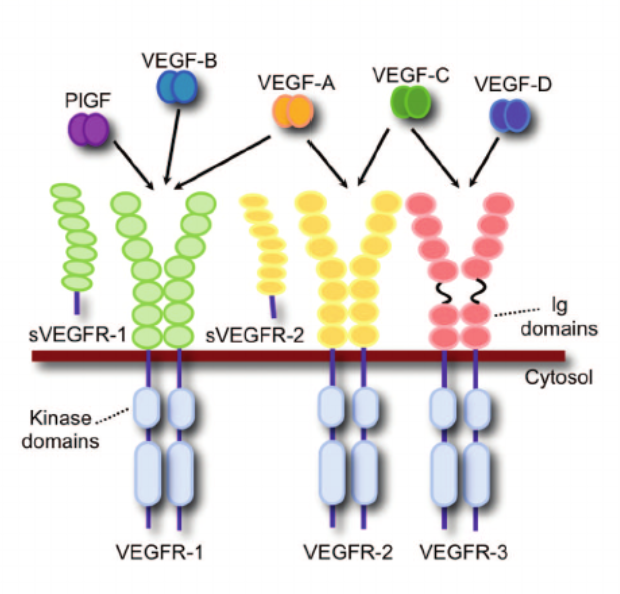
The vascular endothelial growth factor (VEGF) family is a group of heparin-binding growth factors highly specific to vascular endothelial cells. Its members include VEGF-A, VEGF-B, VEGF-C, VEGF-D, VEGF-E, VEGF-F, and placental growth factor (PIGF). Recently, a new member, EG-VEGF, has been added to the family. Among these, VEGF-A is the most functionally significant member, with its gene mRNA undergoing alternative splicing to produce multiple protein isoforms such as VEGF121, VEGF145, VEGF165, VEGF189, and VEGF206. VEGF165, composed of 165 amino acid residues with a molecular weight of approximately 45 kDa (in homodimeric form), is the most abundant secreted isoform and the most physiologically active form of VEGF.
II. Structural Features and Receptor Binding Mechanisms of VEGF165
The molecular structure of VEGF165 contains multiple functional domains: an N-terminal signal peptide for protein secretion, a receptor-binding domain mediating interactions with VEGFR-1 and VEGFR-2, and a heparin-binding domain enabling binding to cell surface and extracellular matrix heparan sulfate proteoglycans, which is crucial for tissue distribution and function. VEGF165 primarily exerts its angiogenic effects by binding to VEGFR-2 (KDR/Flk-1) on vascular endothelial cells—inducing receptor dimerization and autophosphorylation, thereby activating downstream signaling pathways such as PLCγ/PKC, PI3K/AKT, and RAS/MAPK, which drive endothelial cell proliferation, survival, and migration. VEGFR-1 (Flt-1) has a higher affinity for VEGF165 than VEGFR-2, but its tyrosine kinase activity is weaker, primarily serving as a decoy receptor to regulate VEGF signal spatial distribution.
III. Physiological Functions and Tissue Repair Roles of VEGF165
VEGF165 plays a critical role in various physiological and pathological processes. In angiogenesis, it promotes endothelial cell proliferation, migration, and lumen formation, serving as a key driver of embryonic vascular development and adult neovascularization. In wound healing, VEGF165 stimulates neovascularization at wound sites, accelerating granulation tissue growth and re-epithelialization, and is essential in the repair of diabetic ulcers, pressure sores, and surgical wounds. In neuroprotection, VEGF165 exhibits direct neurotrophic effects, promoting neuronal survival and axon growth. In bone homeostasis, it participates in the coupling regulation of bone formation and resorption. In immune modulation, VEGF165 exerts immunosuppressive functions by inhibiting dendritic cell maturation and inducing immunosuppressive cell aggregation.
IV. The Central Role of VEGF165 in Tumor Angiogenesis
Tumor growth and metastasis depend on neovascularization, and VEGF165 plays an irreplaceable central role in this process. In the tumor microenvironment, hypoxia-induced HIF-1α stabilization drives transcriptional upregulation of VEGF165, which is secreted extracellularly and activates tumor cells and endothelial cells via autocrine and paracrine mechanisms. VEGF165 promotes abnormal vascular growth within tumors, supplying oxygen and nutrients for tumor growth, and enhances vascular permeability to facilitate hematogenous metastasis of tumor cells.
V. Clinical Applications of VEGF165 as a Broad-Spectrum Tumor Marker
VEGF165 is abnormally overexpressed in virtually all solid tumors, and its levels are not restricted to specific tissues or organs, making it a broad-spectrum tumor marker for screening and auxiliary diagnosis. Unlike traditional tissue-specific markers such as PSA or AFP, VEGF165's non-tissue specificity provides broader coverage, enabling detection of abnormal elevations in multiple cancers (e.g., lung, gastric, colorectal, breast, liver, and ovarian cancers).
VI. Conclusion
As the most biologically active major isoform of the VEGF family, VEGF165 plays an irreplaceable central role in angiogenesis, tissue repair, neuroprotection, and tumor progression. Its function in promoting abnormal neovascularization in the tumor microenvironment makes it a critical target for broad-spectrum tumor screening and anti-angiogenic therapy. Recombinant human VEGF165 protein, as an essential tool for basic research and drug development, will continue to provide key support for exploring angiogenesis mechanisms and developing anti-tumor strategies.
In VEGF165-related basic research and drug screening, high-quality recombinant human VEGF165 protein is a core tool for receptor binding analysis, endothelial cell function studies, and signaling pathway dissection. To meet these research needs, Uni offers VEGF165 Protein, Human, suitable for applications such as VEGFR-1/VEGFR-2 binding activity analysis, vascular endothelial cell proliferation and migration studies, and in vitro activity evaluation of anti-VEGF antibody drugs.
This article is reviewed and published by the technical expert team of UA
Disclaimer: This article partially utilizes artificial intelligence assistance in its creation. If any content involves copyright or intellectual property issues, please let us know and we promise to verify and remove it as soon as possible.
Purchase recombinant protein, choose Nanjing UA-Bio
UA protein focuses on providing various protein reagents, raw materials, and services required for drug research and development, cell therapy, gene therapy, and basic scientific research, including drug target proteins, immune checkpoint proteins, cytokines, tool enzymes, customized protein expression, and full-length transmembrane protein development. Youai is committed to providing customers with high-quality products and professional services, and building a High-tech Biological Enterprise with International Competitiveness.
Target proteins | membrane proteins | cytokines | enzymes | viral antigens | protein customization
Nanjing UA Biotechnology Co., Ltd. Email:order@ua-bio.com Phone:+86-25-56221161

Product Information

Link:





©2021-2026 all rights reserved UA Biotechnology Co.,Ltd.
Privacy Policy 
网站备案号 浙ICP备2022019033号-2 浙公网安备33010202004867号
 Business license (three certificates in one)
 Tel:+86-25-56221161
E-mail:order@ua-bio.com
All products sold on this website shall not be used for clinical diagnosis or treatment of humans or animals, and shall only be used for non-medical purposes such as industrial or scientific research.
