




The molecular structure of R-Spondin 1, its mechanism of enhancing Wnt signaling, and its applications in organoid research
Author: Senior Product Manager of UA Views:17 


This article focuses on the molecular characteristics and biological functions of R-Spondin 1 (RSPO1), systematically elaborating its domain composition as a core member of the R-spondin family. It analyzes the molecular mechanism by which RSPO1 enhances the Wnt/β-catenin signaling pathway through its furin-like domain binding to LGR4/5 receptors and neutralizing RNF43/ZNRF3-mediated ubiquitination degradation of Frizzled receptors.
- Recent Advances
- Product Information
Recent Advances
Molecular Structure of R-Spondin 1, Its Mechanism of Enhancing Wnt Signaling, and Applications in Organoid Research
Summary
This article systematically elucidates the molecular characteristics and biological functions of R-Spondin 1 (RSPO1), a core member of the R-spondin family. It analyzes its domain composition and the molecular mechanism by which it enhances the Wnt/β-catenin signaling pathway through the furin-like domains binding to LGR4/5 receptors and neutralizing RNF43/ZNRF3-mediated ubiquitination degradation of Frizzled receptors.
This article systematically elucidates the molecular characteristics and biological functions of R-Spondin 1 (RSPO1), a core member of the R-spondin family. It analyzes its domain composition and the molecular mechanism by which it enhances the Wnt/β-catenin signaling pathway through the furin-like domains binding to LGR4/5 receptors and neutralizing RNF43/ZNRF3-mediated ubiquitination degradation of Frizzled receptors.
I. Molecular Composition of the R-Spondin Family and Localization of RSPO1
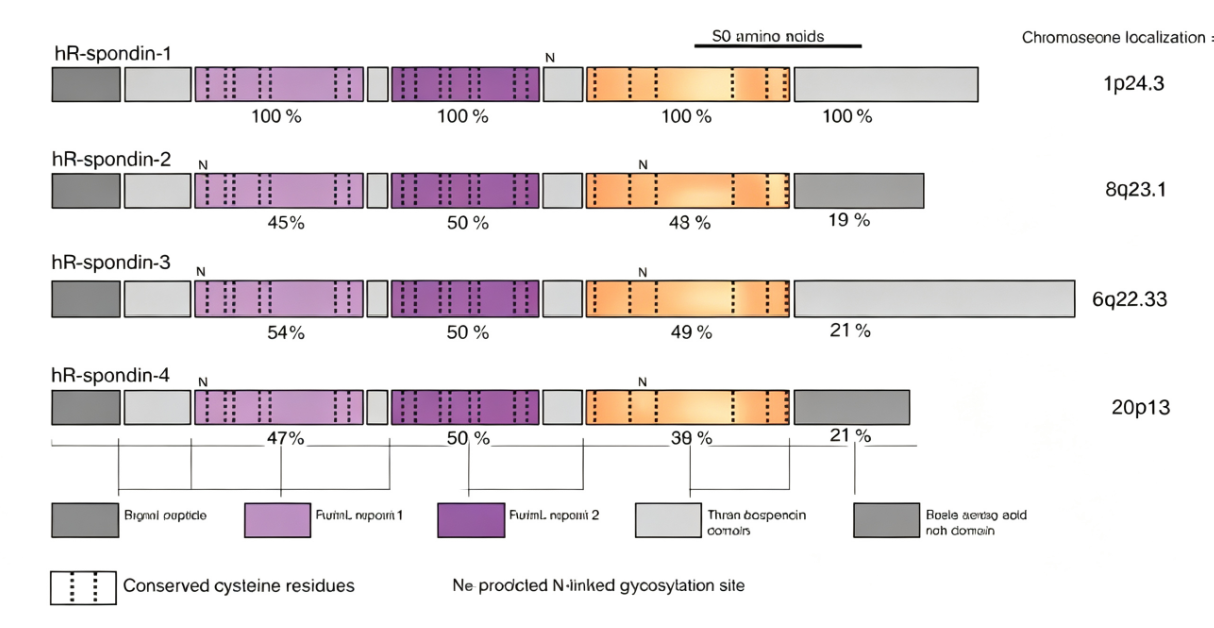
The R-spondin protein family consists of four members, RSPO1 to RSPO4, encoding four evolutionarily conserved small secreted proteins with sequence and domain similarities ranging from 40% to 60%. The human RSPO1 gene is located on chromosome 1p34.3, and its encoded protein plays a critical regulatory role in embryonic development, adult stem cell maintenance, and tumorigenesis, making it one of the most extensively studied members of the family.
II. Protein Domain Composition of R-Spondin 1
RSPO1 protein contains four main functional regions: an N-terminal signal peptide guiding secretion to the extracellular space; two adjacent furin-like domains (FU1 and FU2), responsible for binding to LGR4/5/6 receptors and RNF43/ZNRF3, which are the core regions for activating Wnt signaling; a TSP1 domain involved in protein-protein interactions and cell adhesion; and a C-terminal region rich in basic amino acids, potentially involved in binding to cell surface heparan sulfate proteoglycans, affecting RSPO1 distribution in tissues and signaling efficiency. The two adjacent furin-like domains are decisive for activating the canonical Wnt signaling pathway, and the loss of either domain abolishes this activation ability.
III. Molecular Mechanism of R-Spondin 1 in Enhancing Wnt Signaling
The Wnt/β-catenin signaling pathway is a central pathway regulating cell proliferation, differentiation, and stem cell self-renewal. In the absence of RSPO1 signaling, the E3 ubiquitin ligases RNF43 and ZNRF3 on the cell membrane bind to Wnt receptor Frizzled, promoting its ubiquitination and clearance via endocytosis-degradation pathways, thereby weakening Wnt signal transduction. As a Wnt signaling enhancer, RSPO1's furin-like domains first bind to the LGR4/5 receptors on the cell membrane, forming an RSPO1-LGR complex. This complex then interacts with the extracellular regions of RNF43/ZNRF3 via the FU1 domain of RSPO1, neutralizing their E3 ubiquitin ligase activity. This process prevents Frizzled receptor ubiquitination and degradation, allowing Frizzled to persist on the cell surface. When Wnt ligands bind to Frizzled and LRP5/6, the stabilized Frizzled receptors effectively transmit signals, ultimately leading to β-catenin accumulation in the cytoplasm and translocation to the nucleus, where it binds to TCF/LEF transcription factors to initiate downstream target gene expression.
IV. Applications of R-Spondin 1 in Organoid Culture
By enhancing the Wnt/β-catenin signaling pathway, RSPO1 plays an indispensable supportive role in the long-term maintenance and proliferation of various organoid systems. In intestinal organoids, RSPO1 synergizes with Wnt3A to maintain the self-renewal capacity of Lgr5⁺ intestinal stem cells, supporting crypt structure formation and long-term expansion. In gastric organoids, RSPO1 sustains the proliferation and differentiation potential of gastric stem cells. In liver organoids, RSPO1 collaborates with factors like HGF to promote the expansion and maturation of hepatic progenitor cells.
V. Conclusion
As a core member of the R-spondin family, R-Spondin 1 precisely regulates the intensity of the Wnt/β-catenin signaling pathway by binding to LGR4/5 receptors via its furin-like domains and neutralizing RNF43/ZNRF3-mediated ubiquitination degradation of Frizzled receptors. It plays an irreplaceable role in embryonic development and adult stem cell maintenance. Human recombinant R-Spondin 1 (21-146) protein serves as a vital tool in basic research and organoid culture, providing key support for elucidating Wnt signaling mechanisms and developing therapeutic strategies for related diseases.
In Wnt signaling research and organoid culture, high-quality recombinant RSPO1 protein is crucial for maintaining pathway activity and organoid growth efficiency. RSPO1 (21-146) corresponds to the functional core region of RSPO1, containing two intact furin-like domains and retaining full capacity to bind LGR4/5 receptors and neutralize RNF43/ZNRF3. To meet this research demand, Uni offers R-Spondin 1(21-146) Protein, Human, suitable for Wnt/β-catenin signaling studies, establishment and long-term maintenance of organoid culture systems, and analysis of LGR4/5 receptor binding activity.
This article is reviewed and published by the technical expert team of UA
Disclaimer: This article partially utilizes artificial intelligence assistance in its creation. If any content involves copyright or intellectual property issues, please let us know and we promise to verify and remove it as soon as possible.
Purchase recombinant protein, choose Nanjing UA-Bio
UA protein focuses on providing various protein reagents, raw materials, and services required for drug research and development, cell therapy, gene therapy, and basic scientific research, including drug target proteins, immune checkpoint proteins, cytokines, tool enzymes, customized protein expression, and full-length transmembrane protein development. Youai is committed to providing customers with high-quality products and professional services, and building a High-tech Biological Enterprise with International Competitiveness.
Target proteins | membrane proteins | cytokines | enzymes | viral antigens | protein customization
Nanjing UA Biotechnology Co., Ltd. Email:order@ua-bio.com Phone:+86-25-56221161

Product Information

Link:





©2021-2026 all rights reserved UA Biotechnology Co.,Ltd.
Privacy Policy 
网站备案号 浙ICP备2022019033号-2 浙公网安备33010202004867号
 Business license (three certificates in one)
 Tel:+86-25-56221161
E-mail:order@ua-bio.com
All products sold on this website shall not be used for clinical diagnosis or treatment of humans or animals, and shall only be used for non-medical purposes such as industrial or scientific research.
