




Th2 cytokines: The dominant players in humoral immunity and key regulators of disease balance
Author: Senior Product Manager of UA Views:11 


This article focuses on the molecular characteristics and biological functions of Th2 cytokines, systematically elaborating their core role in humoral immune responses, and analyzing the pathological significance of Th1/Th2 balance shift in tumor immunity, autoimmune diseases, infectious diseases, and reproductive immunology.
- Recent Advances
- Product Information
Recent Advances
Th2 Cytokines: Dominant Players in Humoral Immunity and Key Regulators of Disease Balance
Overview
This article systematically elaborates the molecular characteristics and biological functions of Th2 cytokines, focusing on their central role in humoral immune responses, and analyzes the pathological significance of Th1/Th2 balance shifts in tumor immunity, autoimmune diseases, infectious diseases, and reproductive immunity.
This article systematically elaborates the molecular characteristics and biological functions of Th2 cytokines, focusing on their central role in humoral immune responses, and analyzes the pathological significance of Th1/Th2 balance shifts in tumor immunity, autoimmune diseases, infectious diseases, and reproductive immunity.
I. Composition and Functional Orientation of Th2 Cytokines
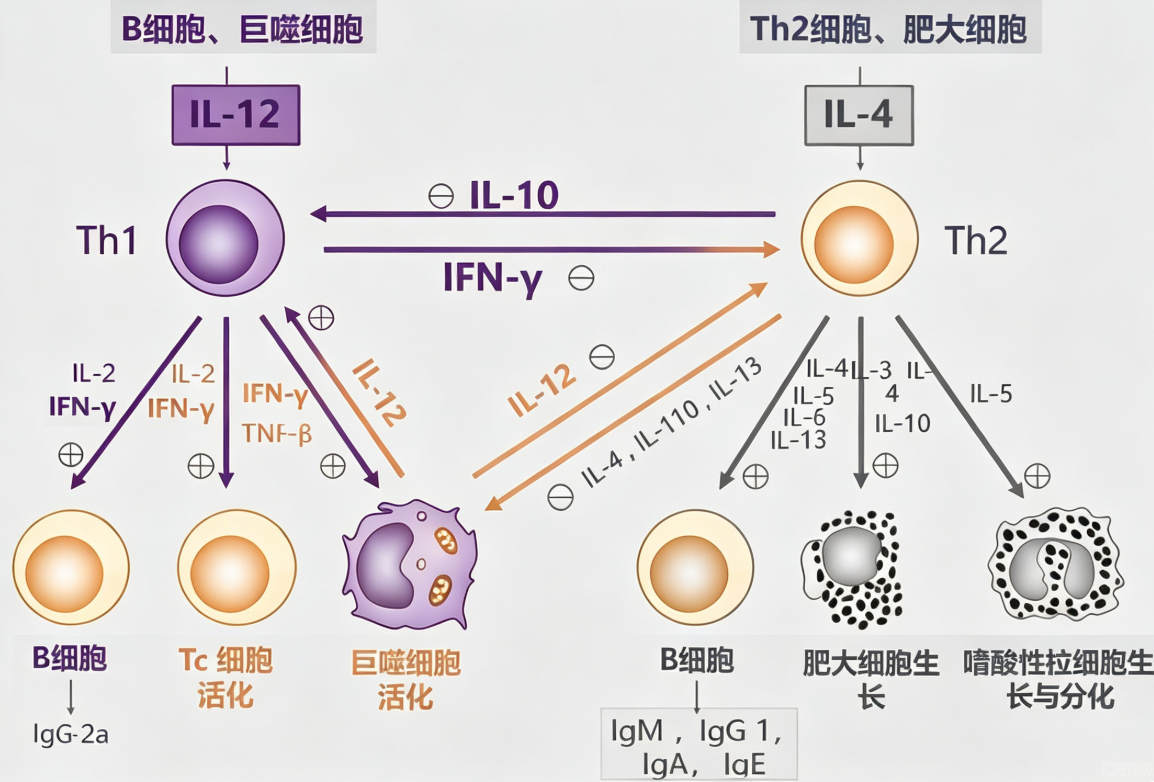
Th2 cells are one of the important subsets of CD4⁺ helper T cells, primarily mediating humoral immune responses through the secretion of a series of characteristic cytokines. The core members of Th2 cytokines include interleukin-4 (IL-4), IL-5, IL-6, IL-10, and IL-13. IL-4 is a key inducer for the differentiation of naive T cells into Th2 cells, IL-5 is the main factor promoting eosinophil differentiation and activation, IL-10 is a potent anti-inflammatory immunoregulatory factor, and IL-13 plays a significant role in mucosal immunity and allergic reactions. Th2 cytokines collectively promote antibody production, mediate humoral immune responses, participate in immune defense against extracellular pathogens (e.g., parasites), and play a crucial role in immediate hypersensitivity reactions. Under physiological conditions, the humoral immunity mediated by Th2 cytokines and the cellular immunity mediated by Th1 cytokines maintain a dynamic balance, together forming a complete network of immune responses in the body.
II. Physiological Significance and Regulatory Mechanisms of Th1/Th2 Balance
Th1 and Th2 cells mutually inhibit and cross-regulate through their secreted cytokines, maintaining a dynamic balance between cellular and humoral immunity in the body. Th2 cytokines (especially IL-10 and IL-4) can inhibit the production and function of Th1 cytokines, while Th1 cytokines (e.g., IFN-γ) can suppress the proliferation and differentiation of Th2 cells. This mutual inhibition mechanism ensures that the immune response can select the appropriate effector mode based on the type of pathogen. When this balance is disrupted, resulting in a "Th1/Th2 shift," it may lead to the occurrence and development of diseases.
III. Relationship Between Th1/Th2 Imbalance and Diseases
In autoimmune diseases, different diseases exhibit distinct directions of Th1/Th2 balance shifts. Diseases such as systemic lupus erythematosus and scleroderma show a Th2-dominant state, while rheumatoid arthritis, type I diabetes, and multiple sclerosis exhibit a Th1-dominant state. In tumor immunity, peripheral blood of advanced cancer patients often shows reduced secretion of IL-2 and IFN-γ and increased secretion of IL-10, indicating a Th0-to-Th2 differentiation advantage. This Th2-dominant state is closely related to tumor immune escape. In infectious diseases, HIV infection and hepatitis B virus infection are associated with Th2 shifts. In transplant rejection, transplant tolerance is characterized by elevated Th2 cytokines (IL-4, IL-10), while acute transplant rejection is often related to increased Th1 cytokines.
IV. Central Role of Th1/Th2 Balance in Reproductive Immunity
In the field of reproductive immunity, the Th1/Th2 balance is closely related to pregnancy outcomes. As a semi-allograft, the embryo requires adaptive adjustments in the maternal immune system—Th2 cytokines (IL-4, IL-10) play a crucial protective role in maintaining normal pregnancy. During normal pregnancy, the maternal-fetal interface is dominated by Th2-type immunity, providing immune protection to sustain pregnancy. In contrast, unexplained recurrent spontaneous abortion (URSA) is characterized by increased secretion of Th1 cytokines and relative insufficiency of Th2 cytokines, leading to enhanced immune damage and pregnancy failure. URSA patients show elevated levels of IL-2, IFN-γ, and IL-17 in peripheral blood, along with reduced levels of IL-4 and IL-10, resulting in a Th1-biased Th1/Th2 imbalance that ultimately leads to pregnancy loss.
V. Conclusion
Th2 cytokines, as core executors of humoral immune responses, play key roles in anti-parasitic immunity, allergic reaction regulation, and pregnancy maintenance. The precise maintenance of Th1/Th2 balance is crucial for immune homeostasis, and its disruption is closely associated with various pathological conditions, including tumor immune escape, autoimmune diseases, infectious diseases, and adverse pregnancy outcomes. In-depth research on Th2 cytokines and their differentiation mechanisms will provide a theoretical basis for immune intervention strategies for related diseases.
In studies on Th2 cell differentiation and function, as well as explorations of Th1/Th2 balance regulation mechanisms, standardized in vitro induction systems are essential experimental tools. To meet this research demand, UniLove offers a Mouse Th2 Polarization Kit, suitable for the in vitro directional induction and differentiation of naive CD4⁺ T cells into the Th2 subset. This kit can be used for research on Th2 differentiation mechanisms, establishment of allergic disease models, and evaluation of vaccine adjuvants, among other applications.
This article is reviewed and published by the technical expert team of UA
Disclaimer: This article partially utilizes artificial intelligence assistance in its creation. If any content involves copyright or intellectual property issues, please let us know and we promise to verify and remove it as soon as possible.
Purchase recombinant protein, choose Nanjing UA-Bio
UA protein focuses on providing various protein reagents, raw materials, and services required for drug research and development, cell therapy, gene therapy, and basic scientific research, including drug target proteins, immune checkpoint proteins, cytokines, tool enzymes, customized protein expression, and full-length transmembrane protein development. Youai is committed to providing customers with high-quality products and professional services, and building a High-tech Biological Enterprise with International Competitiveness.
Target proteins | membrane proteins | cytokines | enzymes | viral antigens | protein customization
Nanjing UA Biotechnology Co., Ltd. Email:order@ua-bio.com Phone:+86-25-56221161

Product Information

Link:





©2021-2026 all rights reserved UA Biotechnology Co.,Ltd.
Privacy Policy 
网站备案号 浙ICP备2022019033号-2 浙公网安备33010202004867号
 Business license (three certificates in one)
 Tel:+86-25-56221161
E-mail:order@ua-bio.com
All products sold on this website shall not be used for clinical diagnosis or treatment of humans or animals, and shall only be used for non-medical purposes such as industrial or scientific research.
