




DT3C recombinant protein: An innovative tool for detecting antibody internalization efficiency
Views:16 


This article systematically elaborates on the criticality of evaluating antibody internalization efficiency in the research and development of antibody-drug conjugates (ADCs), analyzes the principles and limitations of existing detection methods, and highlights the unique mechanism and technical advantages of DT3C recombinant protein in assessing internalization efficiency through the catalytic domain of diphtheria toxin-mediated cytotoxicity.
- Recent Advances
- Product Information
Recent Advances
DT3C Recombinant Protein: An Innovative Tool for Antibody Internalization Efficiency Detection
Summary
This article systematically elaborates on the criticality of evaluating antibody internalization efficiency in the development of antibody-drug conjugates (ADCs), analyzes the principles and limitations of existing detection methods, and highlights the unique mechanism and technical advantages of DT3C recombinant protein in assessing internalization efficiency through the cytotoxicity mediated by the diphtheria toxin catalytic domain.
This article systematically elaborates on the criticality of evaluating antibody internalization efficiency in the development of antibody-drug conjugates (ADCs), analyzes the principles and limitations of existing detection methods, and highlights the unique mechanism and technical advantages of DT3C recombinant protein in assessing internalization efficiency through the cytotoxicity mediated by the diphtheria toxin catalytic domain.
I. Antibody Internalization Efficiency: A Key Parameter in ADC Drug Development
Antibody-drug conjugates (ADCs) consist of three components: a targeting antibody, a linker, and a highly cytotoxic small-molecule drug. They specifically recognize tumor cell surface antigens through the antibody and utilize receptor-mediated endocytosis pathways to precisely deliver cytotoxic agents into tumor cells, thereby achieving targeted killing of tumor cells. In this process, whether the antibody can be efficiently internalized is primarily determined by the biological characteristics of the target itself, while the efficiency of internalization is closely related to multiple factors such as antigen density, antibody affinity, and the epitope bound by the antibody. Therefore, accurate characterization of antibody internalization efficiency is crucial for early screening and optimization of ADC drug candidates, serving as a core parameter that determines whether an ADC can deliver sufficient cytotoxic agents into target cells.
II. Principles and Limitations of Existing Antibody Internalization Detection Methods
Currently, various methods are available for assessing antibody internalization efficiency, each with distinct principles and operational characteristics but also inherent limitations.
The radioactive isotope labeling method uses radiolabeled antibodies, removes non-internalized cell surface-bound antibodies through acidic buffer washing, and measures the retained intracellular radioactive signals to quantify internalization efficiency. This method provides quantitative data but is complex to operate and involves safety management issues related to radioactive materials.
The pHrodo technology employs pH-sensitive fluorescent dyes, which emit strong fluorescence signals when antibodies enter the acidic intracellular environment. The fluorescence intensity is detected via fluorescence microscopy or flow cytometry to evaluate the degree of internalization. This method is simple to operate and highly sensitive, but the fluorescence signals are susceptible to interference from non-internalization factors.
The secondary antibody method incubates antibodies at 4°C and 37°C, leveraging temperature shifts to promote internalization, and assesses internalization rates and degrees through changes in fluorescence signals. This method is straightforward but is an endpoint assay and prone to interference from other factors.
The IncuCyte system, as a real-time cell imaging system, captures images of fluorescently labeled cells at fixed intervals and uses image analysis software to calculate the number and rate of internalized cells, serving as a visualization aid.
The mAb-ZAP method combines ZAP, a toxin-bearing protein, with antibodies to form a complex. After antibody internalization, ZAP is released into the cytoplasm, causing cell death. The degree of internalization is evaluated by observing cell survival status. This method is simple and highly sensitive but still faces issues with fluorescence signal interference.
III. Technical Principles and Core Advantages of DT3C Protein
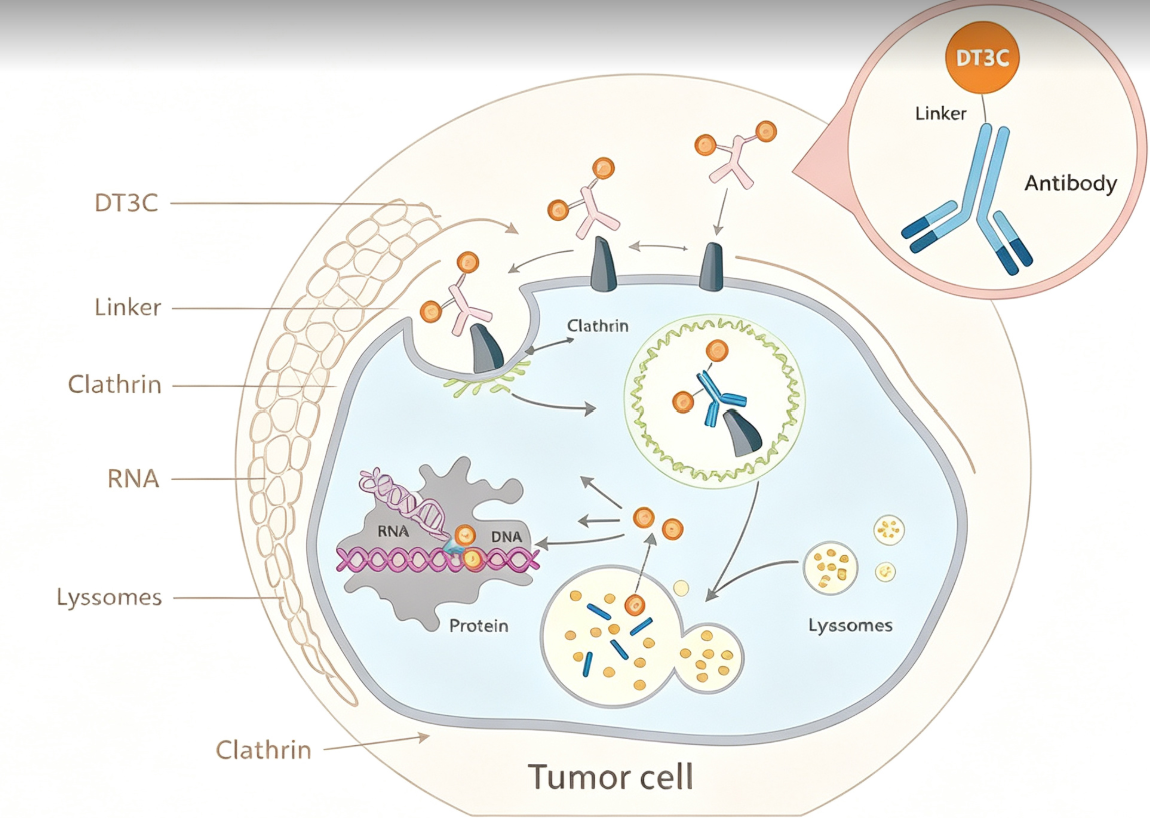
The DT3C recombinant protein is a fusion protein comprising the catalytic domain of diphtheria toxin and the C-terminal domain of streptococcal protein G. Its technical principle is based on the unique mechanism of diphtheria toxin: when the mAb-DT3C conjugate complex recognizes and binds to cell surface antigens, the complex is internalized into the cell. Subsequently, DT3C is cleaved by furin protease in the cytoplasm, releasing the catalytic domain. This catalytic domain induces ADP-ribosylation of elongation factor-2 (EF-2), inhibiting the protein translation machinery and ultimately leading to cytotoxicity.
Compared to traditional methods, DT3C technology offers several significant advantages. In terms of preparation, the mAb-DT3C conjugate can be formed by incubating at room temperature for just 30 minutes, making the operation extremely simple. In terms of applicability, it can bind to any IgG from different species, offering broad compatibility. In terms of detection, internalization efficiency can be rapidly and accurately assessed via flow cytometry or fluorescence microscopy. For internalization evaluation, DT3C significantly reduces cell viability only during the internalization process, resulting in stronger signal specificity. Research data indicate that its antibody internalization efficiency is significantly higher than that of the Mab-ZAP method.
IV. Conclusion
Accurate evaluation of antibody internalization efficiency is essential throughout the entire process of ADC drug development, from target validation to candidate molecule screening. The DT3C recombinant protein, with its unique mechanism based on diphtheria toxin ADP-ribosylation cytotoxicity, simple conjugation operation, broad species compatibility, and highly specific signal output, provides an efficient and reliable tool for antibody internalization efficiency detection. Its widespread application in early ADC drug development will accelerate the screening and optimization of antibodies with high internalization efficiency.
To meet the demand for precise detection of antibody internalization efficiency in early ADC drug development, U-AB offers DT3C (Diphtheria toxin & spg 3C domain) Protein, Corynephage beta. This product is prepared using an E. coli expression system and verified by SDS-PAGE and SEC-HPLC, with a purity exceeding 90%. Functional validation shows that in concentration gradient experiments, after incubating DT3C protein with CCR8 antibody at 37°C for 30 minutes and culturing for 48 hours, the half-maximal effective concentration (EC50) values range between 0.56-1.40 μg/mL, demonstrating good batch-to-batch consistency and biological activity.
Disclaimer: This article partially utilizes artificial intelligence assistance in its creation. If any content involves copyright or intellectual property issues, please let us know and we promise to verify and remove it as soon as possible.
Purchase recombinant protein, choose Nanjing UA-Bio
UA protein focuses on providing various protein reagents, raw materials, and services required for drug research and development, cell therapy, gene therapy, and basic scientific research, including drug target proteins, immune checkpoint proteins, cytokines, tool enzymes, customized protein expression, and full-length transmembrane protein development. Youai is committed to providing customers with high-quality products and professional services, and building a High-tech Biological Enterprise with International Competitiveness.
Target proteins | membrane proteins | cytokines | enzymes | viral antigens | protein customization
Nanjing UA Biotechnology Co., Ltd. Email:order@ua-bio.com Phone:+86-25-56221161

Product Information

Link:





©2021-2026 all rights reserved UA Biotechnology Co.,Ltd.
Privacy Policy 
网站备案号 浙ICP备2022019033号-2 浙公网安备33010202004867号
 Business license (three certificates in one)
 Tel:+86-25-56221161
E-mail:order@ua-bio.com
All products sold on this website shall not be used for clinical diagnosis or treatment of humans or animals, and shall only be used for non-medical purposes such as industrial or scientific research.
