




BAFF: The Core Regulator of B Cell Survival and Its Critical Role in Autoimmune Diseases
Views:18 


This article systematically elaborates on the molecular characteristics and expression distribution of B-cell activating factor (BAFF) as a member of the tumor necrosis factor ligand family, analyzes its signaling network regulating B-cell survival, proliferation, and differentiation through three receptors (BAFFR, TACI, BCMA), and explores the abnormal expression of BAFF in various autoimmune diseases such as systemic lupus erythematosus and its pathogenic mechanisms.
- Recent Advances
- Product Information
Recent Advances
BAFF: The Core Regulator of B Cell Survival and Its Pivotal Role in Autoimmune Diseases
Overview
This article systematically elucidates the molecular characteristics and expression distribution of B cell-activating factor (BAFF) as a member of the tumor necrosis factor ligand family, analyzes its signaling network through three receptors (BAFFR, TACI, BCMA) in regulating B cell survival, proliferation, and differentiation, and explores the aberrant expression of BAFF in various autoimmune diseases such as systemic lupus erythematosus and its pathogenic mechanisms.
This article systematically elucidates the molecular characteristics and expression distribution of B cell-activating factor (BAFF) as a member of the tumor necrosis factor ligand family, analyzes its signaling network through three receptors (BAFFR, TACI, BCMA) in regulating B cell survival, proliferation, and differentiation, and explores the aberrant expression of BAFF in various autoimmune diseases such as systemic lupus erythematosus and its pathogenic mechanisms.
I. Molecular Structure and Cellular Sources of BAFF
B cell-activating factor (BAFF), a member of the tumor necrosis factor ligand superfamily, is a cytokine critical for B cell survival and humoral immune responses, also known as BLyS, TALL-1, THANK, and CD257. Human BAFF has a molecular weight of approximately 32 kDa and is a type II transmembrane glycoprotein composed of an intracellular domain, transmembrane domain, and extracellular domain, existing in both membrane-bound and soluble forms. BAFF is expressed in various hematopoietic cells, including monocytes, macrophages, neutrophils, dendritic cells, and T cells, as well as in adipocytes. BAFF can be released from the cell surface through proteolytic cleavage, forming soluble trimers that serve as the primary form for systemic regulation in vivo.
II. BAFF Receptor System and B Cell Signal Transduction
BAFF exerts its biological functions by binding to three receptors expressed on B cells: BAFFR (TNFRSF13C), TACI (TNFRSF13B), and BCMA (TNFRSF17). These receptors, all members of the TNF receptor superfamily, exhibit differential expression patterns and functions during various stages of B cell development.
BAFFR is the primary receptor for BAFF, widely expressed from transitional B cells to mature and memory B cells, playing a central role in the BAFF system. Activation of BAFFR signaling primarily drives B cell survival and maturation, and its deficiency leads to the loss of over 90% of mature B cells, highlighting its irreplaceable role in B cell homeostasis.
TACI exhibits more complex regulatory functions, providing both positive signals for B cell activation and negative regulation to prevent excessive B cell activation. Studies have shown that in systemic lupus erythematosus (SLE) patients, TACI expression is significantly reduced in atypical B cell subsets (DN2), correlating with high disease activity and elevated IL-21 levels, further supporting TACI's immunomodulatory role in autoimmunity.
BCMA primarily supports the survival of long-lived plasma cells in the bone marrow, playing a critical role in terminally differentiated plasma cells.
III. Pathological Significance of BAFF in Autoimmune Diseases
Aberrant BAFF expression is closely associated with the pathogenesis of various autoimmune diseases. Elevated BAFF levels have been detected in the serum of patients with systemic lupus erythematosus, rheumatoid arthritis, Sjögren's syndrome, IgA nephropathy, and bullous pemphigoid, among others.
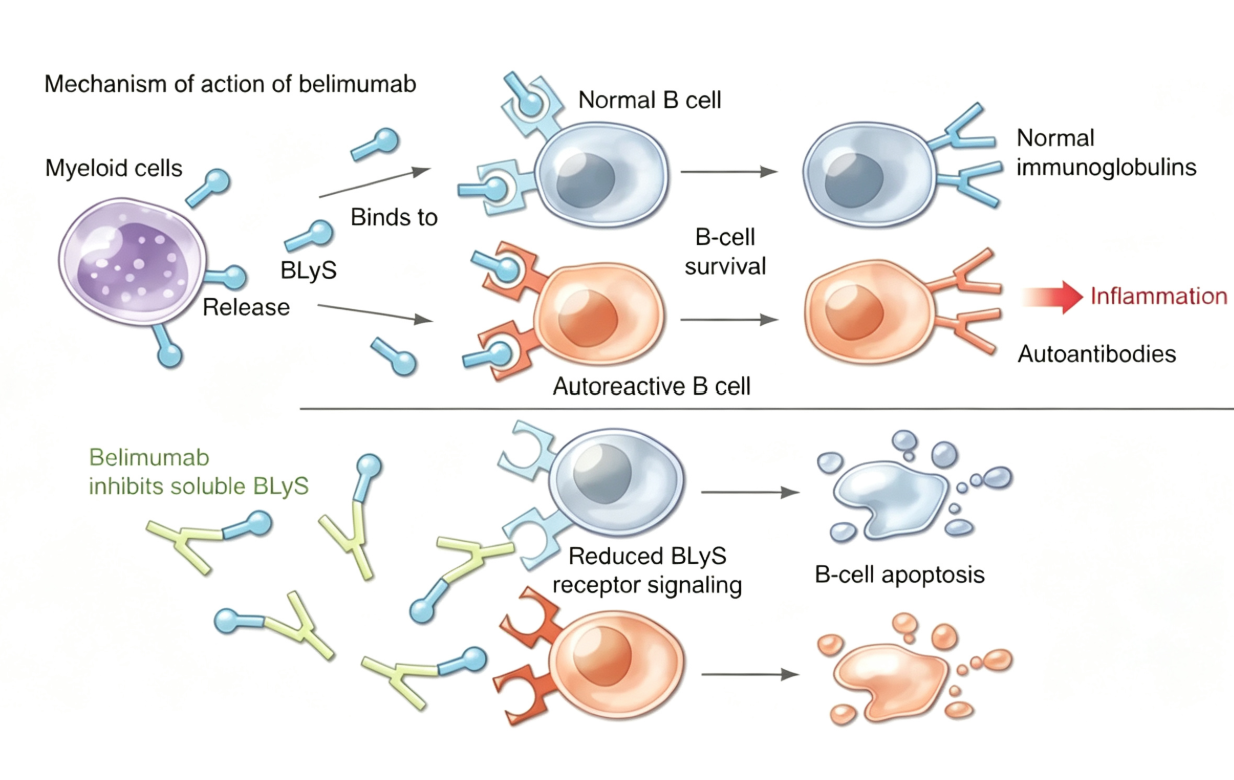
The mechanisms by which BAFF overexpression contributes to autoimmunity involve two main aspects. First, excessive BAFF supports the survival of autoreactive B cells, enabling these cells to escape immune tolerance checkpoints, ultimately leading to autoantibody production and tissue damage. BAFF transgenic mice spontaneously develop autoimmune phenotypes resembling SLE and Sjögren's syndrome. Second, BAFF not only acts on B cells but also promotes T cell activation, proliferation, and differentiation, forming a positive feedback loop that amplifies immune responses—IFN-γ activates myeloid cells to produce more BAFF, which in turn promotes T cell differentiation into IFN-γ-producing cells, creating a self-amplifying cycle of autoimmunity. Additionally, in SLE patients, BAFF and BAFFR levels correlate positively with SLEDAI scores, while BAFF levels correlate positively with antinuclear antibody titers and negatively with leukocyte, C3, and C4 levels, further suggesting BAFF as an important biomarker for assessing disease activity and prognosis.
In terms of BAFF-targeted therapeutic strategies, BAFF antagonists have been clinically approved for SLE treatment, demonstrating efficacy in reducing disease activity. Emerging strategies show potential in addressing BAFF rebound elevation following B cell depletion, offering promise for refractory autoimmune diseases.
IV. Conclusion
BAFF, through its fine-tuned regulation of B cell survival, differentiation, and function via three receptors, holds a central position in B cell homeostasis and humoral immune responses. Its overexpression is directly linked to the pathogenesis of various autoimmune diseases, including SLE, and BAFF-targeted therapies have been clinically validated. Mouse BAFF recombinant protein, as a key tool for basic research and drug screening, will continue to advance the in-depth understanding of BAFF signaling pathways and the optimization of related therapeutic strategies.
For BAFF-related basic research and drug screening, high-quality mouse BAFF recombinant protein is essential for receptor binding assays, neutralizing antibody evaluation, and B cell functional experiments. To meet this research need, Uni offers BAFF Protein, Mouse, suitable for BAFF/BAFFR binding studies, anti-BAFF antibody activity assessment, and B cell functional experiments.
Disclaimer: This article partially utilizes artificial intelligence assistance in its creation. If any content involves copyright or intellectual property issues, please let us know and we promise to verify and remove it as soon as possible.
Purchase recombinant protein, choose Nanjing UA-Bio
UA protein focuses on providing various protein reagents, raw materials, and services required for drug research and development, cell therapy, gene therapy, and basic scientific research, including drug target proteins, immune checkpoint proteins, cytokines, tool enzymes, customized protein expression, and full-length transmembrane protein development. Youai is committed to providing customers with high-quality products and professional services, and building a High-tech Biological Enterprise with International Competitiveness.
Target proteins | membrane proteins | cytokines | enzymes | viral antigens | protein customization
Nanjing UA Biotechnology Co., Ltd. Email:order@ua-bio.com Phone:+86-25-56221161

Product Information

Link:





©2021-2026 all rights reserved UA Biotechnology Co.,Ltd.
Privacy Policy 
网站备案号 浙ICP备2022019033号-2 浙公网安备33010202004867号
 Business license (three certificates in one)
 Tel:+86-25-56221161
E-mail:order@ua-bio.com
All products sold on this website shall not be used for clinical diagnosis or treatment of humans or animals, and shall only be used for non-medical purposes such as industrial or scientific research.
