




BAFF: From B-Cell Survival Factor to Key Therapeutic Target in Systemic Lupus Erythematosus
Views:20 


This article systematically elucidates the structural characteristics and functional diversity of B-cell activating factor (BAFF), detailing its various forms from membrane-bound to soluble trimers and 60-mers, along with their biological significance. It analyzes the signaling networks through which BAFF regulates B-cell survival and differentiation via its three receptors (BAFFR, TACI, BCMA), and explores the pathological association between BAFF overexpression and autoimmune diseases such as systemic lupus erythematosus.
- Recent Advances
- Product Information
Recent Advances
BAFF: From B Cell Survival Factor to Key Therapeutic Target in Systemic Lupus Erythematosus
Overview
This article systematically elaborates on the structural characteristics and functional diversity of B cell-activating factor (BAFF), detailing its various forms—from membrane-bound to soluble trimers and 60-mers—and their biological significance. It analyzes the signaling network through which BAFF regulates B cell survival and differentiation via three receptors (BAFFR, TACI, BCMA) and explores the pathological association between BAFF overexpression and autoimmune diseases such as systemic lupus erythematosus.
This article systematically elaborates on the structural characteristics and functional diversity of B cell-activating factor (BAFF), detailing its various forms—from membrane-bound to soluble trimers and 60-mers—and their biological significance. It analyzes the signaling network through which BAFF regulates B cell survival and differentiation via three receptors (BAFFR, TACI, BCMA) and explores the pathological association between BAFF overexpression and autoimmune diseases such as systemic lupus erythematosus.
1. Molecular Structure and Multimeric Forms of BAFF
B cell-activating factor (BAFF, also known as BLyS or CD257) is a member of the tumor necrosis factor (TNF) superfamily and is a cytokine critical for B cell survival and humoral immune responses. The human BAFF gene (TNFSF13B) encodes a 285-amino acid type II transmembrane protein, comprising a 46-amino acid cytoplasmic domain, a 21-amino acid transmembrane domain, and a 218-amino acid extracellular domain.
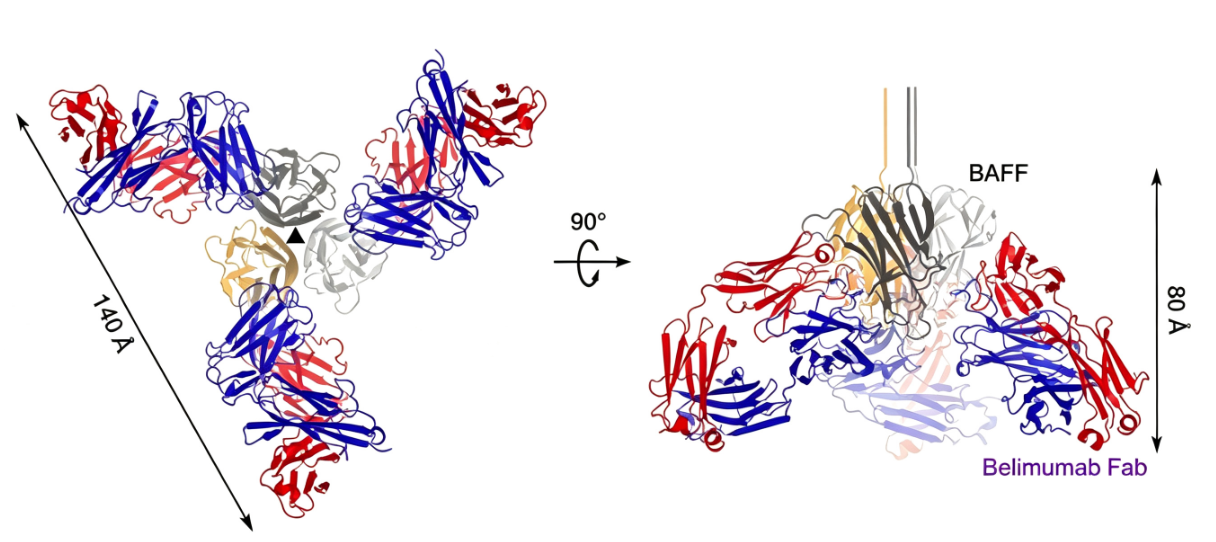
BAFF is expressed on the cell surface as a homotrimeric transmembrane protein. Upon cleavage by furin protease at specific conserved sequence sites, it is released as a soluble trimeric cytokine, which is the primary form for systemic regulatory functions. However, BAFF's multimerization potential extends beyond this. Studies show that trimers can link via the "flap" region (DE loop) to form a virus-like particle structure composed of 20 trimers (60-mer). This 60-mer structure is an intrinsic property of BAFF, dependent on pH (pH ≥ 7.0) and histidine residue 218 in the DE loop. Notably, the 60-mer exhibits stronger B cell proliferation-inducing activity than the trimer, likely due to its ability to engage in multivalent binding with B cell surface receptors, thereby more effectively activating downstream signaling pathways.
2. BAFF Receptor System and B Cell Signal Transduction
The biological functions of BAFF are primarily mediated through its interaction with three receptors on B cells: BAFFR (BR3, TNFRSF13C), TACI (TNFRSF13B), and BCMA (TNFRSF17). These receptors exhibit distinct expression patterns at different stages of B cell development and mediate diverse biological effects.
BAFFR is the primary receptor for BAFF, widely expressed from transitional to mature and memory B cells. The binding of BAFF to BAFFR is the core signal driving B cell survival and maturation. BAFFR activation primarily functions through the non-canonical NF-κB signaling pathway—when B cell receptor signals upregulate BAFFR expression and generate the p100 substrate, BAFFR activates downstream signals to promote B cell survival and maturation. Loss of BAFFR results in the depletion of over 90% of mature B cells, highlighting its irreplaceable role in B cell homeostasis.
TACI is the most enigmatic of the three receptors. It binds both BAFF and APRIL and plays a dual role in T cell-independent B cell antibody responses, class switching, and B cell homeostasis—providing both positive signals to drive B cell activation and negative regulation to prevent excessive B cell activation. TACI expression is closely linked to the activation of innate receptors such as TLRs on B cells.
BCMA primarily supports the survival of long-lived plasma cells in the bone marrow and plays a critical role in terminally differentiated plasma cells.
3. Pathological Significance of BAFF in Autoimmune Diseases
Excessive B cell proliferation and differentiation are central mechanisms in the pathogenesis of autoimmune diseases such as systemic lupus erythematosus (SLE). In SLE patients, BAFF levels are significantly elevated and closely correlated with disease activity and organ damage. BAFF transgenic mice spontaneously develop severe autoimmune diseases resembling SLE and Sjögren's syndrome. The pathological mechanism lies in the fact that excess BAFF supports the survival of autoreactive B cells, enabling these cells—which should otherwise be eliminated—to escape immune tolerance checkpoints, ultimately leading to autoantibody production and tissue damage.
Based on this pathological mechanism, targeting the BAFF/BAFFR axis is considered a potential strategy for treating SLE by reducing the proliferation of transitional and mature B cells and controlling the survival of autoreactive B cells.
4. Conclusion
BAFF occupies a central position in B cell homeostasis maintenance due to its unique molecular structure—ranging from trimers to 60-mer multimeric assemblies—and its fine-tuned regulation of B cell survival, differentiation, and function through three receptors: BAFFR, TACI, and BCMA. Its overexpression is directly linked to the pathological mechanisms of various autoimmune diseases, including SLE. The therapeutic strategy targeting BAFF has been validated by the clinical application of belimumab. A deeper understanding of the 60-mer formation mechanism and the continuous refinement of recombinant BAFF protein tools will provide critical support for basic research and the development of next-generation, more effective targeted therapies.
In BAFF-related basic research and drug screening, high-quality recombinant human BAFF protein is a core tool for receptor binding analysis, neutralizing antibody evaluation, and cell proliferation experiments. To meet this research demand, UniLove offers BAFF Protein, Human, suitable for BAFF/BAFFR binding studies, anti-BAFF antibody activity evaluation, and B cell functional experiments.
Disclaimer: This article partially utilizes artificial intelligence assistance in its creation. If any content involves copyright or intellectual property issues, please let us know and we promise to verify and remove it as soon as possible.
Purchase recombinant protein, choose Nanjing UA-Bio
UA protein focuses on providing various protein reagents, raw materials, and services required for drug research and development, cell therapy, gene therapy, and basic scientific research, including drug target proteins, immune checkpoint proteins, cytokines, tool enzymes, customized protein expression, and full-length transmembrane protein development. Youai is committed to providing customers with high-quality products and professional services, and building a High-tech Biological Enterprise with International Competitiveness.
Target proteins | membrane proteins | cytokines | enzymes | viral antigens | protein customization
Nanjing UA Biotechnology Co., Ltd. Email:order@ua-bio.com Phone:+86-25-56221161

Product Information

Link:





©2021-2026 all rights reserved UA Biotechnology Co.,Ltd.
Privacy Policy 
网站备案号 浙ICP备2022019033号-2 浙公网安备33010202004867号
 Business license (three certificates in one)
 Tel:+86-25-56221161
E-mail:order@ua-bio.com
All products sold on this website shall not be used for clinical diagnosis or treatment of humans or animals, and shall only be used for non-medical purposes such as industrial or scientific research.
