




Noggin: A Key Negative Regulator of the Bone Morphogenetic Protein Signaling Pathway and Its Application in Organoid Culture
Views:12 


This paper systematically elucidates the molecular mechanisms by which Noggin acts as an antagonist of the bone morphogenetic protein (BMP) signaling pathway and its central role in regulating cell proliferation and differentiation. It introduces a Noggin activity detection method based on the BMP reporter gene system and highlights its critical application value in the long-term culture of organoids.
- Recent Advances
- Product Information
Recent Advances
Noggin: A Key Negative Regulator of BMP Signaling Pathway and Its Application in Organoid Culture
Summary
This article systematically elaborates on the molecular mechanism of Noggin as an antagonist of the Bone Morphogenetic Protein (BMP) signaling pathway and its central role in regulating cell proliferation and differentiation. It introduces the BMP reporter gene system for detecting Noggin activity and highlights its critical application value in long-term organoid culture.
This article systematically elaborates on the molecular mechanism of Noggin as an antagonist of the Bone Morphogenetic Protein (BMP) signaling pathway and its central role in regulating cell proliferation and differentiation. It introduces the BMP reporter gene system for detecting Noggin activity and highlights its critical application value in long-term organoid culture.
1. Physiological and Pathological Significance of the BMP Signaling Pathway
Bone Morphogenetic Proteins (BMPs) are important members of the Transforming Growth Factor-β (TGF-β) superfamily, playing multifaceted roles in development and homeostasis. In the skeletal system, BMPs positively regulate osteoblast proliferation, differentiation, and bone formation, making them one of the most critical factors in bone development and metabolism. However, BMP functions extend far beyond the skeleton—they are indispensable in early embryonic development, organ formation, nervous system development, somitogenesis, limb development, and the development of organs such as the kidneys, gastrointestinal tract, lungs, and teeth. Moreover, aberrant activation of the BMP signaling pathway is closely associated with the initiation and progression of various tumors, promoting tumor invasion and metastasis, supporting tumor angiogenesis, suppressing immune responses in the tumor microenvironment, and inducing epithelial-mesenchymal transition (EMT).
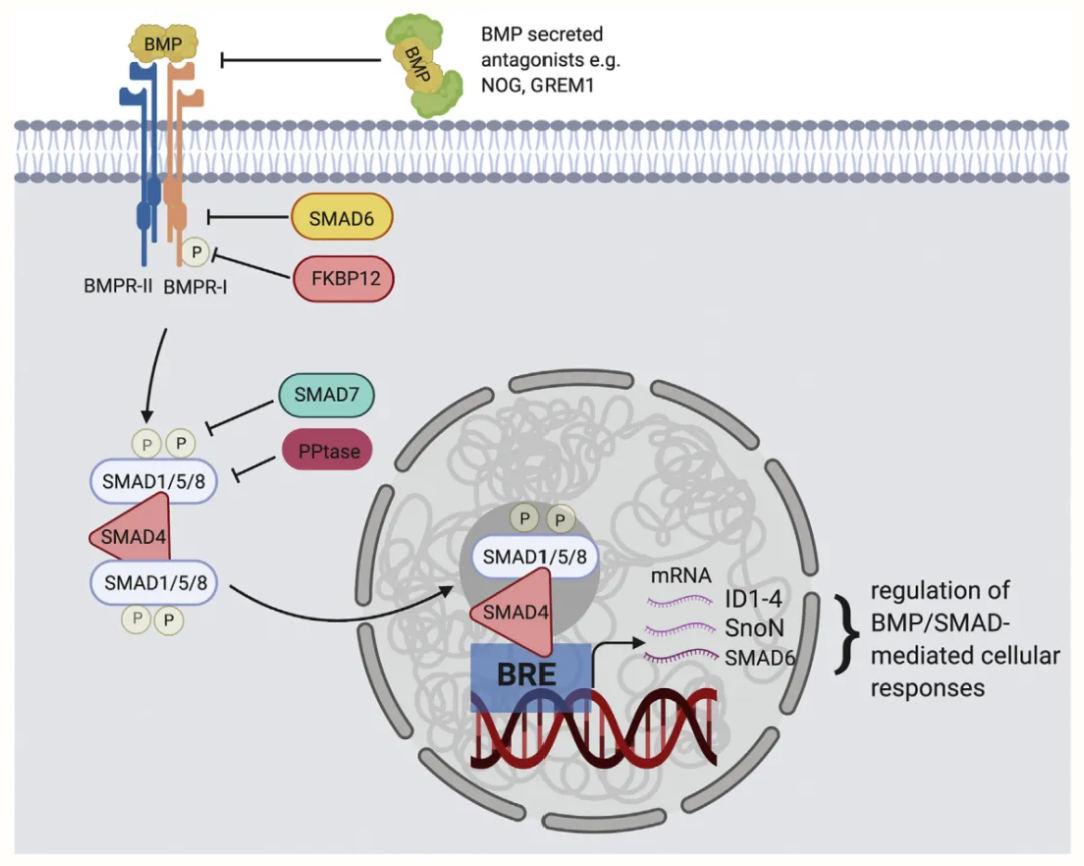
The BMP signaling pathway is primarily transmitted through two routes: the Smad-dependent canonical pathway and the MAPK-dependent non-canonical pathway. In the canonical pathway, BMP molecules bind to type I and type II receptors, leading to the phosphorylation of receptor-regulated Smads (R-Smads, i.e., Smad1/5/8) by the intracellular serine/threonine kinase domains of the receptors. The phosphorylated R-Smads then form a complex with the common Smad (Smad4), translocate into the nucleus, and initiate the transcription of downstream target genes (e.g., Id1, SnoN, and SMAD6).
2. Establishment and Principle of the BMP Reporter Gene System
Based on the characteristic that the Id1 promoter sequence is a classic downstream responsive element of the BMP signaling pathway, researchers constructed the BMP reporter gene system. Its core principle involves assembling the Id1 promoter sequence containing Smad-binding elements upstream of a luciferase reporter gene to create a stably transfected reporter cell line. When the BMP-Smad pathway is activated, the reporter gene expresses luciferase, and the level of BMP pathway activation can be quantitatively assessed with high sensitivity by measuring luciferase activity.
This detection system exhibits high pathway specificity—the reporter cells show no cross-reactivity to TGF-β signaling, ensuring assay specificity. This platform is not only useful for drug development and screening of BMP pathway agonists or antagonists but also serves as a critical tool for batch-to-batch activity quality control of Noggin, a core protein in organoid culture, due to its sensitivity and reliability.
3. Structural Features and BMP Antagonistic Mechanism of Noggin
Noggin is a secreted homodimeric glycoprotein belonging to the BMP antagonist family. Its molecular structure includes a conserved N-terminal cysteine-rich region, which stabilizes the dimer through a cystine knot structure and mediates high-affinity binding to BMP ligands. Noggin forms a Noggin-BMP complex, specifically blocking the binding of BMP molecules to their type I receptors (Alk1, Alk2, Alk3, and Alk6) and type II receptors (BMPR2, ActRIIa, and ActRIIb), thereby competitively inhibiting the initiation of BMP signaling. This antagonistic effect is crucial for establishing BMP activity gradients during embryonic development—by restricting the spatiotemporal range of BMP signaling, Noggin finely regulates key processes such as neural crest formation, somite differentiation, and skeletal development.
4. Core Value of Noggin in Organoid Culture
Organoid culture represents a major breakthrough in three-dimensional cell culture, and its success relies on precise control of stem cell self-renewal and differentiation signals. In various organoid systems, Noggin is an indispensable core supplement in the culture medium. By binding to BMP and antagonizing its pro-differentiation signals, Noggin coordinates Wnt signaling activation to maintain stem cells in a proliferative rather than differentiated state, thereby supporting long-term expansion of organoids. This role has been validated in multiple organoid systems, including liver, small intestine, stomach, and fallopian tube organoids. Therefore, the batch-to-batch activity and quality consistency of Noggin directly impact the reproducibility and stability of organoid culture experiments.
5. Application of Activity Detection Methods in Noggin Quality Control
In the aforementioned BMP reporter gene system, the addition of Noggin dose-dependently inhibits BMP-induced Id1 transcriptional activation, leading to a reduction in luciferase signal. This enables quantitative analysis of Noggin's neutralizing activity. By plotting a dose-response curve of Noggin concentration versus reporter gene signal inhibition rate, the half-maximal inhibitory concentration (IC₅₀) of Noggin can be precisely calculated to assess whether the activity of different batches of Noggin protein meets the standard. Activity detection data show that when Noggin concentrations range from 10-100 ng/mL, they effectively inhibit BMP-induced luciferase activity, with IC₅₀ typically falling within the 20-50 ng/mL range.
6. Conclusion
As a key negative regulator of the BMP signaling pathway, Noggin blocks BMP-receptor binding by forming a Noggin-BMP complex, playing multiple roles in embryonic development, tissue homeostasis, and tumor regulation. In the field of organoid culture, Noggin maintains the proliferative potential of stem cells by precisely regulating BMP signaling and has become an irreplaceable core component in various organoid culture systems. The activity detection method based on the BMP reporter gene system provides a reliable quantitative tool for Noggin quality control. High-quality recombinant murine Noggin protein serves as an important tool for organoid research and signaling pathway exploration.
To meet the needs of organoid culture and signaling pathway research, U-Impact offers Noggin Protein, Mouse. This product is an active recombinant murine Noggin protein, suitable for establishing and maintaining mouse-derived organoid culture systems, as well as in vitro evaluation of BMP signaling pathway antagonistic activity.
Disclaimer: This article partially utilizes artificial intelligence assistance in its creation. If any content involves copyright or intellectual property issues, please let us know and we promise to verify and remove it as soon as possible.
Purchase recombinant protein, choose Nanjing UA-Bio
UA protein focuses on providing various protein reagents, raw materials, and services required for drug research and development, cell therapy, gene therapy, and basic scientific research, including drug target proteins, immune checkpoint proteins, cytokines, tool enzymes, customized protein expression, and full-length transmembrane protein development. Youai is committed to providing customers with high-quality products and professional services, and building a High-tech Biological Enterprise with International Competitiveness.
Target proteins | membrane proteins | cytokines | enzymes | viral antigens | protein customization
Nanjing UA Biotechnology Co., Ltd. Email:order@ua-bio.com Phone:+86-25-56221161

Product Information

Link:





©2021-2026 all rights reserved UA Biotechnology Co.,Ltd.
Privacy Policy 
网站备案号 浙ICP备2022019033号-2 浙公网安备33010202004867号
 Business license (three certificates in one)
 Tel:+86-25-56221161
E-mail:order@ua-bio.com
All products sold on this website shall not be used for clinical diagnosis or treatment of humans or animals, and shall only be used for non-medical purposes such as industrial or scientific research.
