




CD6 and CD37: Dual Targets for Lymphocyte Signaling Regulation and Immunotherapy
Views:9 


This paper systematically elucidates the structural characteristics, expression profiles, and biological functions of CD6 and CD37 as key molecules on the surface of lymphocytes, analyzes their synergistic and complementary roles in T cell activation, B cell regulation, and immune synapse formation, and explores their potential as therapeutic targets in autoimmune diseases and tumor immunotherapy.
- Recent Advances
- Product Information
Recent Advances
CD6 and CD37: Dual Targets in Lymphocyte Signaling Regulation and Immunotherapy
Summary
This article systematically elucidates the structural characteristics, expression profiles, and biological functions of CD6 and CD37 as key molecules on lymphocyte surfaces, analyzing their synergistic and complementary roles in T cell activation, B cell regulation, and immune synapse formation, and exploring their value as targets in autoimmune diseases and tumor immunotherapy.
This article systematically elucidates the structural characteristics, expression profiles, and biological functions of CD6 and CD37 as key molecules on lymphocyte surfaces, analyzing their synergistic and complementary roles in T cell activation, B cell regulation, and immune synapse formation, and exploring their value as targets in autoimmune diseases and tumor immunotherapy.
I. Molecular Structure and Expression Features of CD6.
CD6 is a type I transmembrane glycoprotein belonging to the scavenger receptor cysteine-rich superfamily. Its extracellular region consists of three tandem SRCR domains, connected via a stalk region to the transmembrane domain and intracellular tail. The human CD6 gene is located on chromosome 11q12.2, encoding a full-length protein of 668 amino acids with a molecular weight of approximately 105-130 kDa, varying mainly due to phosphorylation levels. The intracellular tail of CD6 lacks intrinsic catalytic activity but contains phosphorylation sites that can bind various signaling effector molecules, regulating signal transduction in T and B cells.
In terms of expression, CD6 is present on almost all developing and mature T lymphocytes, as well as a subset of NK cells and B1a cells. In thymocytes, CD6 expression gradually increases with developmental stages, reaching its highest levels in mature single-positive thymocytes. Soluble CD6 can be released from the cell surface via metalloproteinase-mediated proteolysis, existing in trace amounts in normal serum and elevated in certain inflammatory states.
II. Ligand System and Immune Function Regulation of CD6.
CD6 exerts complex immunomodulatory functions through interactions with multiple ligands. Its primary ligands include CD166 (ALCAM, activated leukocyte cell adhesion molecule), CD318 (CDCP1), and the recently identified CD44. ALCAM is widely expressed on activated T cells, monocytes, epithelial cells, fibroblasts, and various tumor cells. CD318 is also expressed on normal and cancerous epithelial cells, participating in inflammatory responses, autoimmunity, and tumor progression. Studies show that galectin-1 and -3 can also bind CD6, influencing T cell adhesion, activation, and apoptosis.
CD6 plays a dual role in T cell activation. On one hand, anti-CD6 monoclonal antibodies can trigger T cell activation and proliferation, indicating its co-stimulatory function. CD6 physically associates with the TCR/CD3 complex and co-localizes at the center of the immune synapse, stabilizing adhesion contacts between T cells and antigen-presenting cells to optimize proliferation and differentiation responses. On the other hand, some studies suggest CD6 may act as a signal attenuator, with its function likely determined by the balance of stimulatory and inhibitory signals from various ligands. CD6 also regulates B1a cell function and natural IgM antibody production, playing a critical role in early antibacterial immune responses—CD6-deficient mice exhibit reduced survival rates and higher bacterial loads in sepsis models.
III. Molecular Structure and Functional Features of CD37.
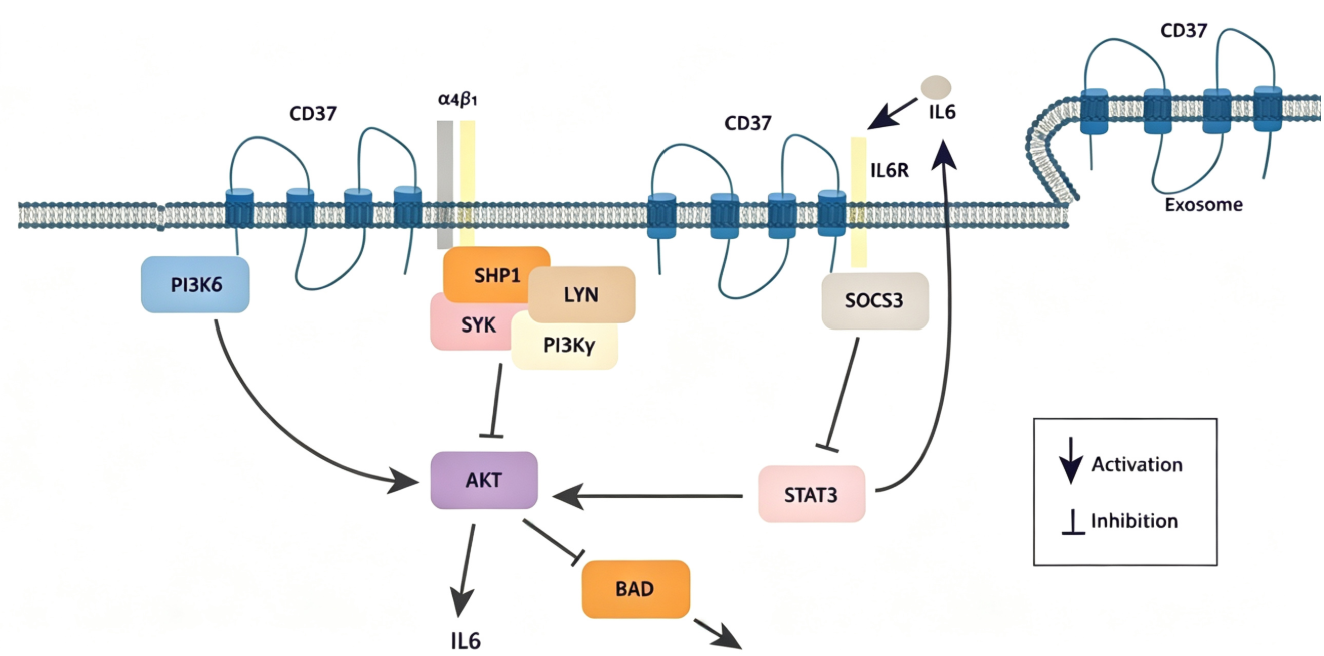
CD37 is a member of the tetraspanin superfamily, also known as TSPAN26, encoded by the CD37 gene. It consists of 281 amino acids with a molecular weight of approximately 32 kDa. CD37 contains four hydrophobic transmembrane domains, with its N- and C-termini and a large extracellular loop located on the cell surface. The CD37 gene is located on chromosome 19q13.33 and is expressed in B lymphocytes and certain T cells, participating in the regulation of humoral immune responses.
CD37 can form complexes with integrins and other tetraspanins, mediating signal transduction events that regulate cell development, activation, growth, and motility. In the immune synapse, CD37 localization suggests its involvement in T cell-B cell interactions. Functionally, CD37 participates in B cell activation and proliferation regulation—its downregulation is associated with B cell lymphoma progression, indicating potential tumor-suppressive roles.
IV. Research Progress of CD6 and CD37 in Disease and Therapy.
In autoimmune diseases, CD6 has been identified as a risk gene for multiple sclerosis. Genome-wide association studies have linked the single nucleotide polymorphism rs17824933 to MS susceptibility alleles in intron 1 of the CD6 gene, associated with reduced full-length CD6 expression in CD4+ and CD8+ T cells and weakened proliferation during prolonged activation. CD6-deficient mice exhibit reduced pathogenic Th1 and Th17 cells, decreased spinal T cell infiltration, and attenuated disease severity in experimental autoimmune encephalomyelitis models.
In tumor immunology, CD6 and its ligands ALCAM and CD318 are associated with prognosis and metastasis in various cancers. CD6 transcript levels correlate negatively with disease progression in colon cancer. Monoclonal antibodies targeting the CD6/CD318 axis enhance cytotoxic lymphocyte-mediated killing of breast, prostate, and lung cancer cells. CD37 has emerged as a therapeutic target for B cell malignancies, with several anti-CD37 antibody drugs in clinical development for diffuse large B cell lymphoma and chronic lymphocytic leukemia.
V. Conclusion.
As key signaling molecules on lymphocyte surfaces, CD6 and CD37 play indispensable roles in the activation, adhesion, and functional regulation of T and B cells, respectively. CD6 regulates T cell responses through complex signaling networks mediated by its ligands, while CD37 participates in B cell homeostasis via tetraspanin interactions. Their value as targets in autoimmune diseases and tumor immunotherapy has been widely validated, and the development of recombinant protein tools provides essential support for further exploration of their mechanisms and clinical translation. Uni offers CD6 His Tag Protein, Human, suitable for studying CD6 binding activity with ligands ALCAM or CD318, as well as screening and evaluating anti-CD6 antibody drugs.
Disclaimer: This article partially utilizes artificial intelligence assistance in its creation. If any content involves copyright or intellectual property issues, please let us know and we promise to verify and remove it as soon as possible.
Purchase recombinant protein, choose Nanjing UA-Bio
UA protein focuses on providing various protein reagents, raw materials, and services required for drug research and development, cell therapy, gene therapy, and basic scientific research, including drug target proteins, immune checkpoint proteins, cytokines, tool enzymes, customized protein expression, and full-length transmembrane protein development. Youai is committed to providing customers with high-quality products and professional services, and building a High-tech Biological Enterprise with International Competitiveness.
Target proteins | membrane proteins | cytokines | enzymes | viral antigens | protein customization
Nanjing UA Biotechnology Co., Ltd. Email:order@ua-bio.com Phone:+86-25-56221161

Product Information

Link:





©2021-2026 all rights reserved UA Biotechnology Co.,Ltd.
Privacy Policy 
网站备案号 浙ICP备2022019033号-2 浙公网安备33010202004867号
 Business license (three certificates in one)
 Tel:+86-25-56221161
E-mail:order@ua-bio.com
All products sold on this website shall not be used for clinical diagnosis or treatment of humans or animals, and shall only be used for non-medical purposes such as industrial or scientific research.
