




PI3K Kinase Activity Assay Based on ADP Detection: Principles, Applications, and the Value of Biotinylated Tools
Views:7 


This article systematically elaborates on the central role of the phosphatidylinositol 3-kinase (PI3K) signaling pathway in cellular regulation, analyzes the design principles and technical advantages of ADP detection-based kinase activity assays, and explores the application strategies of biotinylated substrates in PI3K activity analysis.
- Recent Advances
- Product Information
Recent Advances
PI3K Kinase Activity Assay Based on ADP Detection: Principles, Applications, and the Value of Biotinylated Tools
Summary
This article systematically elaborates on the central role of the phosphatidylinositol 3-kinase (PI3K) signaling pathway in cellular regulation, analyzes the design principles and technical advantages of the ADP detection-based kinase activity assay, and explores the application strategies of biotinylated substrates in PI3K activity analysis.
This article systematically elaborates on the central role of the phosphatidylinositol 3-kinase (PI3K) signaling pathway in cellular regulation, analyzes the design principles and technical advantages of the ADP detection-based kinase activity assay, and explores the application strategies of biotinylated substrates in PI3K activity analysis.
1. The Central Role of the PI3K Signaling Pathway in Physiology and Pathology.
Phosphatidylinositol 3-kinase (PI3K) is a class of lipid kinases that play a pivotal regulatory role in cell proliferation, survival, metabolism, and migration. PI3K phosphorylates the 3-hydroxyl group of the inositol ring in phosphatidylinositol-4,5-bisphosphate (PIP2) to generate the second messenger phosphatidylinositol-3,4,5-trisphosphate (PIP3), which recruits and activates downstream effector proteins containing PH domains (such as AKT and PDK1), initiating a cascade of signaling reactions. Hyperactivation of the PI3K/AKT/mTOR signaling axis is closely associated with the development and progression of various malignancies, making it one of the most targeted pathways in cancer therapy.
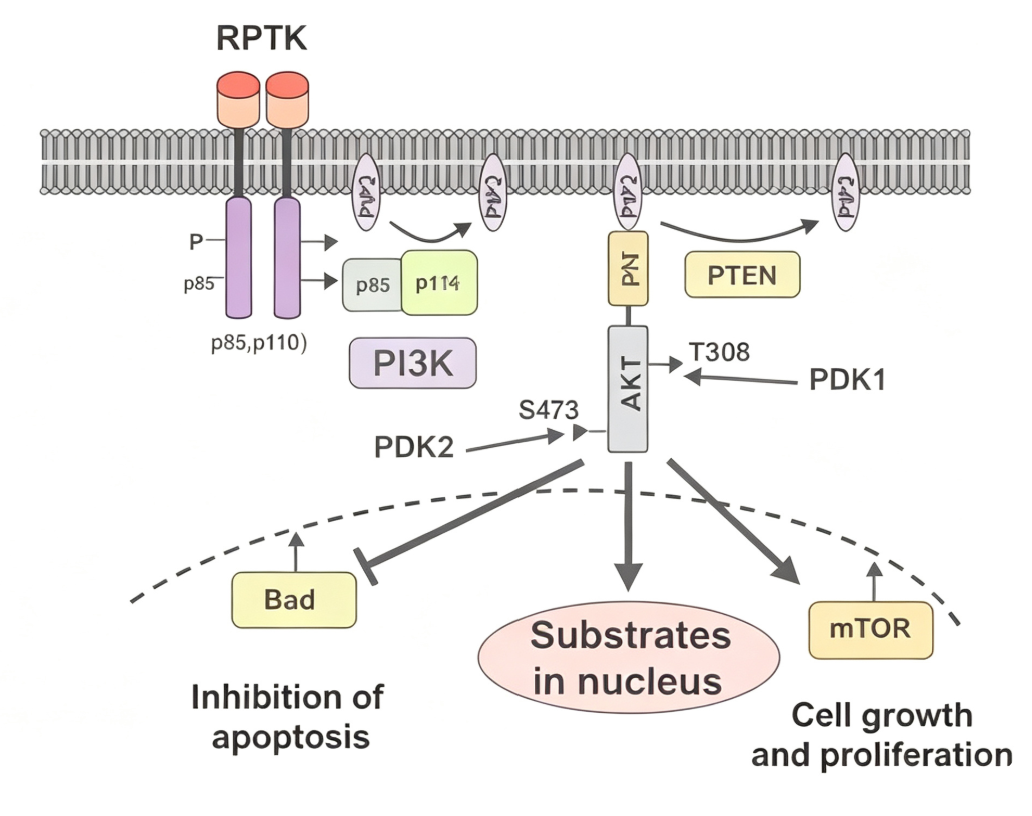
In drug development, accurate, sensitive, and reproducible kinase activity assays are essential tools for evaluating the activity and selectivity of PI3K inhibitors. Traditional methods such as radioactive isotope labeling or high-performance liquid chromatography (HPLC) are cumbersome, low-throughput, or involve radioactive materials, and have gradually been replaced by more advanced homogeneous detection methods.
2. Common Methods and Principles of Kinase Activity Assays.
The fundamental principle of kinase activity assays is to quantitatively measure the progress of the kinase-catalyzed substrate phosphorylation reaction. For PI3K, the direct substrate (PIP2) and product (PIP3) are both lipid molecules, posing additional challenges for assay design. Apart from antibody-based product detection (ELISA) and fluorescence polarization methods based on PIP3 binding to PH domains, the coupled enzyme assay (ADP-Glo assay) has become one of the most widely used methods for kinase activity detection. Its core principle is: for every molecule of ATP consumed in the kinase reaction, one molecule of ADP is generated. The ADP is converted back to ATP through a coupled enzyme system, and the resulting ATP is quantified via a luciferase reaction, producing a luminescent signal proportional to the ADP concentration, thereby enabling quantitative measurement of kinase activity.
3. Optimization Strategies for Biotinylated Substrates in PI3K Kinase Assays.
For lipid kinases such as PI3K, the experimental system requires the addition of the lipid substrate PIP2. To simplify the workflow and adapt to high-throughput screening, researchers often introduce biotinylated substrates into the system. The high-affinity binding between biotin and streptavidin allows the lipid components in the reaction system to be immobilized on streptavidin-coated solid-phase carriers or magnetic beads, facilitating washing and subsequent detection. The biotinylation strategy enables efficient capture of substrates in a homogeneous reaction system, improving the signal-to-noise ratio and standardization of operations.
4. Conclusion.
The ADP detection-based kinase activity assay, with its homogeneous operation, high sensitivity, and excellent scalability, has become a core technology for studying lipid kinases such as PI3K and for drug discovery. The introduction of biotinylated substrates further optimizes the experimental workflow and data quality. The UA-Glo® Kinase ADP Assay Kit, which integrates optimized components, provides a reliable and efficient standardized platform for phosphatidylinositol 3-kinase activity research.
To address the aforementioned PI3K activity detection needs, U-A offers the UA-Glo® Kinase ADP Assay with PI3K Substrate PIP2:3PS. This kit combines an optimized ratio of PI3K substrate (PIP2:3PS, a mixture of phosphatidylinositol-4,5-bisphosphate and phosphatidylserine), a highly sensitive coupled enzyme system for ADP quantification, and a biotinylation-based substrate capture system. Rigorous quality control ensures that all components of the kit exhibit high sensitivity and excellent batch-to-batch consistency. The kit provides an efficient and convenient solution for a wide range of experimental needs, from basic kinase characterization to high-throughput inhibitor screening, making it a powerful tool for PI3K signaling pathway research and anti-tumor drug development.
Disclaimer: This article partially utilizes artificial intelligence assistance in its creation. If any content involves copyright or intellectual property issues, please let us know and we promise to verify and remove it as soon as possible.
Purchase recombinant protein, choose Nanjing UA-Bio
UA protein focuses on providing various protein reagents, raw materials, and services required for drug research and development, cell therapy, gene therapy, and basic scientific research, including drug target proteins, immune checkpoint proteins, cytokines, tool enzymes, customized protein expression, and full-length transmembrane protein development. Youai is committed to providing customers with high-quality products and professional services, and building a High-tech Biological Enterprise with International Competitiveness.
Target proteins | membrane proteins | cytokines | enzymes | viral antigens | protein customization
Nanjing UA Biotechnology Co., Ltd. Email:order@ua-bio.com Phone:+86-25-56221161

Product Information

Link:





©2021-2026 all rights reserved UA Biotechnology Co.,Ltd.
Privacy Policy 
网站备案号 浙ICP备2022019033号-2 浙公网安备33010202004867号
 Business license (three certificates in one)
 Tel:+86-25-56221161
E-mail:order@ua-bio.com
All products sold on this website shall not be used for clinical diagnosis or treatment of humans or animals, and shall only be used for non-medical purposes such as industrial or scientific research.
