

FGF-23: An Early Sensitive Indicator of Phosphorus Metabolism Disorders in Chronic Kidney Disease and a Cardiovascular Risk Factor


This article systematically elaborates on the physiological functions of fibroblast growth factor 23 (FGF-23) as a phosphaturic hormone and its pathological significance in chronic kidney disease (CKD). It analyzes key evidence demonstrating that FGF-23 undergoes early alterations in CKD and serves as a sensitive indicator of phosphorus retention. Additionally, it explores the mechanisms by which FGF-23 mediates cardiovascular damage through "off-target" effects and discusses its potential value as a therapeutic target.
- Recent Advances
- Product Information
FGF-23: An Early Sensitive Indicator of Phosphorus Metabolism Dysregulation in Chronic Kidney Disease and a Cardiovascular Risk Factor
Brief Summary: This article systematically elucidates the physiological functions of fibroblast growth factor 23 (FGF-23) as a phosphaturic hormone and its pathological significance in chronic kidney disease (CKD), analyzes the key evidence that FGF-23 changes in the early stages of CKD and serves as a sensitive indicator of phosphorus retention, explores the mechanisms of its "off-target" effects mediating cardiovascular damage, and discusses its value as a potential therapeutic target.
I. Molecular Characteristics and Physiological Functions of FGF-23
Fibroblast Growth Factor-23 (FGF-23) is an endocrine signaling protein secreted by osteocytes and osteoblasts, belonging to the FGF-19 subfamily. The mature FGF-23 protein consists of 227 amino acids and can be structurally divided into three functional regions: the N-terminal fibroblast growth factor receptor binding domain, the C-terminal α-Klotho binding domain, and the proteolytic cleavage site located between them.
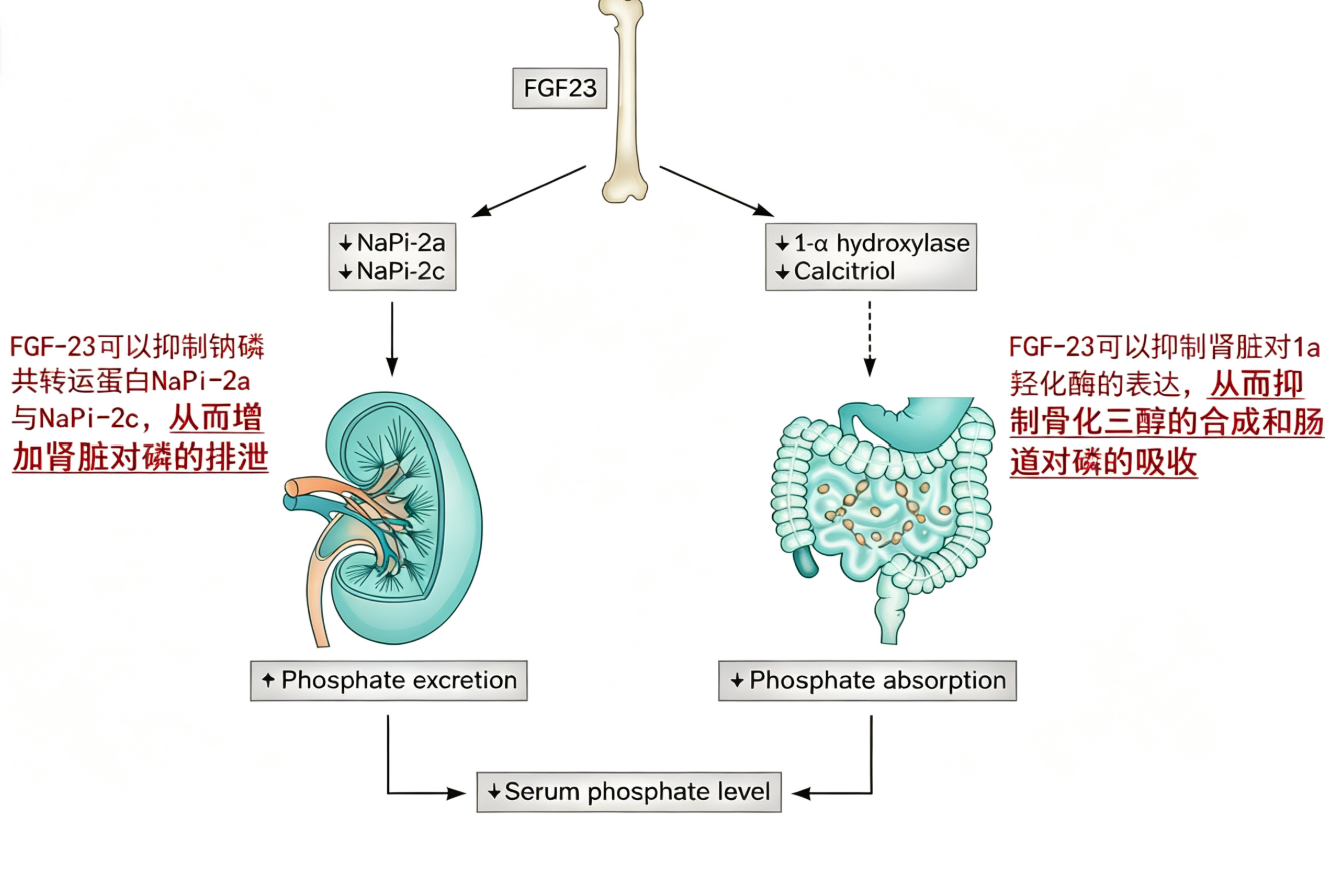
Under physiological conditions, FGF-23 exerts its core function as a phosphaturic hormone by binding to the FGFR1c/α-Klotho receptor complex on the surface of renal proximal tubular cells. Specifically, FGF-23 reduces renal phosphate reabsorption by inhibiting the expression and membrane localization of sodium-phosphate cotransporters (NaPi-IIa and NaPi-IIc) on the apical membrane of proximal tubules, thereby promoting urinary phosphate excretion. At the same time, FGF-23 suppresses CYP27B1 (1α-hydroxylase) and activates CYP24A1 (24-hydroxylase), reducing the production of active vitamin D (1,25-(OH)₂D₃) and further decreasing intestinal phosphate absorption. This finely tuned regulatory network collectively maintains phosphate homeostasis in the body.
II. Phosphate Homeostasis Dysregulation and Early Changes in FGF-23 During CKD Progression
As chronic kidney disease (CKD) progresses, renal function gradually declines, and phosphate excretion capacity decreases, leading to phosphate retention. However, compensatory regulatory mechanisms are already activated long before serum phosphate levels become significantly elevated.
A large body of research has confirmed that FGF-23 is the earliest mineral metabolism parameter to change during CKD progression. Animal model studies have shown that elevated FGF-23 is the earliest change in mineral metabolism in CKD rats, with its gradually increasing levels leading to early reductions in 1,25-(OH)₂D₃ levels, which in turn causes parathyroid hormone (PTH) to lose feedback inhibition, resulting in secondary hyperparathyroidism—all of these changes occur before serum phosphate levels become significantly elevated. In the early stages of CKD, FGF-23 plays an even more significant role in phosphate regulation than PTH.
A large cohort study involving 3,879 patients with CKD stages 2-4 confirmed that serum phosphate and PTH levels can remain within the normal range even when FGF-23 is elevated, while FGF-23 significantly increases with declining estimated glomerular filtration rate (eGFR). Analysis of patients with CKD stages 1-3 also showed that FGF-23 levels are significantly positively correlated with fractional phosphate excretion, indicating that the kidneys can still respond to FGF-23 in the early stages of CKD.
III. "Off-Target" Effects of FGF-23 and Cardiovascular Risk
As CKD progresses to advanced stages, FGF-23 levels can rise sharply, and due to the downregulation of α-Klotho expression in target organs (such as the kidneys), this leads to selective aberrant activation of FGFR4, producing "off-target" effects. In tissues lacking Klotho, such as the myocardium, pathological levels of FGF-23 bind to FGFR4 and activate downstream signaling pathways including ERK, directly mediating myocardial hypertrophy, fibrosis, and electrophysiological remodeling. Multiple clinical studies have confirmed that high FGF-23 levels are significantly associated with left ventricular hypertrophy, heart failure (particularly heart failure with preserved ejection fraction), atrial fibrillation, and all-cause mortality in CKD patients, serving as a cardiovascular risk predictor independent of traditional risk factors. In hemodialysis patients, even when serum phosphate levels are normal, FGF-23 levels are inversely correlated with mortality risk, further highlighting its distinctiveness as a risk factor.
IV. Strategies and Prospects of FGF-23 as a Therapeutic Target
Given the central role of FGF-23 in the early warning of CKD-MBD and cardiovascular damage, therapeutic strategies targeting FGF-23 have garnered widespread attention. On the one hand, reducing FGF-23 levels and phosphate burden through measures such as reducing dietary phosphate intake and using phosphate binders remains the foundation of management. On the other hand, intervention strategies directly targeting FGF-23 itself, such as anti-FGF-23 monoclonal antibodies and recombinant Klotho protein, have demonstrated potential in regulating mineral metabolism balance in preclinical and early clinical studies. Research has shown that C-terminal FGF-23 fragments can serve as natural antagonists to block the pathogenic signaling of pathological FGF-23 through gene therapy approaches, inhibiting pro-inflammatory gene expression and renal inflammation induced by FGF-23. The clinical efficacy of these strategies still requires further validation.
V. Application Value of FGF-23 Recombinant Protein in Research and Detection
FGF-23, as the core phosphaturic hormone of the bone-kidney axis, undergoes early changes during CKD progression, making it a sensitive indicator for assessing phosphate retention. Its elevation at pathological levels not only contributes to the development of CKD-MBD but also directly damages the cardiovascular system through "off-target" effects, serving as an important molecular bridge connecting CKD with poor prognosis. High-quality FGF-23 recombinant proteins provide the essential material foundation for in-depth exploration of its physiological and pathological mechanisms and the development of targeted intervention strategies. In FGF-23-related basic research, assay development, and drug screening, high-quality recombinant proteins are indispensable core tools. To address this need, UniBio provides FGF-23 Protein, Human, which can be used in research scenarios such as establishing immunoassays for FGF-23, antibody screening, and as a ligand for FGF-23/receptor binding activity analysis.
Disclaimer: This article partially utilizes artificial intelligence assistance in its creation. If any content involves copyright or intellectual property issues, please let us know and we promise to verify and remove it as soon as possible.
Purchase recombinant protein, choose Nanjing UA-Bio
UA protein focuses on providing various protein reagents, raw materials, and services required for drug research and development, cell therapy, gene therapy, and basic scientific research, including drug target proteins, immune checkpoint proteins, cytokines, tool enzymes, customized protein expression, and full-length transmembrane protein development. Youai is committed to providing customers with high-quality products and professional services, and building a high-tech enterprise with international competitiveness.







 Business license (three certificates in one)