

Mouse-derived CD3E/CD3D heterodimer: The core signaling module of the TCR-CD3 complex and a tool for immunological research


This article systematically elucidates the structural basis of the heterodimer formed by murine CD3E and CD3D within the TCR-CD3 complex, their signaling transduction functions, and their pivotal roles in T cell development and activation, while analyzing the significance of this heterodimer as a target for immunological research and the development of bispecific antibodies.
- Recent Advances
- Product Information
Murine CD3E/CD3D Heterodimer: The Core Signaling Module of TCR-CD3 Complex and Its Role as an Immunological Research Tool
Brief Description: This article systematically elaborates on the structural basis, signal transduction functions, and core role of murine CD3E and CD3D heterodimers within the TCR-CD3 complex during T cell development and activation, while analyzing their significance as targets for immunological research and bispecific antibody development.
I. Composition of TCR-CD3 Complex and Structural Features of Murine CD3 Subunits.
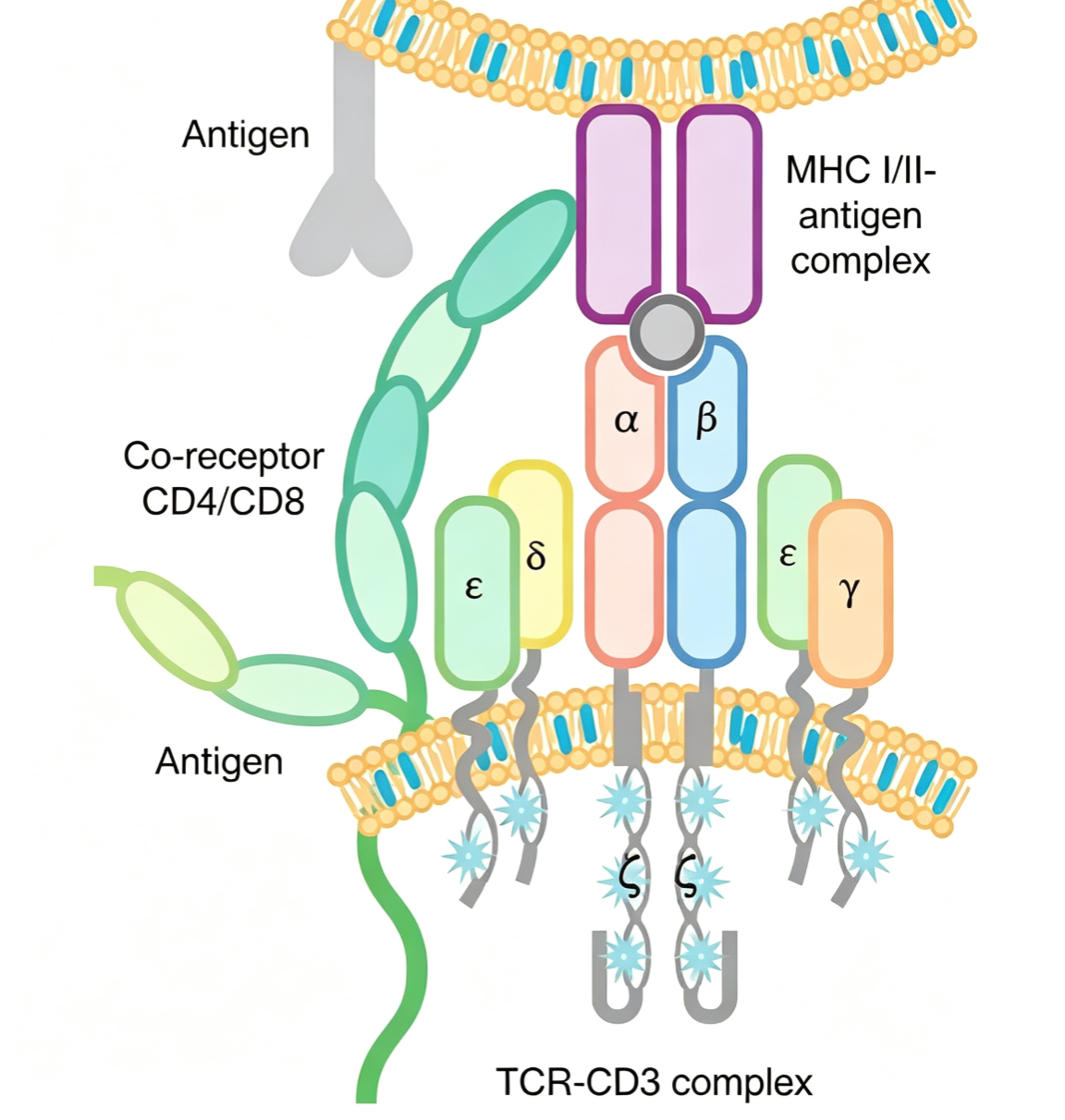
The T cell receptor (TCR) is the core molecule for antigen recognition and initiation of adaptive immune responses in T cells, but it lacks intrinsic transmembrane signal transduction capability. This function is fulfilled by the CD3 molecular family, which consists of four subtypes—CD3D (CD3δ), CD3E (CD3ε), CD3G (CD3γ), and CD3Z (CD3ζ). These subunits associate non-covalently with the TCR α and β chains to form a structurally intact and functionally coordinated TCR-CD3 complex.
From a molecular structural perspective, murine CD3E (NCBI Gene ID: 12501) and murine CD3D (NCBI Gene ID: 12500) are both type I single-pass transmembrane proteins. Their extracellular domains contain an immunoglobulin-like domain responsible for assembly with TCRα/β chains and other CD3 subunits. In the complex assembly pattern, CD3D and CD3E exist as a heterodimer, CD3G and CD3E form another heterodimer, while CD3Z exists as a homodimer. Thus, CD3E serves as a critical node connecting different CD3 subunits to form functional dimers.
Notably, the interaction between the extracellular domains of CD3D and CD3E is highly conserved across species, but their functions exhibit interspecies differences. For example, studies show that human CD3D/CD3E heterodimers can restore impaired pre-TCR function in CD3γ-deficient mice, suggesting distinct roles of human and murine CD3 subunits in thymocyte development regulation. The asymmetry in the G-chain geometry of CD3γ and CD3δ is crucial for maximizing antigen-triggered TCR activation, and the unique conformation of CD3γ cannot be replaced by the extracellular region of CD3δ.
II. Core Functions of CD3E/CD3D Heterodimer in T Cell Signal Initiation.
The CD3E/CD3D heterodimer not only serves as the structural framework maintaining the conformational stability of the TCR-CD3 complex but also acts as a functional module for signal transduction from the extracellular to the intracellular environment. All CD3 chains contain immunoreceptor tyrosine-based activation motifs (ITAMs) in their cytoplasmic tails, which serve as the initiation sites for T cell signal transduction.
When the TCR binds to specific MHC-peptide complexes presented on the surface of antigen-presenting cells, conformational changes are transmitted to the intracellular regions via CD3 subunits. Upon antigen stimulation, Src family protein tyrosine kinases (e.g., LCK) phosphorylate the tyrosine residues in the ITAMs of the CD3 complex, providing binding sites for proteins containing SH2 domains (e.g., ZAP-70). Subsequently, a series of downstream signaling molecules are recruited and activated, initiating multiple signaling pathways such as MAPK, NF-κB, and NFAT, ultimately driving T cell proliferation, differentiation, cytokine secretion, and effector functions.
Thus, the CD3E/CD3D heterodimer constitutes the primary signaling hub in the T cell activation cascade. Its structural integrity and functional correctness are the molecular basis for T cells to recognize antigens and mount appropriate responses. Notably, CD3D also establishes critical functional connections with CD4 and CD8 co-receptors during the activation and positive selection of CD4⁺ or CD8⁺ T cells.
III. Targeting CD3 in Immunological Research and Drug Development: Importance of Murine Models.
In the field of antibody drug development, particularly for T cell-redirecting bispecific antibodies, CD3 is one of the most prominent targets. The majority of therapeutic anti-CD3 antibodies recognize the native heterodimeric conformation formed by CD3E and CD3D (or CD3G), rather than isolated CD3E monomers. Studies confirm that only when CD3E forms heterodimers with CD3D or CD3G does its extracellular region exhibit the correct immunogenic conformation, enabling recognition and binding by therapeutic antibodies.
Murine CD3E/CD3D heterodimer proteins hold irreplaceable value in preclinical research. Mouse models are the most commonly used animal models for evaluating the efficacy, pharmacokinetics, and toxicology of T cell-engaging therapies such as bispecific antibodies and CAR-T. Therefore, recombinant heterodimer proteins that accurately mimic the native murine CD3 conformation are essential tool molecules for such studies. They can be used to assess the binding affinity, specificity, and potency of candidate molecules in inducing T cell activation, providing reliable data for lead compound screening and optimization.
IV. Conclusion.
Murine CD3E and CD3D form an indispensable structural and functional module within the TCR-CD3 complex through heterodimerization, providing the platform for signal transduction following TCR antigen recognition. The dependence of therapeutic anti-CD3 antibodies on the native heterodimeric conformation necessitates the use of recombinant proteins that precisely mimic this conformation in related drug development. High-quality recombinant murine CD3E&CD3D heterodimer proteins, with their well-defined molecular design, stringent quality control, and compatibility with various detection platforms, play a pivotal role as research tools in T cell immunology, antibody screening, and preclinical efficacy evaluation. U-Antibody offers CD3E&CD3D Heterodimer, Fc, His Tag&Fc, Flag Tag Protein, Mouse. This product fuses the extracellular domains of murine CD3E and CD3D with different tags (His and Flag), respectively, and forms the precise heterodimeric conformation through co-expression in HEK293 cells. The product covers key amino acid regions of the extracellular domains of CD3E and CD3D, with Fc tags enabling stable heterodimer formation and efficient purification.
Disclaimer: This article partially utilizes artificial intelligence assistance in its creation. If any content involves copyright or intellectual property issues, please let us know and we promise to verify and remove it as soon as possible.
Purchase recombinant protein, choose Nanjing UA-Bio
UA protein focuses on providing various protein reagents, raw materials, and services required for drug research and development, cell therapy, gene therapy, and basic scientific research, including drug target proteins, immune checkpoint proteins, cytokines, tool enzymes, customized protein expression, and full-length transmembrane protein development. Youai is committed to providing customers with high-quality products and professional services, and building a high-tech enterprise with international competitiveness.







 Business license (three certificates in one)