

The dual regulatory role of IL-2 in B cell function: mechanistic insights from pro-differentiation to anti-inflammatory homeostasis
Views:11 


This article systematically elucidates the molecular mechanisms by which interleukin-2 (IL-2) directly regulates B cells through its receptor complex, analyzes the dual functions of IL-2 in promoting plasma cell differentiation and limiting excessive humoral responses, explores its critical role in inducing IL-10-secreting regulatory B cells, and introduces the application value of biotinylated IL-2 protein in receptor binding studies.
- Recent Advances
- Product Information
Recent Advances
Dual Regulation of B Cell Function by IL-2: Mechanistic Insights from Pro-Differentiation to Anti-Inflammatory Homeostasis
Summary: This article systematically elucidates the molecular mechanisms by which interleukin-2 (IL-2) directly regulates B cells through its receptor complex. It analyzes the dual functions of IL-2 in promoting plasma cell differentiation and limiting excessive humoral responses, explores its pivotal role in inducing IL-10-secreting regulatory B cells, and introduces the application value of biotinylated IL-2 protein in receptor binding studies.
1. Expression and Signaling Basis of IL-2 and Its Receptors in B Cells.
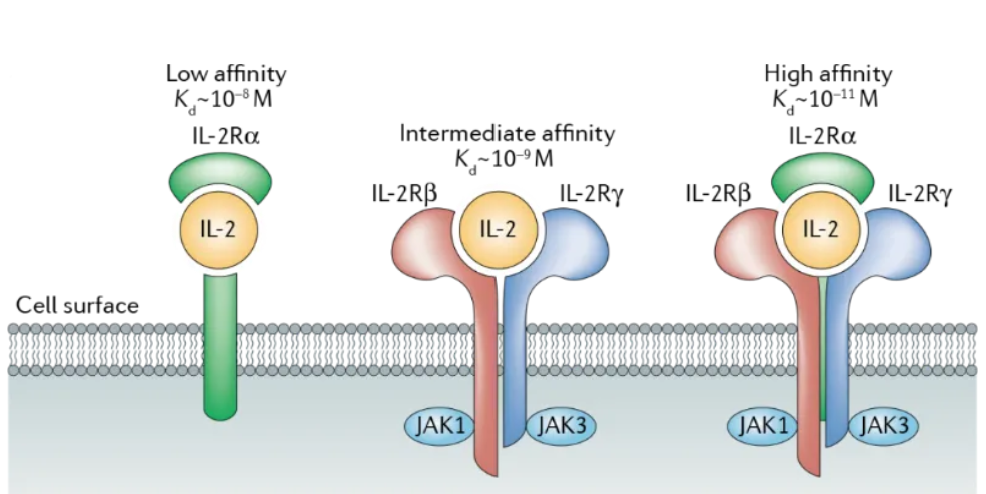
Interleukin-2 (IL-2) is a pleiotropic cytokine primarily produced by activated CD4-positive helper T cells, playing a central role in the initiation, maintenance, and homeostatic regulation of immune responses. IL-2 exerts its biological functions by binding to the IL-2 receptor (IL-2R) on the surface of target cells. The IL-2R consists of three subunits: IL-2Rα (CD25), IL-2Rβ (CD122), and the common γ-chain (IL-2Rγ, CD132). Depending on subunit combinations, IL-2R exists in three forms: the low-affinity monomeric IL-2Rα, the medium-affinity IL-2Rβ/γ dimer, and the high-affinity IL-2Rα/β/γ trimeric complex.
Regarding the relationship between IL-2 and B cells, early studies generally considered B cells as secondary targets of IL-2 signaling. However, substantial evidence indicates that IL-2 directly regulates B cells. Research has shown that unstimulated human tonsillar B cells can differentiate under IL-2 stimulation, and this effect is not mediated by indirect assistance from T cells or monocytes but rather by the direct action of IL-2 on B cells. Additionally, monoclonal B cells isolated from patients with B-cell chronic lymphocytic leukemia exhibit enhanced IgM synthesis and upregulated μ gene expression upon IL-2 stimulation alone. These findings establish IL-2 as a direct regulator of B cells.
2. Dual Regulatory Role of IL-2 in B Cell Differentiation.
The impact of IL-2 on B cell differentiation exhibits significant duality, with specific effects depending on the activation state of B cells and microenvironmental conditions.
Promotion of plasma cell differentiation. Under in vitro conditions, the synergistic effect of IL-2 and B cell receptor (BCR) signaling can significantly drive B cells toward B220lowCD138pos plasma cell differentiation, accompanied by a substantial increase in IgM and IgA secretion. At the molecular level, IL-2 activates the STAT5 signaling pathway, upregulating the key plasma cell transcription factor Prdm1 (encoding BLIMP-1) while downregulating Bcl6, which maintains germinal center B cell fate, thereby promoting the transition of B cells to plasma cells. Early, transient stimulation of naïve B cells by IL-2 provides a critical licensing signal for B cells to acquire plasma cell differentiation capacity.
Inhibition of excessive humoral responses in vivo. In contrast to its pro-differentiation effects in vitro, IL-2 functions as a "brake" to suppress excessive plasma cell generation under physiological conditions in vivo. Studies have confirmed that mice with B cell-specific deletion of IL-2Rβ exhibit significantly increased extrafollicular plasma cell numbers and elevated serum IgM and IgG1 levels after immunization. These results suggest that IL-2 limits excessive plasma cell expansion through B cell-intrinsic mechanisms, preventing uncontrolled humoral immune responses.
3. Key Role of IL-2 in Polarizing B Cells Toward Anti-Inflammatory Phenotypes.
Beyond its role in differentiation regulation, IL-2 profoundly influences the cytokine secretion profile of B cells, skewing them toward anti-inflammatory phenotypes. The synergistic effect of IL-2 and IFN-γ significantly upregulates the expression of the anti-inflammatory factor IL-10 in B cells. This effect is mediated by the induction of the transcription factor MAF, which directly binds to the IL-10 promoter and enhances its transcription.
In vivo, low-dose IL-2 therapy has been shown to effectively increase the number of IL-10-secreting B cells in peripheral blood. Single-cell RNA sequencing analysis reveals that IL-2 treatment markedly downregulates the expression of the transcriptional repressor BACH2 in B cells. Since BACH2 binds to the IL-10 gene promoter to exert inhibitory effects, its downregulation is a key mechanism by which IL-2 relieves IL-10 transcriptional repression. These IL-10+ regulatory B cells can suppress CD4+ T cell proliferation and IFN-γ secretion. In a mouse model of multiple sclerosis (experimental autoimmune encephalomyelitis), IL-2 signaling deficiency leads to a significant reduction in IL-10+ B cells in the central nervous system and exacerbates disease severity.
4. Specific Regulation of Age-Associated B Cell (ABC) Subsets by IL-2.
IL-2 exerts unique regulatory effects on PDCA-1+ age-associated B cell (ABC) precursors. These cells highly express IL-2Rβ and are highly sensitive to IL-2 signaling. Under the synergistic action of IL-2 and IFN-γ, ABC precursors are programmed via the MAF pathway to become major sources of IL-10 secretion, transforming from pro-inflammatory to regulatory phenotypes. Simultaneously, IL-2 effectively limits excessive ABC accumulation, preventing aberrant activation of their pro-inflammatory potential.
5. Tool Value of Biotinylated IL-2 Protein in Receptor Studies.
Technical advantages of biotin labeling. Biotin labeling of recombinant cytokines is a classic and powerful research tool. Biotinylated IL-2 retains full receptor-binding activity and cell growth-promoting function while leveraging the high specificity and sensitivity of the biotin-avidin system to facilitate receptor detection.
In studies of IL-2 and B cell interactions, biotinylated IL-2 can be used for IL-2R expression detection—via flow cytometry or immunohistochemistry, labeled IL-2 can directly display the expression levels and density of IL-2Rα/β/γ on the surface of different B cell subsets (e.g., ABCs), providing direct evidence for research on IL-2-targeted B cell subsets. Additionally, this tool is suitable for receptor-binding affinity assays based on ELISA or surface plasmon resonance, as well as for screening IL-2/IL-2R interaction inhibitors and evaluating functional regulatory molecules.
6. Conclusion.
The role of IL-2 in B cells has evolved from the traditional perception of a "secondary effect" to a "central node" that finely regulates B cell differentiation and function. Its effects are markedly context-dependent—synergizing with BCR to promote plasma cell differentiation in vitro while limiting excessive humoral responses in vivo; collaborating with IFN-γ to drive ABC differentiation into IL-10-secreting regulatory B cells, yet restricting pro-inflammatory ABC accumulation under steady-state conditions. This multifaceted nature makes IL-2 a key regulatory molecule linking the pro-inflammatory and anti-inflammatory functions of B cells. Biotinylated IL-2, as an essential tool for studying IL-2/IL-2R interactions, will play an indispensable role in further elucidating the precise regulatory mechanisms of IL-2 on B cells. UniLove offers IL-2 Protein, Human, which is suitable for basic research scenarios such as B cell differentiation and function studies, IL-2 signaling pathway analysis (e.g., STAT5 phosphorylation detection), and IL-2R binding activity assays.
Disclaimer: This article partially utilizes artificial intelligence assistance in its creation. If any content involves copyright or intellectual property issues, please let us know and we promise to verify and remove it as soon as possible.
Purchase recombinant protein, choose Nanjing UA-Bio
UA protein focuses on providing various protein reagents, raw materials, and services required for drug research and development, cell therapy, gene therapy, and basic scientific research, including drug target proteins, immune checkpoint proteins, cytokines, tool enzymes, customized protein expression, and full-length transmembrane protein development. Youai is committed to providing customers with high-quality products and professional services, and building a high-tech enterprise with international competitiveness.
Target proteins | membrane proteins | cytokines | enzymes | viral antigens | protein customization
Nanjing UA Biotechnology Co., Ltd. Email:order@ua-bio.com Phone:0571-87565022

Product Information

Link:





©2021-2026 all rights reserved UA Biotechnology Co.,Ltd.

网站备案号 浙ICP备2022019033号-2 浙公网安备33010202004867号
 Business license (three certificates in one)
 Tel:+86-0571-87565022
E-mail:order@ua-bio.com
All products sold on this website shall not be used for clinical diagnosis or treatment of humans or animals, and shall only be used for non-medical purposes such as industrial or scientific research.
