

CD3E/CD3D heterodimer: The core signaling module of the TCR-CD3 complex and a key target for bispecific antibody development
Views:14 


This article systematically elaborates on the structural basis and signal transduction functions of CD3E and CD3D within the TCR-CD3 complex, analyzes the physiological necessity of their formation as heterodimers, and discusses their significance as targets in antibody drug development. It also introduces the application value of biotinylated CD3E/CD3D heterodimeric recombinant proteins in the screening and evaluation of bispecific antibodies.
- Recent Advances
- Product Information
Recent Advances
CD3E/CD3D Heterodimer: The Core Signaling Module of TCR-CD3 Complex and a Key Target for Bispecific Antibody Development
Summary: This article systematically elaborates on the structural basis and signal transduction functions of CD3E and CD3D within the TCR-CD3 complex, analyzes the physiological necessity of their heterodimer formation and its significance as a target in antibody drug development, and introduces the application value of biotinylated CD3E/CD3D heterodimer recombinant proteins in the screening and evaluation of bispecific antibodies.
1. Composition and Structural Basis of the TCR-CD3 Complex
The T-cell receptor (TCR) is the core molecule for T-cell antigen recognition and the initiation of adaptive immune responses, but it lacks intrinsic transmembrane signal transduction capability. This function is carried out by the CD3 molecule family. CD3 is a group of type I transmembrane proteins found on the T-cell surface, comprising four subtypes—CD3D, CD3E, CD3G, and CD3Z (also known as CD3δ, CD3ε, CD3γ, and CD3ζ). These subunits associate with the TCR α and β chains (or γ and δ chains) via non-covalent bonds to form a structurally intact and functionally coordinated TCR-CD3 complex.
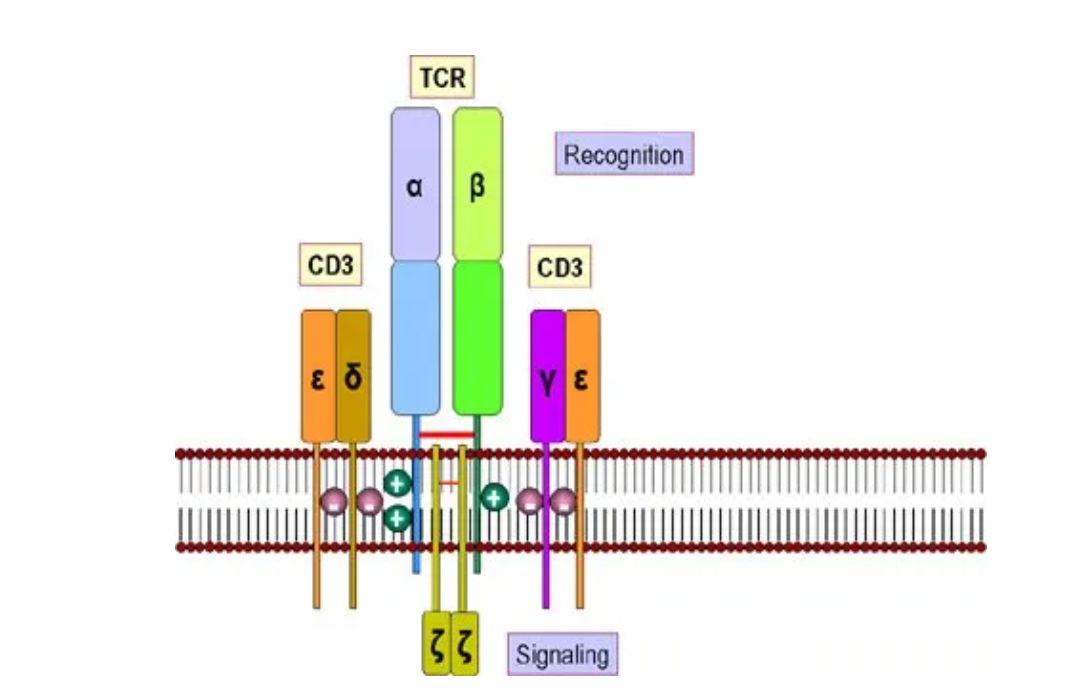
In the assembly pattern of the complex, CD3D and CD3E exist as heterodimers, CD3G and CD3E form another heterodimer pair, while CD3Z exists as a homodimer. Thus, CD3E serves as the critical node connecting different CD3 subunits into functional dimers. These heterodimers are not only the structural framework maintaining the conformational stability of the TCR-CD3 complex but also the functional modules for signal transduction from the extracellular to the intracellular space.
2. Core Functions of the CD3E/CD3D Heterodimer in T-Cell Signal Initiation
When the MHC-peptide complex presented on antigen-presenting cells binds to the TCR, conformational changes are transmitted to the intracellular regions via the CD3 subunits. All CD3 chains contain immunoreceptor tyrosine-based activation motifs (ITAMs) in their cytoplasmic tails, which serve as the initiation sites for T-cell signal transduction. Upon antigen stimulation, Src family protein tyrosine kinases (e.g., LCK) phosphorylate the tyrosine residues in the ITAMs of the CD3 complex, providing binding sites for SH2 domain-containing proteins (e.g., ZAP-70). Subsequently, a series of downstream signaling molecules are recruited and activated, initiating multiple signaling pathways such as MAPK, NF-κB, and NFAT, ultimately driving T-cell proliferation, differentiation, cytokine secretion, and effector functions.
Therefore, the CD3E/CD3D heterodimer constitutes the primary signaling hub in the T-cell activation cascade. Its structural integrity and functional correctness are the molecular basis for T-cells to recognize antigens and mount appropriate responses.
3. CD3-Targeted Antibody Drug Development: Why the CD3E/CD3D Heterodimer is Required
In the field of antibody drug development, particularly in the creation of bispecific antibodies, CD3 is one of the most prominent targets. Research databases indicate that CD3 ranks among the top 5 hotspot targets, with over 400 pre-clinical and clinical projects globally targeting CD3. These drugs are typically designed with one arm targeting tumor-associated antigens and the other binding to CD3 on T-cells to activate them, thereby achieving targeted killing of tumor cells.
In discussions about targeting CD3, strictly speaking, most therapeutic antibodies (e.g., OKT3, UCHT1) recognize the native heterodimeric conformation of CD3E and CD3D (or CD3G), rather than isolated CD3E monomers. Studies confirm that only when CD3E forms heterodimers with CD3D or CD3G does its extracellular domain exhibit the correct immunogenic conformation, enabling recognition and binding by therapeutic antibodies. Isolated CD3E, CD3D, or CD3G cannot be effectively recognized by these antibodies. This characteristic dictates that in the screening, evaluation, and quality control of CD3-targeted drugs, recombinant proteins that accurately mimic the native heterodimeric conformation must be used as research tools, rather than simple single-subunit proteins.
4. Design and Preparation Strategies for Biotinylated CD3E/CD3D Heterodimers
To meet the needs of such research and drug development, scientists have constructed tool molecules that precisely simulate the native CD3E/CD3D heterodimeric conformation using recombinant protein engineering. The core design strategy involves co-expressing the extracellular domains of human CD3E and CD3D, utilizing Fc fragments or other heterodimerization domains to drive the formation of 1:1 heterodimeric complexes.
On this basis, by introducing His tags and Avi tags on specific subunits and covalently linking biotin to the lysine residues of the Avi tag via enzymatic reactions, biotinylated CD3E/CD3D heterodimers can be obtained. The high specificity and sensitivity of the biotin-streptavidin system make such proteins highly valuable in binding activity and blocking efficiency analyses of bispecific antibodies using techniques such as ELISA, SPR, and flow cytometry, offering higher signal-to-noise ratios and faster detection speeds.
5. Conclusion
CD3E and CD3D form an indispensable structural and functional module in the TCR-CD3 complex via heterodimerization, providing the platform for signal transduction following TCR antigen recognition. The dependence of therapeutic anti-CD3 antibodies on the native heterodimeric conformation necessitates the use of recombinant protein tools that accurately mimic this conformation in the development of CD3-targeted drugs such as bispecific antibodies. Biotinylated CD3E/CD3D heterodimers, with their well-defined molecular design, site-specific biotin labeling, and compatibility with multiple detection platforms, play a pivotal role as tools in antibody screening, affinity determination, and mechanistic studies.
U-Immuno offers Biotinylated CD3E&CD3D Fc, His, Avi tag&Fc, Flag, Avi tag Heterodimer Protein, Human. This product is prepared via a HEK293 cell co-expression system, accurately mimicking the native CD3E/CD3D heterodimeric conformation while achieving site-specific biotin labeling through AviTag™ technology. Its core applications include: binding activity and affinity determination of bispecific antibodies (e.g., T-cell engagers) with CD3 targets using ELISA or SPR platforms; serving as a positive control molecule for evaluating the competitive blocking efficiency of candidate antibodies or small-molecule compounds on the CD3E/CD3D binding interface; analyzing interactions between the CD3 complex and downstream signaling molecules in T-cell activation mechanism studies; and serving as an antigen for preparing anti-CD3E/CD3D heterodimer-specific antibodies or establishing corresponding immunoassays.
Disclaimer: This article partially utilizes artificial intelligence assistance in its creation. If any content involves copyright or intellectual property issues, please let us know and we promise to verify and remove it as soon as possible.
Purchase recombinant protein, choose Nanjing UA-Bio
UA protein focuses on providing various protein reagents, raw materials, and services required for drug research and development, cell therapy, gene therapy, and basic scientific research, including drug target proteins, immune checkpoint proteins, cytokines, tool enzymes, customized protein expression, and full-length transmembrane protein development. Youai is committed to providing customers with high-quality products and professional services, and building a high-tech enterprise with international competitiveness.
Target proteins | membrane proteins | cytokines | enzymes | viral antigens | protein customization
Nanjing UA Biotechnology Co., Ltd. Email:order@ua-bio.com Phone:0571-87565022

Product Information

Link:





©2021-2026 all rights reserved UA Biotechnology Co.,Ltd.

网站备案号 浙ICP备2022019033号-2 浙公网安备33010202004867号
 Business license (three certificates in one)
 Tel:+86-0571-87565022
E-mail:order@ua-bio.com
All products sold on this website shall not be used for clinical diagnosis or treatment of humans or animals, and shall only be used for non-medical purposes such as industrial or scientific research.
