

Clinical features, diagnosis, and treatment of MOGAD: An independent CNS inflammatory demyelinating disease
Views:11 


This article systematically elaborates on the molecular basis and clinical characteristics of myelin oligodendrocyte glycoprotein immunoglobulin G antibody-associated disease (MOGAD) as an independent disease entity, analyzes its key differences from multiple sclerosis and neuromyelitis optica spectrum disorders, and introduces the diverse clinical manifestations, diagnostic points, and treatment strategies of MOGAD in different age groups.
- Recent Advances
- Product Information
Recent Advances
Clinical Features, Diagnosis, and Treatment of MOGAD: An Independent CNS Inflammatory Demyelinating Disease
Summary: This article systematically elaborates on the molecular basis and clinical features of myelin oligodendrocyte glycoprotein immunoglobulin G antibody-associated disease (MOGAD) as an independent disease entity, analyzes its key differences from multiple sclerosis and neuromyelitis optica spectrum disorders, and introduces the diverse clinical manifestations, diagnostic points, and treatment strategies of MOGAD in different age groups.
1. Disease Definition and Molecular Basis of MOGAD
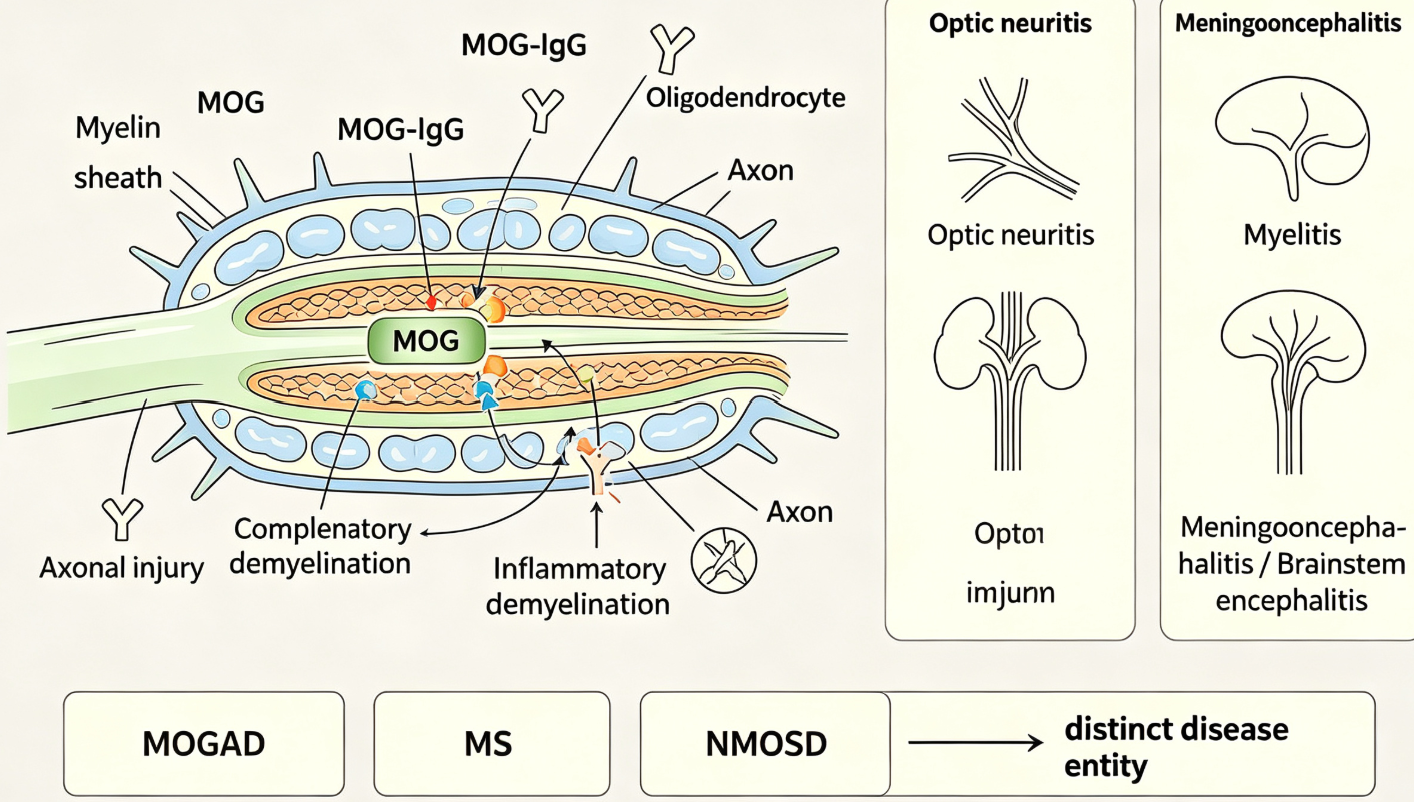
Myelin oligodendrocyte glycoprotein immunoglobulin G antibody-associated disease (MOGAD) is an immune-mediated inflammatory demyelinating disease of the central nervous system that has been redefined in recent years. The hallmark feature of this disease is the presence of IgG antibodies targeting myelin oligodendrocyte glycoprotein (MOG) in the patient's serum. MOG is a minor myelin protein expressed on the outermost layer of the central nervous system myelin and belongs to the immunoglobulin superfamily.
Current research generally suggests that MOG-IgG is not only a disease marker but also likely a direct pathogenic antibody in MOGAD. Based on extensive clinical observations, pathological studies, and animal experiments, MOGAD has now been confirmed as a distinct disease entity separate from multiple sclerosis and neuromyelitis optica spectrum disorders. This distinction has significant clinical implications, as misdiagnosing MOGAD as MS may lead to inappropriate treatment—studies have shown that some disease-modifying therapies used for MS may worsen MOGAD.
2. Epidemiological Features and Disease Course Characteristics of MOGAD
The incidence of MOGAD is higher in children than in adults, with a male-to-female ratio of approximately 1:1. Infections or vaccinations are common triggers, typically occurring 4 days to 4 weeks before onset.
In terms of disease course, MOGAD can be divided into monophasic and relapsing types. About 50%-60% of patients exhibit a relapsing course, and recurrent episodes may leave varying degrees of neurological disability. Unlike MS and NMOSD, the first episode of MOGAD is often the most severe, but patients have the potential for complete recovery, whereas MS and NMOSD patients typically experience multiple episodes, each potentially leading to cumulative disability. In relapsing patients, the persistent positivity of MOG-IgG is closely related to the risk of relapse, so patients with seroconversion have a relatively lower risk of recurrence.
3. Clinical Heterogeneity and Age-Related Differences in MOGAD
MOGAD lesions can extensively involve the optic nerves, brain, and spinal cord, exhibiting significant clinical heterogeneity. Confirmation of different clinical manifestations requires corresponding imaging support.
Optic neuritis (ON) is the most common clinical phenotype of MOGAD, with optic nerve involvement reaching 90% in adult patients. Clinical features include eye pain (especially aggravated by eye movement), rapid vision loss, visual field defects, and color vision abnormalities. Bilateral optic nerve involvement and optic disc edema are common. Myelitis accounts for 20%-30% of MOGAD cases and can manifest as short-segment or long-segment spinal cord lesions, with lumbar cord and conus medullaris involvement being more specific. Patients may experience limb weakness, sensory disturbances, and bowel/bladder dysfunction. Meningoencephalitis and brainstem encephalitis are also common manifestations, presenting with symptoms such as consciousness disturbances, seizures, intractable nausea and vomiting, dysarthria, and oculomotor nerve palsy.
Notably, the clinical manifestations of MOGAD exhibit significant age-related differences: children often present with acute disseminated encephalomyelitis-like phenotypes, while adults more commonly exhibit neuromyelitis optica-like phenotypes. The diagnosis of MOGAD requires combining clinical manifestations with serological testing. Patients with AQP4-IgG-negative central nervous system inflammatory demyelinating diseases should be screened for MOG-IgG.
4. Conclusion
As a unique CNS inflammatory demyelinating disease, MOGAD differs fundamentally from MS and NMOSD in pathogenesis, clinical manifestations, and treatment response. MOG-IgG is not only a diagnostic marker but also a core participant in the disease's pathogenic mechanism. With the clarification of MOGAD diagnostic criteria and the optimization of treatment strategies, understanding of this disease continues to deepen. Further research on MOG protein and its antibodies will advance progress in this field. Univ provides MOG His Tag Protein, Mouse, which can be used for the development and validation of MOG-IgG antibody detection methods, as well as the establishment and mechanistic research of MOGAD disease models.
Disclaimer: This article partially utilizes artificial intelligence assistance in its creation. If any content involves copyright or intellectual property issues, please let us know and we promise to verify and remove it as soon as possible.
Purchase recombinant protein, choose Nanjing UA-Bio
UA protein focuses on providing various protein reagents, raw materials, and services required for drug research and development, cell therapy, gene therapy, and basic scientific research, including drug target proteins, immune checkpoint proteins, cytokines, tool enzymes, customized protein expression, and full-length transmembrane protein development. Youai is committed to providing customers with high-quality products and professional services, and building a high-tech enterprise with international competitiveness.
Target proteins | membrane proteins | cytokines | enzymes | viral antigens | protein customization
Nanjing UA Biotechnology Co., Ltd. Email:order@ua-bio.com Phone:0571-87565022

Product Information

Link:





©2021-2026 all rights reserved UA Biotechnology Co.,Ltd.

网站备案号 浙ICP备2022019033号-2 浙公网安备33010202004867号
 Business license (three certificates in one)
 Tel:+86-0571-87565022
E-mail:order@ua-bio.com
All products sold on this website shall not be used for clinical diagnosis or treatment of humans or animals, and shall only be used for non-medical purposes such as industrial or scientific research.
