

Heterogeneity of TFH cells, functional plasticity, and regulatory strategies in diseases, along with research tools for polarization studies
Views:5 


This article systematically elaborates on the core functions of follicular helper T (TFH) cells under physiological and pathological conditions, analyzes the molecular basis of their phenotypic heterogeneity and functional plasticity, explores the dual roles of TFH cells in infection immunity, tumor surveillance, and autoimmune diseases, and summarizes current strategies for targeting TFH cell regulation. On this basis, it illustrates the application of T cell polarization research tools in related experiments.
- Recent Advances
- Product Information
Recent Advances
Heterogeneity and Functional Plasticity of TFH Cells, Their Regulatory Strategies in Diseases, and Research Tools for Polarization Studies
Brief Description: This article systematically elaborates on the core functions of follicular helper T (TFH) cells under physiological and pathological conditions, analyzes the molecular basis of their phenotypic heterogeneity and functional plasticity, discusses their dual roles in infection immunity, tumor surveillance, and autoimmune diseases, summarizes current strategies for targeting TFH cells, and introduces the application of T cell polarization research tools in related experiments.
1. Differentiation and Core Functions of TFH Cells
Follicular helper T cells are a specialized subset of CD4+ T helper cells, whose differentiation is precisely regulated by the lineage-defining transcription factor BCL6. Upon receiving antigen signals presented by dendritic cells, naive CD4+ T cells upregulate CXCR5 and downregulate CCR7, migrating to the B cell follicle and completing terminal differentiation within the germinal center. Mature germinal center TFH cells highly express CXCR5, PD-1, and ICOS and secrete the characteristic cytokine IL-21, providing critical helper signals for B cell affinity maturation, antibody class switching, and the differentiation of long-lived plasma cells and memory B cells. TFH cells are essential for pathogen clearance and vaccine-mediated protective antibody responses.
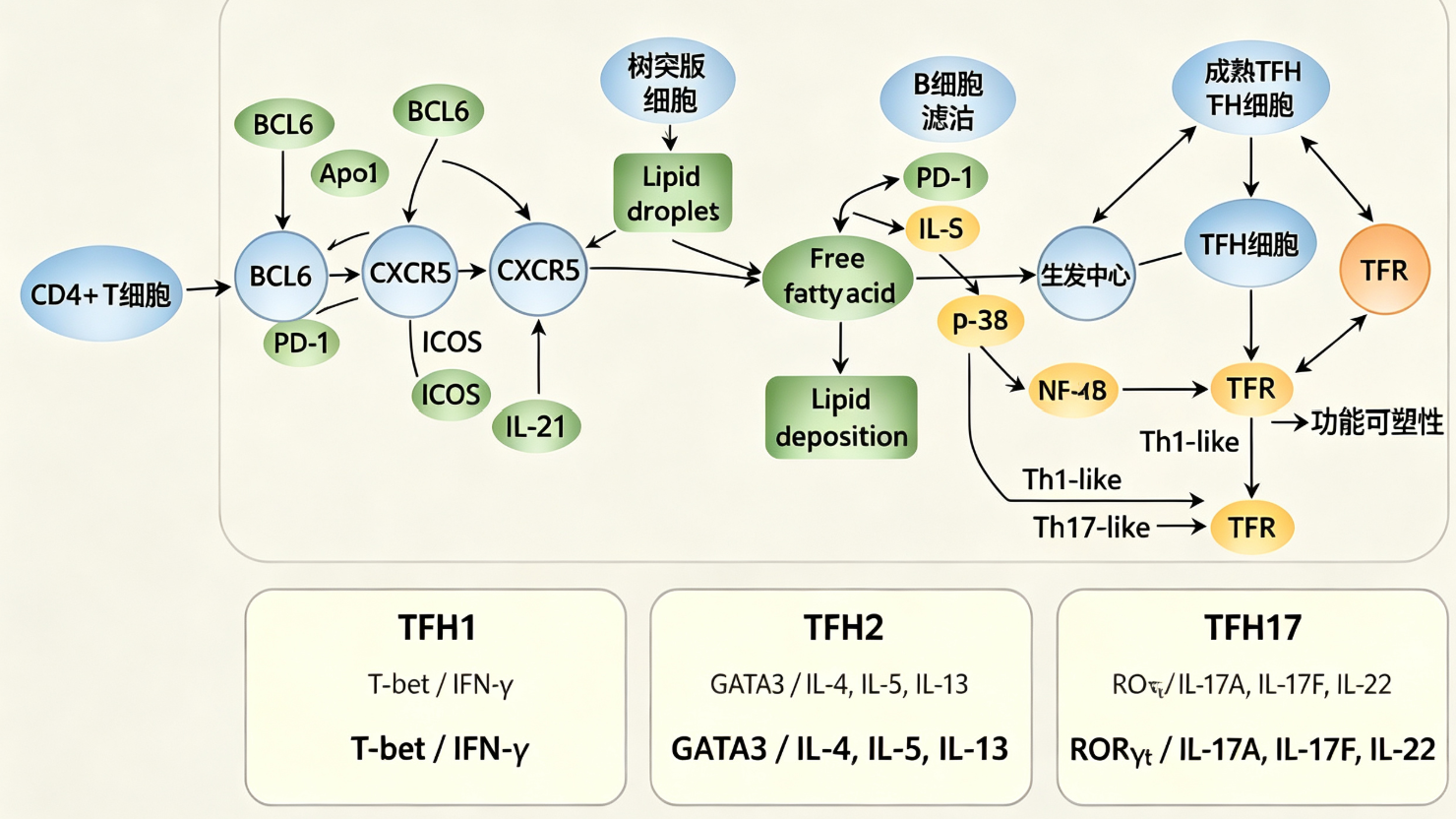
2. Heterogeneity and Functional Plasticity of TFH Cells
TFH cells are not a homogeneous population but exhibit significant heterogeneity and plasticity. Based on chemokine receptor and effector cytokine expression profiles, human TFH cells can be divided into three functional subsets:
CXCR3⁺CCR6⁻ TFH1 cells, expressing the transcription factor T-bet and secreting IFN-γ;
CXCR3⁻CCR6⁻ TFH2 cells, expressing GATA3 and secreting IL-4, IL-5, and IL-13;
CXCR3⁻CCR6⁺ TFH17 cells, expressing RORγt and secreting IL-17A, IL-17F, and IL-22.
Within the germinal center, approximately 50-60% of TFH cells produce IL-21, while the expression of cytokines such as IFN-γ, IL-4, and IL-10 varies by subset. Single-cell sequencing and spatial transcriptomics provide powerful tools for analyzing TFH cell heterogeneity and microenvironment localization. Additionally, TFH cells demonstrate the ability to transdifferentiate into other T helper cell subsets. For example, inflammatory microenvironments can induce TFH cells to acquire functional characteristics similar to Th1 or Th17 cells. This plasticity is both the basis for their functional diversity and the root of functional dysregulation under pathological conditions.
3. Protective Roles of TFH Cells in Infections, Vaccines, and Tumors
In infection immunity, TFH cells play protective roles in at least four aspects: supporting the production of high-affinity protective antibodies, promoting memory B cell formation, maintaining CD8⁺ T cell-mediated cytotoxic responses, and regulating mucosal IgA production. In COVID-19 patients, the expansion of CCR7loPD-1+ICOS+CD38+ circulating TFH cells is closely associated with the production of neutralizing antibodies. In vaccine responses, the quantity and quality of TFH cells are key determinants of vaccine efficacy. The impaired generation of antigen-specific TFH cells in elderly individuals post-vaccination is a major reason for their weakened immunity. In antitumor immunity, tumor-infiltrating TFH cells promote tertiary lymphoid structure formation and secrete IL-21 to enhance CD8⁺ T cell function, correlating closely with patient survival rates.
4. Pathogenic Roles of TFH Cells in Autoimmunity and Lymphoma
Abnormal or excessive TFH cell responses can drive the development of autoimmune diseases and lymphomas. Increased numbers and functional abnormalities of TFH cells have been observed in patients with systemic lupus erythematosus, rheumatoid arthritis, and Sjögren's syndrome, positively correlating with autoantibody titers and disease activity. In lymphomagenesis, TFH cell-derived IL-21 and CD40L signals can abnormally sustain germinal center B cell survival, increasing the risk of malignant transformation. Additionally, TFH cells are susceptible to HIV infection, and their intracellular high levels of HIV-DNA constitute a viral reservoir, posing a significant obstacle to HIV cure.
5. Strategies for Targeting TFH Cells
Given the pivotal role of TFH cells in health and disease, various regulatory strategies are being developed.
Targeting cytokine pathways: The IL-6-STAT3 pathway promotes TFH differentiation, and IL-6 inhibitors or JAK inhibitors can suppress pathogenic TFH activity. Conversely, the IL-2-STAT5 pathway inhibits TFH differentiation, and low-dose IL-2 has shown efficacy in suppressing TFH cells in lupus patients.
Targeting coreceptor signals: CTLA4-Ig fusion proteins effectively inhibit T cell activation and pathogenic TFH function. ICOS, OX40, and CD40-CD40L are also important intervention targets.
Modulating metabolic pathways: mTOR signaling integrates TCR, coreceptor, and cytokine signals. mTORC2 specifically induces TFH differentiation, and phosphatidylethanolamine prevents CXCR5 internalization to maintain the TFH phenotype.
Targeting cellular interactions: Regulating interactions between dendritic cells, B cells, or follicular regulatory T cells (TFR) and TFH cells can indirectly modulate TFH function.
6. Conclusion
With their unique heterogeneity, plasticity, and central role in humoral immunity, TFH cells have become a major focus in immunological research and clinical translation. From infections, vaccines, and tumors to autoimmune diseases, TFH cells are involved throughout, their dual functionality offering both therapeutic targets and insights into disease mechanisms. A deeper understanding of TFH cell differentiation and function, combined with standardized T cell polarization research tools, will provide critical support for vaccine optimization, tumor immunotherapy, and the development of intervention strategies for autoimmune diseases. Uni offers a Mouse Th1 Polarization Kit, which includes recombinant mouse IL-2, recombinant mouse IL-12, anti-mouse CD3ε and CD28 monoclonal antibodies, and anti-mouse IL-4 neutralizing antibodies, enabling efficient directional induction of naive CD4⁺ T cells into the Th1 subset. This kit is suitable for studies on T cell differentiation mechanisms and vaccine adjuvant evaluation.
Disclaimer: This article partially utilizes artificial intelligence assistance in its creation. If any content involves copyright or intellectual property issues, please let us know and we promise to verify and remove it as soon as possible.
Purchase recombinant protein, choose Nanjing UA-Bio
UA protein focuses on providing various protein reagents, raw materials, and services required for drug research and development, cell therapy, gene therapy, and basic scientific research, including drug target proteins, immune checkpoint proteins, cytokines, tool enzymes, customized protein expression, and full-length transmembrane protein development. Youai is committed to providing customers with high-quality products and professional services, and building a high-tech enterprise with international competitiveness.
Target proteins | membrane proteins | cytokines | enzymes | viral antigens | protein customization
Nanjing UA Biotechnology Co., Ltd. Email:order@ua-bio.com Phone:0571-87565022

Product Information

Link:





©2021-2026 all rights reserved UA Biotechnology Co.,Ltd.

网站备案号 浙ICP备2022019033号-2 浙公网安备33010202004867号
 Business license (three certificates in one)
 Tel:+86-0571-87565022
E-mail:order@ua-bio.com
All products sold on this website shall not be used for clinical diagnosis or treatment of humans or animals, and shall only be used for non-medical purposes such as industrial or scientific research.
