

The signaling transduction mechanisms, receptor systems, and functional diversity of IL-4 and IL-13 in immunity and tumors
Views:13 


This article systematically elucidates the molecular characteristics and cellular sources of IL-4 and IL-13 as core cytokines of type 2 immunity, analyzes their mechanisms of differentially activating the JAK-STAT signaling pathway through type I and type II receptor complexes, explores their functional duality in allergic diseases, tissue remodeling, and anti-inflammatory regulation, and introduces their upregulated expression in the tumor microenvironment and their potential as targets for immunotherapy.
- Recent Advances
- Product Information
Recent Advances
Signal Transduction Mechanisms, Receptor Systems, and Functional Diversity of IL-4 and IL-13 in Immunity and Tumors
Summary: This article systematically elucidates the molecular characteristics and cellular sources of IL-4 and IL-13 as core cytokines of type 2 immunity. It analyzes their mechanisms of differentially activating the JAK-STAT signaling pathway through type I and type II receptor complexes, explores their dual roles in allergic diseases, tissue remodeling, and anti-inflammatory regulation, and introduces their upregulated expression in the tumor microenvironment and their potential as targets for immunotherapy.
1. Molecular Classification and Cellular Sources of IL-4 and IL-13
Interleukin-4 (IL-4) and interleukin-13 (IL-13) are core members of the T helper type 2 (Th2) cytokine family, sharing high structural and functional homology. Their genes are located within the same gene cluster on human chromosome 5q31.1, suggesting they may have originated from a common ancestral gene duplication event. IL-4 and IL-13 are primarily produced by activated Th2 cells. Additionally, type 2 innate lymphoid cells (ILC2s), eosinophils, and mast cells secrete these cytokines under specific stimuli. In the immune response landscape, IL-4 and IL-13 collectively form the core signaling axis driving type 2 inflammatory responses, playing irreplaceable roles in defending against parasitic infections, mediating allergic reactions, and maintaining mucosal barrier homeostasis.
2. Receptor Systems and Signal Transduction Mechanisms of IL-4 and IL-13
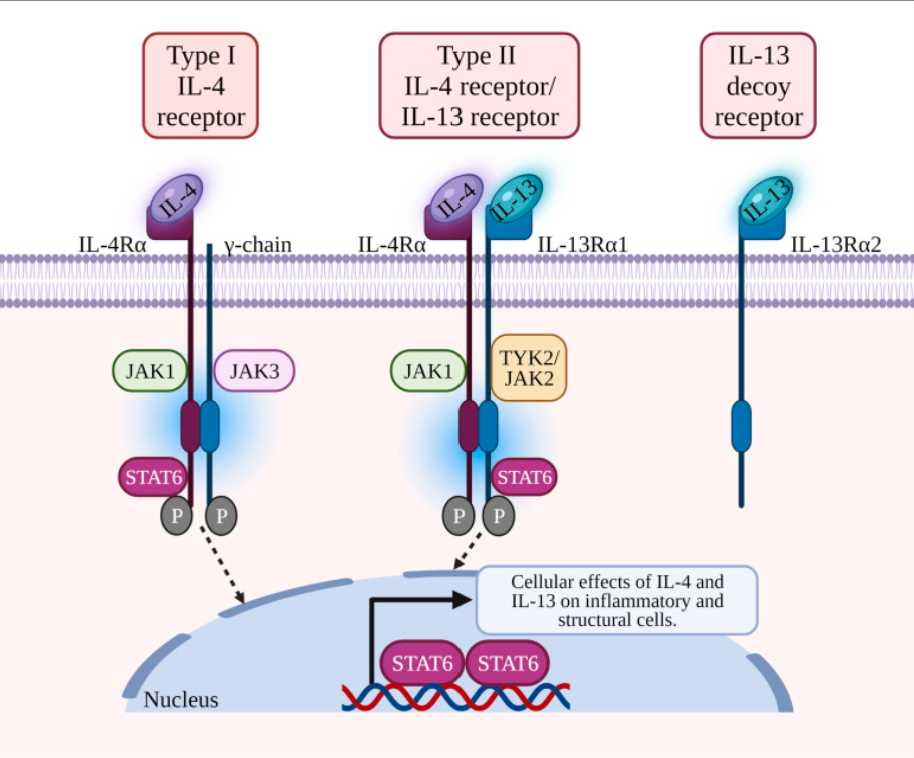
IL-4 and IL-13 initiate downstream signaling cascades by binding to specific receptor complexes on the surface of target cells. Although functionally related, their receptor utilization patterns differ significantly, which forms the molecular basis for their overlapping yet distinct biological functions.
The type I receptor complex consists of the IL-4 receptor α subunit (IL-4Rα) and the common γ chain (γc). This receptor can only bind IL-4, not IL-13. The type I receptor is primarily expressed on hematopoietic cells—including T cells, B cells, and mast cells. When IL-4 binds to the type I receptor, it activates Janus family kinases JAK1 (associated with IL-4Rα) and JAK3 (associated with γc), subsequently phosphorylating signal transducer and activator of transcription 6 (STAT6). This drives the differentiation of Th0 cells toward the Th2 lineage and promotes immunoglobulin class switching to IgE in B cells, a critical process in humoral immune responses and allergic reactions.
The type II receptor complex consists of IL-4Rα and the IL-13 receptor α1 subunit (IL-13Rα1). This receptor serves as a shared signaling platform for both IL-4 and IL-13—both cytokines can bind and activate this complex. The type II receptor is mainly expressed on non-hematopoietic cells, such as epithelial cells, fibroblasts, and smooth muscle cells. Activation of this complex through JAK1 (associated with IL-4Rα) and TYK2 (associated with IL-13Rα1) also phosphorylates STAT6, but its downstream biological effects primarily include inducing mucus secretion, promoting mucosal barrier inflammation, mediating tissue remodeling, and recruiting neutrophils and eosinophils.
3. Pathological Significance of the IL-4/IL-13 Signaling Pathway in Diseases
Under normal physiological conditions, receptor subunits such as IL-4Rα, γc, and IL-13Rα1 maintain low expression levels in dynamic equilibrium to ensure moderate regulation of type 2 immune responses. However, when this signaling axis becomes overactivated, it becomes a core pathological driver of various atopic diseases. In atopic dermatitis, excessive production of IL-4 and IL-13 disrupts skin barrier function, promotes itching, and drives local inflammation. In asthma, they induce airway mucus hypersecretion, airway smooth muscle contraction, and eosinophil infiltration. In chronic rhinosinusitis with nasal polyps, this signaling axis promotes chronic inflammation and polyp formation in the nasal mucosa. Therefore, targeting the IL-4/IL-13 pathway (e.g., using the IL-4Rα-blocking antibody dupilumab) has become an important therapeutic strategy for these diseases.
4. Immune Context-Dependent Functions of IL-4/IL-13
Notably, cytokine functions are not static but strongly dependent on the immune microenvironment. In rheumatoid arthritis, an autoimmune disease primarily driven by Th1/Th17 cells, IL-4 exhibits strikingly opposite anti-inflammatory properties. Studies show that in the synovial microenvironment of rheumatoid arthritis, IL-4 can significantly inhibit synovial fibroblasts and macrophages from producing pro-inflammatory cytokines such as IL-1, IL-6, IL-8, and tumor necrosis factor-α (TNF-α). This phenomenon suggests that IL-4's function is plastic across different immune contexts—acting as a pro-inflammatory factor in Th2-type inflammation but exerting immunosuppressive effects in Th1/Th17-type inflammation. This context-dependency is crucial for understanding the complexity of cytokine networks.
5. Emerging Roles of the IL-4/IL-13 Signaling Axis in Tumor Immunity
In recent years, significant progress has been made in studying the IL-4/IL-13 signaling axis in the tumor microenvironment. Research has found that various tumor cells exhibit abnormally high expression of IL-4Rα and IL-13Rα1, including glioblastoma, breast cancer, lymphoma, ovarian cancer, and melanoma. This upregulated receptor expression is not only associated with tumor proliferation, invasion, and metastasis but may also promote immune evasion by influencing the infiltration and functional states of immune cells in the tumor microenvironment. More importantly, this tumor-selective receptor overexpression provides a potential therapeutic window for immunotherapy. Currently, antibody-drug conjugates and chimeric antigen receptor T-cell strategies targeting IL-4Rα or IL-13Rα1 are in preclinical and early clinical development, aiming to achieve precise tumor killing by leveraging receptor expression differences. The successful application of targeting the IL-13 signaling pathway in atopic dermatitis and asthma also provides safety data support for the translation of related tumor treatment strategies.
6. Conclusion
As core cytokines of type 2 immunity, IL-4 and IL-13 achieve overlapping yet distinct biological functions in hematopoietic and non-hematopoietic cells through differential receptor utilization patterns—IL-4 can bind both type I and type II receptor complexes, while IL-13 only binds the type II receptor. The STAT6 signaling pathway jointly driven by these cytokines plays a key pathological role in allergic diseases and tissue remodeling, while their functions exhibit dual pro-inflammatory and anti-inflammatory roles depending on the immune context. The upregulated receptor expression in the tumor microenvironment opens new directions for targeted therapy. IL-13 protein products provide an important material basis for exploring these fundamental mechanisms and drug development. To meet the needs of IL-13-related signal transduction research, neutralizing antibody screening, and receptor binding analysis, UniLove offers IL-13 Protein, Human, suitable for various research scenarios such as cell proliferation experiments, ELISA, immunoblotting, and surface plasmon resonance. This product serves as an important tool for studying IL-13's binding properties with type II receptors, evaluating the blocking efficiency of anti-IL-13 antibodies, and exploring IL-13's functions in the tumor microenvironment.
Disclaimer: This article partially utilizes artificial intelligence assistance in its creation. If any content involves copyright or intellectual property issues, please let us know and we promise to verify and remove it as soon as possible.
Purchase recombinant protein, choose Nanjing UA-Bio
UA protein focuses on providing various protein reagents, raw materials, and services required for drug research and development, cell therapy, gene therapy, and basic scientific research, including drug target proteins, immune checkpoint proteins, cytokines, tool enzymes, customized protein expression, and full-length transmembrane protein development. Youai is committed to providing customers with high-quality products and professional services, and building a high-tech enterprise with international competitiveness.
Target proteins | membrane proteins | cytokines | enzymes | viral antigens | protein customization
Nanjing UA Biotechnology Co., Ltd. Email:order@ua-bio.com Phone:0571-87565022

Product Information

Link:





©2021-2026 all rights reserved UA Biotechnology Co.,Ltd.

网站备案号 浙ICP备2022019033号-2 浙公网安备33010202004867号
 Business license (three certificates in one)
 Tel:+86-0571-87565022
E-mail:order@ua-bio.com
All products sold on this website shall not be used for clinical diagnosis or treatment of humans or animals, and shall only be used for non-medical purposes such as industrial or scientific research.
