

Inhibitory effects of IGF-I peptide analogs on receptor autophosphorylation and cell proliferation, and their research significance
Views:15 


Based on the central role of the IGF-I receptor in the regulation of cell proliferation, this article systematically elucidates the mechanism by which IGF-I peptide analogs block signal transduction by inhibiting receptor autophosphorylation, analyzes experimental evidence of their growth inhibition in prostate cancer cells and SV40-transformed cells, and explores the potential value of such analogs as research tools for signaling pathways and as anti-tumor therapeutic strategies.
- Recent Advances
- Product Information
Recent Advances
Inhibitory Effects of IGF-I Peptide Analogs on Receptor Autophosphorylation and Cell Proliferation and Their Research Significance
Summary: Based on the central role of IGF-I receptors in cell proliferation regulation, this article systematically elaborates on the mechanism by which IGF-I peptide analogs block signal transduction by inhibiting receptor autophosphorylation. It analyzes experimental evidence of their growth-inhibitory effects on prostate cancer cells and SV40-transformed cells and explores the potential value of these analogs as research tools for signaling pathways and anti-tumor therapeutic strategies.
1. The Central Role of the IGF-I/IGF-IR Signaling Axis in Cell Growth Regulation.
Insulin-like growth factor-I (IGF-I) is a polypeptide growth factor that plays a key regulatory role in cell proliferation, differentiation, and survival. Its biological functions are primarily mediated through the activation of the type I insulin-like growth factor receptor (IGF-IR). IGF-IR is a transmembrane receptor tyrosine kinase composed of two α subunits and two β subunits linked by disulfide bonds to form a heterotetramer. When IGF-I binds to the extracellular domain of the receptor, it induces conformational changes that activate the tyrosine kinase activity of the intracellular domain of the β subunit, leading to the phosphorylation of specific tyrosine residues on the receptor itself—a process known as "receptor autophosphorylation." The autophosphorylated IGF-IR further recruits and phosphorylates downstream adaptor proteins (such as IRS-1 and Shc), thereby initiating signaling cascades like RAS-MAPK and PI3K-AKT, ultimately driving cell cycle progression and protein synthesis. Thus, the activation of IGF-I receptors is considered a central node in the growth of most cell types. Studies have shown that blocking IGF-IR activation can effectively inhibit the malignant proliferation of various tumor cells, providing a solid theoretical foundation for anti-tumor strategies targeting the IGF signaling axis.
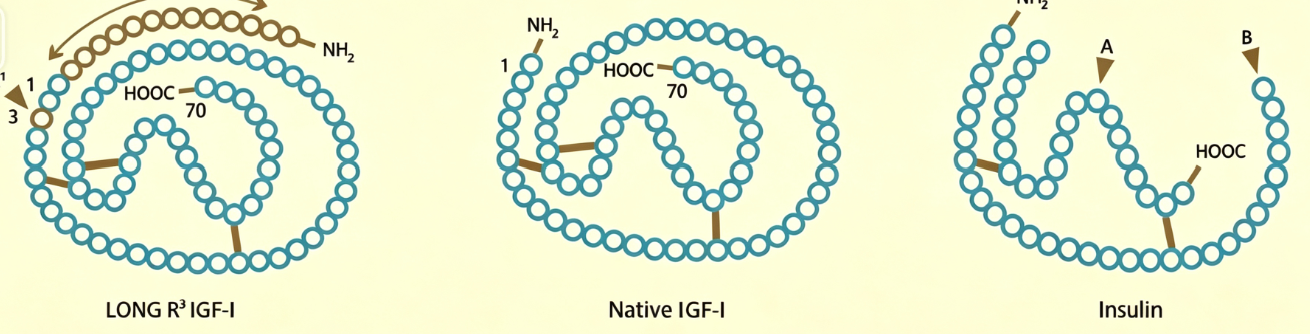
2. Design Concept and Inhibitory Mechanism of IGF-I Peptide Analogs.
Given the central role of IGF-IR in cell growth regulation, researchers have designed and synthesized various peptide analogs of IGF-I using computational chemistry techniques. These analogs share structural homology with natural IGF-I but feature substitutions or modifications at key amino acid residues, enabling them to bind to IGF-IR without activating the receptor—functioning as antagonists. The core mechanism lies in their competitive binding to the ligand-binding domain of IGF-IR, occupying receptor sites and thereby blocking the autophosphorylation process induced by natural IGF-I. Since receptor autophosphorylation is the initial and essential step for downstream signal transduction, inhibiting this process effectively disrupts the activation of the entire IGF-I signaling pathway. Studies have confirmed that these designed peptide analogs can indeed inhibit IGF-I receptor autophosphorylation effectively.
3. Inhibitory Effects of Peptide Analogs on Tumor Cell Proliferation.
After confirming the inhibitory effects of peptide analogs on receptor autophosphorylation, researchers further evaluated their biological functions at the cellular level. Experimental data demonstrated that these IGF-I peptide analogs could effectively inhibit the growth of various cell types, including prostate cancer cells and SV40-transformed cells. The development and progression of prostate cancer are closely linked to abnormal activation of the IGF signaling axis, with multiple studies confirming the critical role of IGF-I in prostate cancer progression, metastasis, and castration resistance. SV40-transformed cells represent a malignant transformation model induced by viral oncogenes. The observed growth-inhibitory effects in these two cell types suggest that the anti-proliferative activity of IGF-I peptide analogs is broad-spectrum, not limited to a single cell type or specific oncogenic mechanism. Additionally, peptide analogs with D-amino acid configurations exhibited significant resistance to degradation by serum proteases, enhancing their stability and half-life for in vivo applications.
4. Application Prospects and Significance of IGF-I Peptide Analogs.
Integrating the mechanistic validation and functional data, IGF-I peptide analogs demonstrate dual application value. First, as molecular probes for studying the structure-function relationship of the IGF-I signaling pathway, they can be used to dissect the fine mechanisms of receptor activation, autophosphorylation, and interactions with downstream effectors. Second, given their ability to inhibit abnormal cell growth in vitro, these analogs hold potential as novel clinical strategies for controlling tumor cell proliferation. Interventions targeting the IGF-I/IGF-IR axis—including small-molecule inhibitors, monoclonal antibodies, and peptide antagonists—have been extensively explored in preclinical and clinical studies for various solid tumors. Peptide antagonists, with their high selectivity, low off-target effects, and tunable pharmacokinetic properties, offer unique advantages in specific applications.
5. Conclusion.
The IGF-I/IGF-IR signaling axis plays a pivotal role in both normal cell growth regulation and tumorigenesis. IGF-I peptide analogs, designed through computational chemistry, competitively bind to the receptor and inhibit autophosphorylation, successfully disrupting abnormal activation of this signaling pathway. Their anti-proliferative activity has been validated in prostate cancer cells and SV40-transformed cells. This strategy not only provides an effective research tool for elucidating the molecular mechanisms of IGF-I signal transduction but also offers promising insights for developing novel IGF-IR-targeted tumor therapies. IGF-I protein products serve as essential materials for related basic research and drug development. To meet the needs of IGF-I signaling pathway research and drug screening, U-Pharm offers IGF-I Protein, Rat, suitable for applications such as cell proliferation assays, receptor binding analysis, and signaling pathway mechanism studies. This product serves as a valuable tool for investigating IGF-I/IGF-IR interactions and evaluating the competitive efficiency of peptide analogs or small-molecule inhibitors (e.g., PQ401, an IGF-1R autophosphorylation inhibitor).
Disclaimer: This article partially utilizes artificial intelligence assistance in its creation. If any content involves copyright or intellectual property issues, please let us know and we promise to verify and remove it as soon as possible.
Purchase recombinant protein, choose Nanjing UA-Bio
UA protein focuses on providing various protein reagents, raw materials, and services required for drug research and development, cell therapy, gene therapy, and basic scientific research, including drug target proteins, immune checkpoint proteins, cytokines, tool enzymes, customized protein expression, and full-length transmembrane protein development. Youai is committed to providing customers with high-quality products and professional services, and building a high-tech enterprise with international competitiveness.
Target proteins | membrane proteins | cytokines | enzymes | viral antigens | protein customization
Nanjing UA Biotechnology Co., Ltd. Email:order@ua-bio.com Phone:0571-87565022

Product Information

Link:





©2021-2026 all rights reserved UA Biotechnology Co.,Ltd.

网站备案号 浙ICP备2022019033号-2 浙公网安备33010202004867号
 Business license (three certificates in one)
 Tel:+86-0571-87565022
E-mail:order@ua-bio.com
All products sold on this website shall not be used for clinical diagnosis or treatment of humans or animals, and shall only be used for non-medical purposes such as industrial or scientific research.
