

Structural characteristics, biological functions, and activity detection methods of human Noggin protein
Views:4 


The biological significance of Noggin as a key antagonist in the BMP signaling pathway.
- Recent Advances
- Product Information
Recent Advances
Structural Features, Biological Functions, and Activity Detection Methods of Human Noggin Protein
Noggin's Biological Role as a Key Antagonist of the BMP Signaling Pathway.
Bone Morphogenetic Proteins (BMPs) belong to the Transforming Growth Factor-β (TGF-β) superfamily and play multifaceted roles in embryonic development, organ formation, bone homeostasis maintenance, and tumorigenesis. The precise regulation of the BMP signaling pathway relies on a series of extracellular antagonists, among which Noggin protein is one of the most representative negative regulators. Noggin binds to BMP molecules with high affinity, blocking their interaction with receptors, thereby playing an indispensable role in fields such as organoid culture, neural development, and bone metabolism research. Therefore, the preparation of highly active, structurally homogeneous recombinant human Noggin protein and the establishment of reliable activity detection methods hold significant tool value for both basic research and translational medicine.
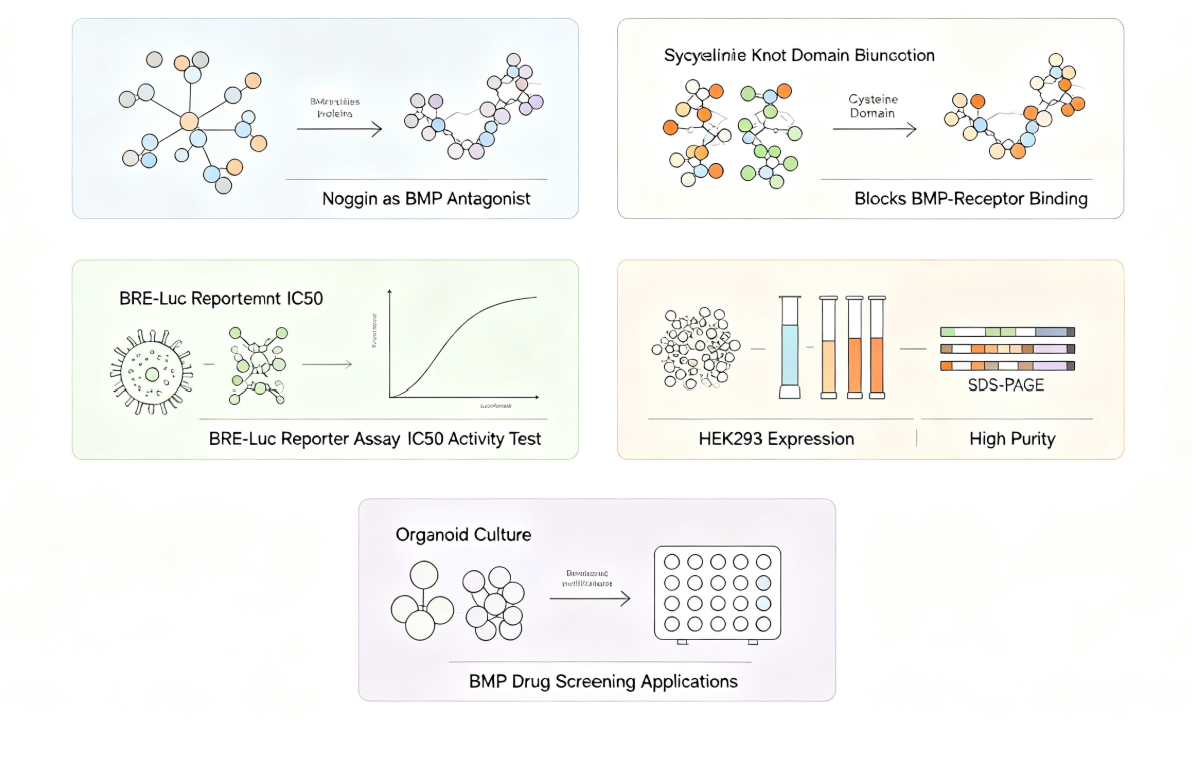
Molecular Structure and Mechanism of Noggin Protein.
Human Noggin protein is encoded by the NOG gene, with its core functional domain located in the C-terminal region, containing a conserved cysteine knot-like structure. This domain endows Noggin with high-affinity binding capability to BMP ligands (particularly BMP-2, BMP-4, and BMP-7). At the molecular level, Noggin forms a Noggin-BMP complex, specifically blocking the binding of BMP molecules to their cell surface receptors. Specifically, Noggin can simultaneously occlude the binding sites of BMP with both Type I receptors (including Alk1, Alk2, Alk3, and Alk6) and Type II receptors (including BMPR2, ActRIIa, and ActRIIb), effectively inhibiting the transmission of BMP signals into the cell. This antagonistic role holds critical physiological significance in processes such as neural plate formation during embryogenesis, mesoderm induction, and postnatal bone remodeling.
Activation Modes of the BMP Signaling Pathway and Detection Principles.
The BMP signaling pathway primarily exerts biological effects through two pathways: the canonical Smad-dependent pathway and the MAPK-mediated non-canonical pathway. In the canonical pathway, after BMP ligands bind to receptors, they activate the serine/threonine kinase activity of the intracellular segment of the receptors, subsequently phosphorylating downstream receptor-regulated Smad proteins (R-Smads, including Smad1, Smad5, and Smad8). Phosphorylated R-Smads form a complex with the common Smad4, translocate into the nucleus, and initiate the transcription of target genes. The Id1 gene is a classic downstream responsive gene of the BMP pathway, and its promoter region contains Smad-binding elements that directly reflect the activation level of the pathway. Based on this principle, researchers constructed the Id1 promoter sequence upstream of a luciferase reporter gene, forming the BRE-Luc reporter gene system. After stable transfection into cells, when the BMP pathway is activated, the expression level of luciferase is positively correlated with pathway activity, enabling high-sensitivity quantification through bioluminescence detection.
Functional Detection Strategies for Noggin Protein Activity.
The biological activity detection of Noggin protein primarily relies on the aforementioned BRE-Luc reporter gene system. The core design is as follows: in a cell line stably transfected with the BRE-Luc reporter gene, exogenous addition of BMP ligands (typically BMP-2 or BMP-4) can significantly induce luciferase expression, producing high-intensity luminescence signals. When Noggin protein is added to this system, due to its neutralizing effect on BMP, the BMP-induced luciferase activity will be dose-dependently inhibited. By plotting a standard curve of Noggin concentration versus inhibition rate, the half-maximal inhibitory concentration can be precisely calculated, enabling quantitative quality control of the biological activity of each batch of recombinant Noggin protein. This detection system exhibits high specificity, with experimental confirmation showing no cross-reactivity with other TGF-β superfamily members such as TGF-β, ensuring the reliability of the results.
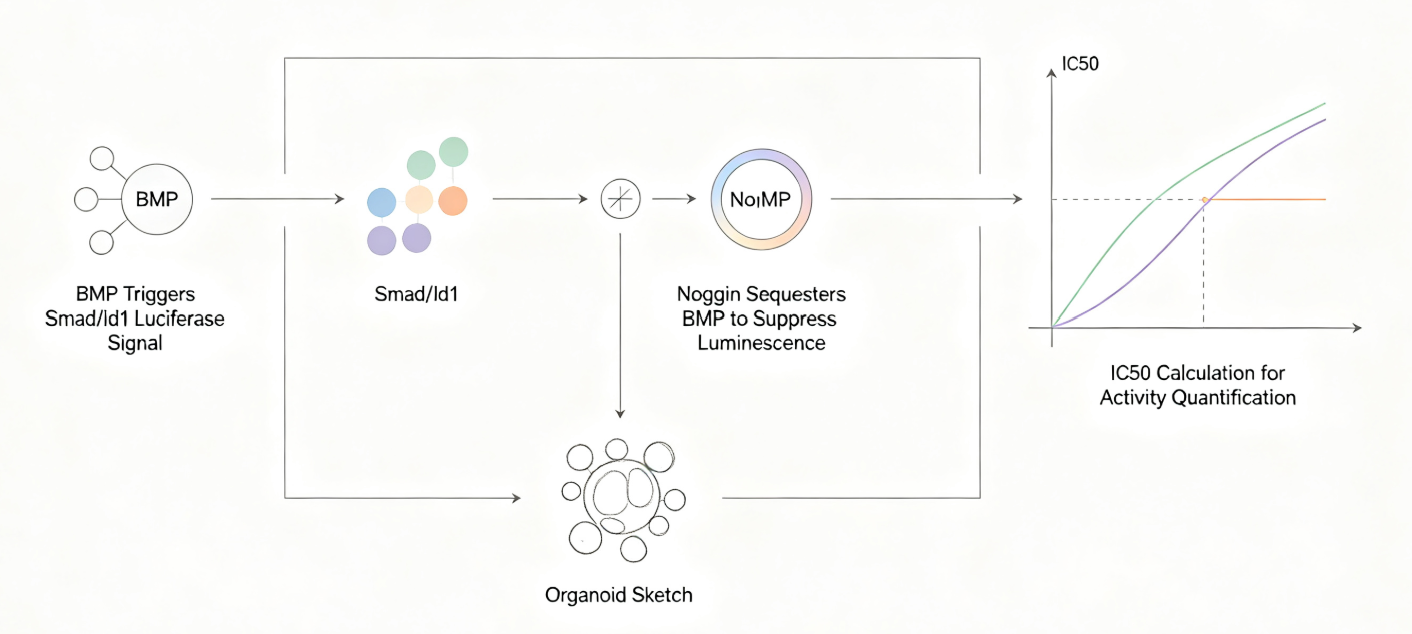
Core Applications of Recombinant Noggin Protein in Organoid Culture.
Organoid culture technology is a major breakthrough in the field of in vitro models in recent years, and Noggin is an essential core additive for the long-term maintenance of various organoids. In culture systems for liver, small intestine, and fallopian tube organoids, Noggin inhibits BMP signaling, synergizing with the Wnt pathway to activate the proliferative potential of stem cells and maintain the balance between self-renewal and differentiation in organoids. Due to the long culture cycles of organoids and the high demand for batch stability of growth factors, quality control of Noggin protein activity before entering the culture system becomes a critical prerequisite for experimental success. Using the BRE-Luc reporter gene method to validate the activity of each batch of Noggin protein can effectively prevent organoid growth abnormalities or phenotypic drift caused by variations in protein activity.
Physicochemical Properties and Quality Control Indicators of the Protein.
Recombinant human Noggin protein is typically produced using mammalian expression systems (such as HEK293 cells) to ensure proper glycosylation modifications and folding conformation. In sequence design, an Fc fragment can be fused to extend in vivo half-life and facilitate affinity purification. After two-step purification via Protein A affinity chromatography and size-exclusion chromatography, the purity of the target protein should exceed 95% as verified by SDS-PAGE and SEC-HPLC. Endotoxin levels, as detected by the Limulus amebocyte lysate (LAL) assay, must be below 1.0 EU/μg to meet the stringent requirements of cell culture and in vivo experiments. Activity quality control employs the aforementioned BRE-Luc reporter gene system, with each batch of product required to provide a clear half-maximal inhibitory concentration value and its relative activity percentage compared to a reference standard.
Translational Application Prospects.
In summary, as a key antagonist of the BMP signaling pathway, the activity detection of human Noggin protein relies on the precise quantification provided by the BRE-Luc reporter gene system. This detection method not only offers a high-throughput platform for screening BMP pathway-related drugs (agonists or antagonists) but also establishes a standardized process for batch quality control of Noggin protein used in organoid culture. High-quality recombinant Noggin protein serves as a fundamental tool supporting the aforementioned research, with broad application potential in developmental biology, stem cell research, bone metabolic diseases, and tumor microenvironment exploration. Currently, U-ACT has launched the corresponding product—Noggin Protein, Human. This product is expressed in HEK293 cells, purified via Fc affinity, and rigorously validated for activity using the BRE-Luc reporter gene method, meeting the stringent requirements for protein activity and purity in organoid culture and BMP pathway research.
Disclaimer: This article partially utilizes artificial intelligence assistance in its creation. If any content involves copyright or intellectual property issues, please let us know and we promise to verify and remove it as soon as possible.
Purchase recombinant protein, choose Nanjing UA-Bio
UA protein focuses on providing various protein reagents, raw materials, and services required for drug research and development, cell therapy, gene therapy, and basic scientific research, including drug target proteins, immune checkpoint proteins, cytokines, tool enzymes, customized protein expression, and full-length transmembrane protein development. Youai is committed to providing customers with high-quality products and professional services, and building a high-tech enterprise with international competitiveness.
Target proteins | membrane proteins | cytokines | enzymes | viral antigens | protein customization
Nanjing UA Biotechnology Co., Ltd. Email:order@ua-bio.com Phone:0571-87565022

Product Information

Link:





©2021-2026 all rights reserved UA Biotechnology Co.,Ltd.

网站备案号 浙ICP备2022019033号-2 浙公网安备33010202004867号
 Business license (three certificates in one)
 Tel:+86-0571-87565022
E-mail:order@ua-bio.com
All products sold on this website shall not be used for clinical diagnosis or treatment of humans or animals, and shall only be used for non-medical purposes such as industrial or scientific research.
