

Abelacimab: A Novel Anti-Factor XI Anticoagulation Strategy and Advances in Clinical Research
Views:7 


Unmet clinical needs in anticoagulation therapy and the target value of coagulation factor XI.
- Recent Advances
- Product Information
Recent Advances
Abelacimab: A Novel Anti-Coagulation Strategy Targeting Factor XI and Its Clinical Research Progress
Unmet Clinical Needs in Anti-Coagulation Therapy and the Target Value of Factor XI
The advent of direct oral anti-coagulants has revolutionized the treatment of thromboembolic diseases, but their clinical application still faces limitations such as increased risk of gastrointestinal bleeding and contraindications in patients with mechanical heart valves. Therefore, developing new drugs that combine potent anti-coagulation with a low bleeding risk has become an important research direction in cardiovascular medicine. Factor XI is increasingly recognized as a promising target for anti-coagulation therapy due to its critical role in pathological thrombosis while having minimal impact on normal hemostasis. Epidemiological studies show that patients with congenital Factor XI deficiency have a significantly lower risk of venous thromboembolism and ischemic stroke compared to the general population, with rare spontaneous bleeding. This suggests that targeting Factor XI may achieve a dissociation between anti-coagulation efficacy and bleeding risk.
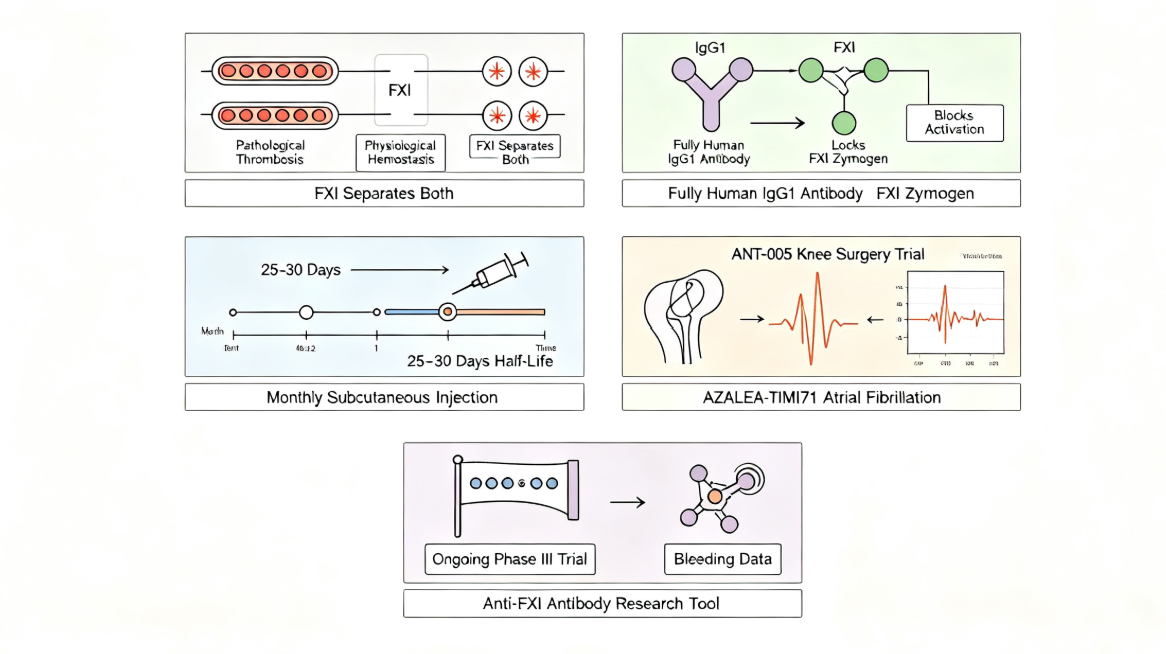
Molecular Design and Mechanism of Action of Abelacimab
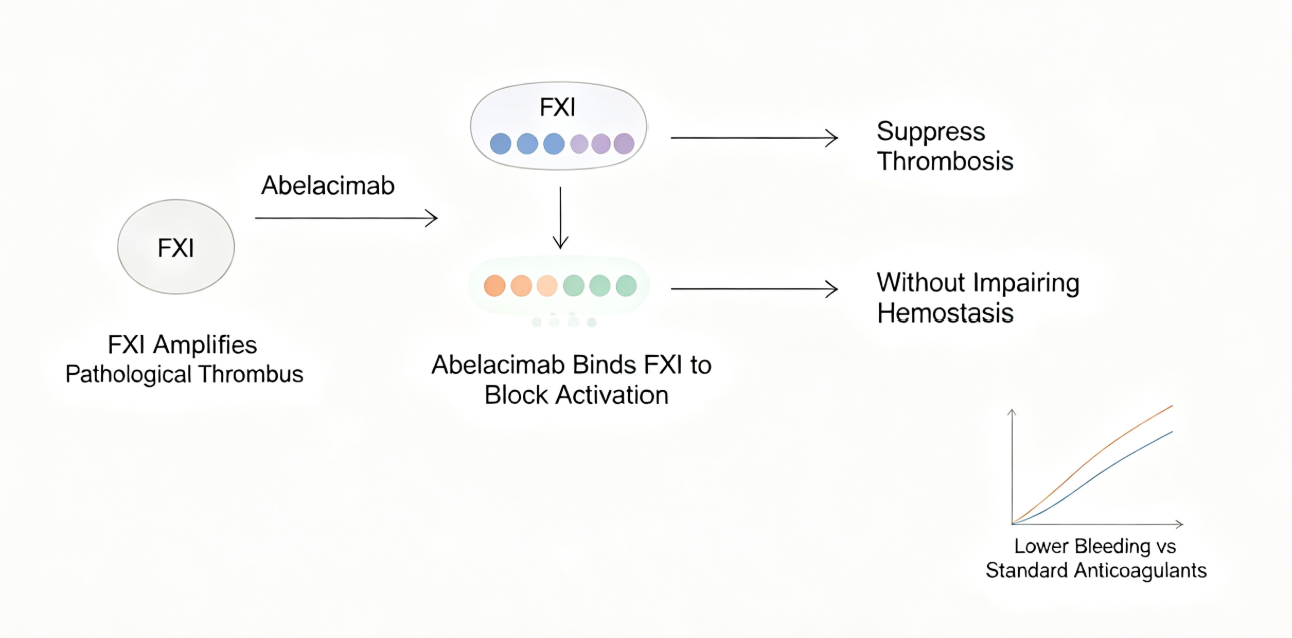
Abelacimab is a fully human monoclonal antibody (immunoglobulin G1 subtype) that targets Factor XI and its activated form, Factor XIa. The antibody binds with high affinity (dissociation constant Kd in the picomolar range) to the catalytic domain of Factor XI via its antigen-binding fragment, locking Factor XI in its zymogen (inactive precursor) conformation. This unique binding mode allows Abelacimab to simultaneously block both the activation of circulating Factor XI by Factor XIIa or thrombin and the activity of existing Factor XIa.
Pathophysiological Role of Factor XI in the Coagulation Cascade
In the classical coagulation cascade model, the tissue factor pathway (extrinsic pathway) initiates physiological hemostasis, while the contact activation pathway (intrinsic pathway) plays a key role in pathological thrombosis. Factor XI lies at the intersection of these two pathways: it can be activated by Factor XIIa or thrombin through a positive feedback loop. Importantly, the tissue factor pathway, which is essential for physiological hemostasis, can largely operate independently of Factor XI, explaining why inhibiting Factor XI has minimal effects on hemostasis. In the thrombotic microenvironment, Factor XI amplifies thrombin generation by activating Factor IX, promoting fibrin network stabilization and thrombus extension. Therefore, targeting Factor XI selectively inhibits pathological thrombus expansion while preserving tissue factor-mediated primary hemostasis.
Pharmacokinetic Characteristics and Dosing Advantages
Abelacimab's pharmacokinetic profile supports a convenient dosing regimen. In healthy volunteers, peak plasma concentrations are achieved approximately 1.75 to 2 hours after intravenous infusion, with an elimination half-life of 25 to 30 days. The antibody is metabolized primarily through reticuloendothelial system endocytosis and proteolytic degradation, independent of cytochrome P450 enzymes, hepatocyte uptake, or biliary excretion. This results in a lower risk of drug-drug interactions compared to traditional anti-coagulants metabolized by the liver or kidneys. Study data indicate dose-proportional increases in the area under the concentration-time curve within the 30 to 150 mg dose range. Notably, obese subjects (body mass index ≥35 kg/m²) may exhibit 30% to 45% lower initial concentrations and area under the curve, likely due to increased volume of distribution. Given its long half-life, Abelacimab supports once-monthly subcutaneous administration, potentially improving long-term patient adherence.
Clinical Evidence for Venous Thromboembolism Prevention: ANT-005 Trial
In a phase 2, prospective, randomized, parallel-group trial involving patients undergoing total knee arthroplasty, researchers compared the efficacy and safety of a single post-operative intravenous infusion of Abelacimab (30 mg, 75 mg, or 150 mg) with once-daily subcutaneous enoxaparin (40 mg). The primary efficacy outcome was venous thromboembolism confirmed by mandatory unilateral ascending venography between days 8 and 12 post-operation. Results showed venous thromboembolism rates of 13% (13/102), 5% (5/99), 4% (4/98), and 22% (22/101) in the 30 mg, 75 mg, and 150 mg Abelacimab groups and the enoxaparin group, respectively. All three Abelacimab regimens met non-inferiority criteria compared to enoxaparin; the 75 mg and 150 mg regimens demonstrated statistically significant superiority (P<0.001). Regarding safety, clinically relevant bleeding (major or clinically relevant non-major bleeding) rates up to day 30 post-operation were low: 2% in both the 30 mg and 75 mg Abelacimab groups, and 0% in the 150 mg and enoxaparin groups. The trial concluded that Factor XI plays a significant role in post-operative venous thromboembolism, and a single post-operative dose of Abelacimab effectively prevents venous thromboembolism after total knee arthroplasty with a low bleeding risk.
Safety Validation in Atrial Fibrillation Patients: AZALEA-TIMI 71 Trial
The AZALEA-TIMI 71 trial further validated the safety advantages of Abelacimab in atrial fibrillation patients. This phase 2 randomized trial enrolled 1,287 patients with moderate-to-high stroke risk, who received either once-monthly subcutaneous Abelacimab (150 mg or 90 mg) or once-daily oral rivaroxaban (20 mg). The trial was terminated early on the recommendation of an independent data monitoring committee due to an unexpectedly large reduction in bleeding events in the Abelacimab groups. The primary safety endpoint was the incidence of major or clinically relevant non-major bleeding: 3.2 events per 100 person-years in the 150 mg Abelacimab group, 2.6 events per 100 person-years in the 90 mg group, and 8.4 events per 100 person-years in the rivaroxaban group (hazard ratios of 0.38 and 0.31, respectively, compared to rivaroxaban, P<0.001). Abelacimab treatment reduced free Factor XI levels by over 97%. In exploratory endpoints, the major gastrointestinal bleeding rate was 4.2% in the rivaroxaban group compared to 0.5% in both Abelacimab groups, representing an 89% reduction.
Research Prospects
Abelacimab, a fully human monoclonal antibody targeting Factor XI/XIa, achieves a unique pharmacological effect by locking Factor XI in its zymogen conformation and inhibiting its activation, selectively suppressing pathological thrombus expansion while preserving physiological hemostasis. Clinical data in post-total knee arthroplasty venous thromboembolism prevention and anti-coagulation therapy for atrial fibrillation patients demonstrate its favorable efficacy and superior safety profile compared to existing standard anti-coagulation treatments. Currently, phase III clinical trials for broader indications such as acute pulmonary embolism are underway. To support research on the anti-human Factor XI monoclonal antibody (Abelacimab), U-Trust has introduced a recombinant protein product—Anti-Human F11Factor XI Monoclonal Antibody (Abelacimab)—for binding activity analysis and functional studies related to this target.
Disclaimer: This article partially utilizes artificial intelligence assistance in its creation. If any content involves copyright or intellectual property issues, please let us know and we promise to verify and remove it as soon as possible.
Purchase recombinant protein, choose Nanjing UA-Bio
UA protein focuses on providing various protein reagents, raw materials, and services required for drug research and development, cell therapy, gene therapy, and basic scientific research, including drug target proteins, immune checkpoint proteins, cytokines, tool enzymes, customized protein expression, and full-length transmembrane protein development. Youai is committed to providing customers with high-quality products and professional services, and building a high-tech enterprise with international competitiveness.
Target proteins | membrane proteins | cytokines | enzymes | viral antigens | protein customization
Nanjing UA Biotechnology Co., Ltd. Email:order@ua-bio.com Phone:0571-87565022

Product Information

Link:





©2021-2026 all rights reserved UA Biotechnology Co.,Ltd.

网站备案号 浙ICP备2022019033号-2 浙公网安备33010202004867号
 Business license (three certificates in one)
 Tel:+86-0571-87565022
E-mail:order@ua-bio.com
All products sold on this website shall not be used for clinical diagnosis or treatment of humans or animals, and shall only be used for non-medical purposes such as industrial or scientific research.
