Human CRBN/DDB1 Complex GST-Tagged Protein Facilitates the Elucidation of Bidirectional Substrate Regulation Mechanisms of Immunomodulatory Drugs
I. The Chemical Renaissance of Thalidomide and the Research Value of CRBN/DDB1 Complex.
Since its introduction in the 1950s as a sedative for pregnant women, thalidomide has been associated with severe clinical drug safety incidents, causing severe limb deformities in tens of thousands of newborns. However, with the in-depth development of chemical biology and molecular medicine, thalidomide and its newer derivatives, lenalidomide and pomalidomide (collectively known as immunomodulatory drugs, IMiDs), have demonstrated remarkable immunomodulatory and antitumor activities, establishing a core position in the clinical treatment of multiple myeloma and 5q deletion-type myelodysplastic syndromes. Recent studies have shown that IMiDs specifically target the CUL4-RBX1-DDB1-CRBN ubiquitin ligase complex and induce the ubiquitination and degradation of transcription factors Ikaros and Aiolos. Although CRBN expression has been confirmed as a core determinant of the antiproliferative effects of IMiDs, how IMiDs binding reshapes the biological activity of the complex at the molecular scale and the identity of the endogenous substrates of the complex have long remained unresolved. To this end, the corresponding author team published groundbreaking findings in Nature titled Structure of the DDB1-CRBN E3 ubiquitin ligase in complex with thalidomide, bringing breakthrough insights to this field.
II. Research Objectives and Scientific Questions.
The study aimed to systematically elucidate the three-dimensional spatial structure of the DDB1-CRBN complex in the presence of thalidomide, lenalidomide, and pomalidomide through high-resolution structural biology methods, thereby identifying the stereoselective binding pockets of IMiDs and key structure-activity relationship interaction sites at the atomic level. Simultaneously, the study sought to identify unknown endogenous physiological substrates of CRBN through unbiased proteome-wide screening, deeply exploring the chemical biology mechanisms by which small-molecule drug binding blocks endogenous substrate recruitment or recruits "new substrates." This series of answers provides a new paradigm for the design of small-molecule regulators of ubiquitin ligases. The resolution of these questions holds significant implications for understanding the dual pharmacological effects of IMiDs and guiding the development of next-generation targeted protein degradation drugs.
III. Overall Crystal Structure Analysis of the DDB1-CRBN Chimeric Complex.
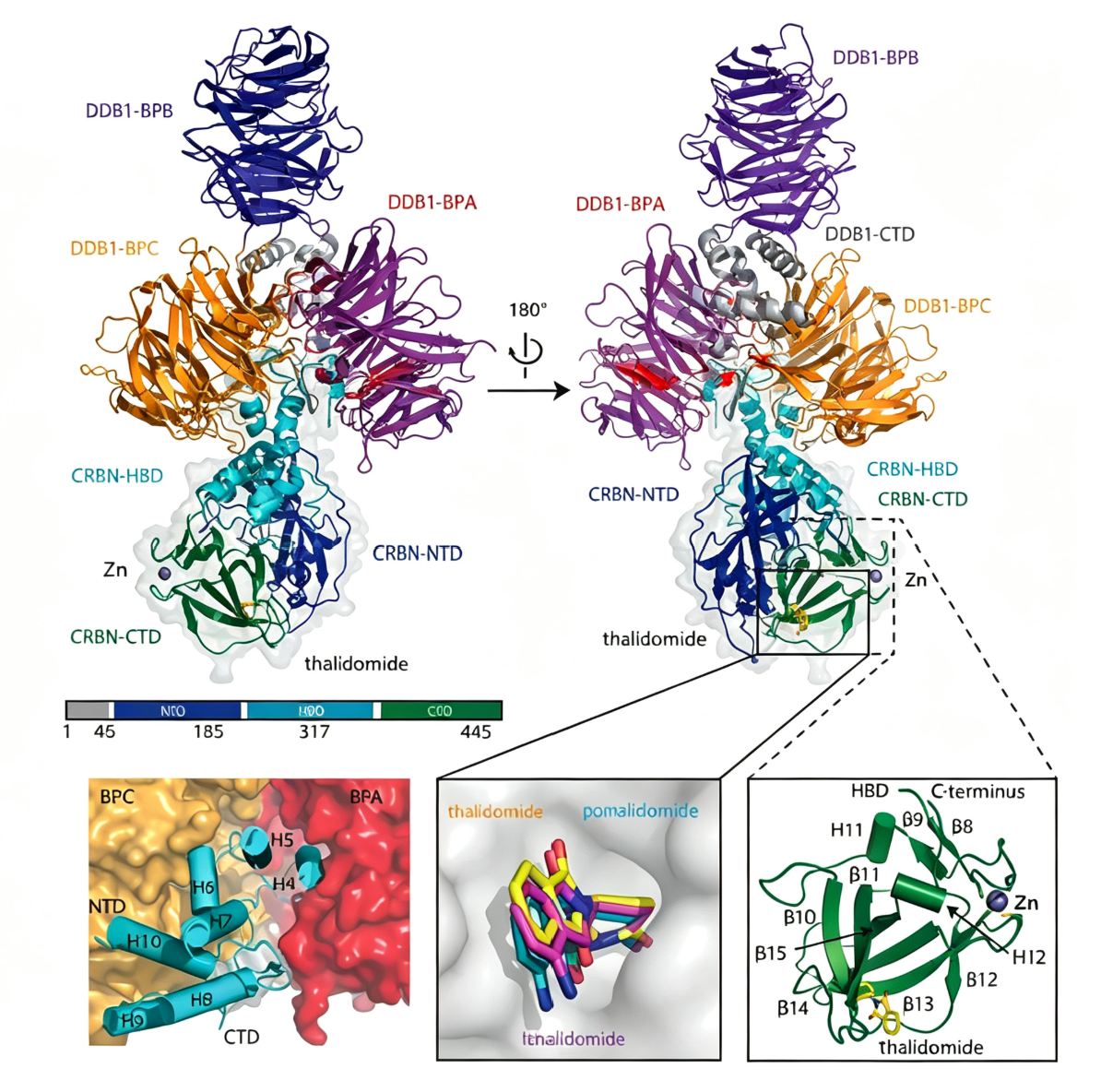
The research team successfully resolved the crystal structures of the chimeric complex formed by human DDB1 and chicken CRBN bound to thalidomide, lenalidomide, and pomalidomide, respectively. Due to the high sequence conservation between chicken and human CRBN, this structure directly reveals the binding mode of the human complex. ggCRBN primarily consists of three subdomains: an N-terminal domain containing seven β-strands, a 7-α-helix bundle domain involved in DDB1 binding, and a C-terminal domain containing eight β-strands and accommodating the thalidomide-binding pocket. DDB1 exhibits a typical triangular trimeric WD40 β-propeller structure, with ggCRBN tightly anchored in the groove between the BPA and BPC propellers of DDB1 through its HBD domain. The resolution of this overall architecture lays the structural foundation for subsequent studies on molecular interaction mechanisms.
IV. Structure-Activity Relationships and Molecular Interactions of Immunomodulatory Drugs Binding to the CRBN-CTD Pocket.
Further analysis revealed that thalidomide, lenalidomide, and pomalidomide all stereoselectively bind to a highly conserved groove on the surface of ggCRBN-CTD. The α-azaglutamine side chains of these three ligands overlap significantly, constituting the primary pharmacophore. The glutamine ring is deeply embedded in a hydrophobic cleft formed by β10 and β13, with the carbonyl and amide nitrogen of glutamine forming critical hydrogen bond networks with His380 and Trp382, respectively. The aliphatic side of the glutamine ring also forms tight van der Waals contacts with a hydrophobic cage formed by Trp382, Trp388, Trp402, and Phe404. Under these stringent stereochemical constraints, the CRBN pocket exhibits a clear affinity preference for (S)-thalidomide while being unable to accommodate the (R)-enantiomer. These atomic-level interaction details provide direct structural evidence for understanding the chiral recognition mechanism of IMiDs.
V. Regional Dynamics of CRBN as a Ligase Substrate Receptor and Specificity Analysis of Ikaros Degradation.
CRBN functions as a substrate receptor in the CRL4 complex. Despite lacking the classical WD40 fold, its spatial occupancy characteristics are entirely consistent with those of classical substrate receptors. Combined motion models indicate that the free Brownian rotational movement of the CUL4 bridge on the DDB1 axis defines a vast ubiquitination region in space. Under this mechanism, dual-luciferase reporter assays revealed that while all three drugs exhibit similar affinity for CRBN, lenalidomide and pomalidomide, with their solvent-exposed aniline functional groups at the C4 position of the phthalimide ring, more efficiently promote Ikaros protein degradation. Conversely, excessively large modifications at this position significantly interfere with interactions with new substrates. This discovery unveils the structural basis of C4-position modifications as key effectors of molecular glue.
VI. Protein Microarray Screening Identifies the Endogenous Physiological Substrate MEIS2.
To identify previously unknown endogenous CRBN substrates, researchers conducted high-throughput human protein microarray ubiquitination screening. Through multiple rounds of cluster analysis and intracellular homeostasis level validation, the transcription factor MEIS2 was confirmed as a novel endogenous physiological substrate. In vitro recombinant systems, MEIS2 could be efficiently ubiquitinated by the CRL4-CRBN complex, and this ubiquitination modification could be directly blocked by IMiDs such as thalidomide and lenalidomide in a dose-dependent manner. In SK-N-DZ and M059J cells, cycloheximide chase experiments and siRNA knockdown experiments further confirmed that the addition of lenalidomide or thalidomide significantly increased and stabilized endogenous MEIS2 protein levels. This marks the identity of MEIS2 as an endogenous CRBN substrate, rigorously validated by multiple orthogonal methods.
VII. The Dual Regulatory Mechanism of Thalidomide as Both an Agonist and Antagonist.
Based on the aforementioned crystal structures and biochemical data, the research team proposed a bidirectional molecular model of IMiDs regulating CRL4-CRBN activity. In the absence of drug binding, the substrate receptor CRBN directly recruits its endogenous substrates, such as MEIS2, in specific spatial conformations and mediates their ubiquitination and degradation. When small-molecule drugs such as thalidomide or lenalidomide bind to the classical binding site of CRBN-CTD, the binding of endogenous substrates like MEIS2 is completely antagonized and prevented due to steric repulsion, leading to abnormal accumulation of MEIS2 protein in cells. Simultaneously, specific functional groups exposed outside the drug pocket act as molecular glue, synergizing with the surrounding residue surfaces of CRBN to create a novel binding interface, thereby specifically "agonizing" and recruiting new substrates like Ikaros/Aiolos for degradation. This bidirectional model defines IMiDs as "substrate remodelers" with both agonist and antagonist properties.
VIII. Conclusion and Outlook: Profound Implications for Targeted Protein Degradation Drug Development.
The study successfully elucidated the atomic-resolution structure of the DDB1-CRBN ubiquitin ligase complex in the presence of IMiDs, providing the first structural biology evidence for the chemical biology mechanism of thalidomide and its derivatives as "substrate remodelers." The study not only indicated that thalidomide-mediated teratogenicity and antitumor effects may stem from the complex bidirectional regulation between endogenous substrate stabilization and new substrate ubiquitination and degradation but, more crucially, this "antagonize endogenous substrates, recruit heterologous new substrates" molecular glue model lays a solid scientific foundation for the rational design of subsequent targeted protein degradation technologies, novel PROTACs, and molecular glue drugs. As a key experimental tool, human CRBN/DDB1 complex GST-tagged protein plays an indispensable role in protein interaction studies, antibody screening, and enzyme activity detection, and will continue to facilitate in-depth exploration in this field.
Nanjing YouAi Biotechnology Co., Ltd. provides human CRBN/DDB1 complex-related protein products. This product is Biotinylated CRBN/DDB1 Protein with a GST tag, suitable for immunomodulatory drug mechanism studies, CRBN-DDB1 interaction analysis, ubiquitination detection, and small-molecule screening experiments. This protein product undergoes rigorous quality control, offering high purity and activity, and serves as a reliable experimental tool for targeted protein degradation and molecular glue drug development.










 Business license (three certificates in one)