

Mouse-derived NNMT His-tagged protein aids in revealing the dual pathways of metabolic regulation in alcoholic liver disease
Views:9 


The Severe Challenge of Alcoholic Liver Disease and the Research Value of NNMT.
- Recent Advances
- Product Information
Recent Advances
Mouse-Derived NNMT His-Tagged Protein Reveals Dual Metabolic Regulation Pathways in Alcoholic Liver Disease
I. The Severe Challenge of Alcoholic Liver Disease and the Research Value of NNMT
Fatty liver disease, a common pathological condition caused by abnormal fat accumulation in hepatocytes, has become a significant global public health concern. Among its various types, alcoholic liver disease and its associated metabolic disorders are particularly prominent, with rising incidence rates and a trend toward younger onset, posing a heavy burden on clinical prevention and treatment. In recent years, nicotinamide N-methyltransferase (NNMT) has emerged as a key player in metabolic regulation. Highly expressed in metabolically active tissues such as the liver and adipose, NNMT catalyzes the methylation and degradation of nicotinamide, deeply participating in the regulation of energy homeostasis and metabolic reprogramming. However, the specific roles and molecular mechanisms of NNMT and its catalytic products in alcoholic liver injury remain largely unexplored, necessitating further in-depth research.
II. Changes in NNMT Expression and Metabolites in Alcoholic Liver Injury Models
During the pathological progression of alcoholic liver injury, the hepatic metabolic network undergoes significant remodeling. Studies have found that in chronic alcohol-fed animal models, the expression levels and enzymatic activity of NNMT in the liver are abnormally activated, leading to a marked increase in the production of its catalytic product, 1-methylnicotinamide (1-MNA). As a key metabolite in the NNMT-mediated nicotinamide degradation pathway, the accumulation of 1-MNA not only reflects changes in NNMT activity but may also act as an effector molecule in the complex regulatory network of hepatocyte injury and repair. This discovery suggests that the NNMT/1-MNA metabolic axis may play a dual role in the development of alcoholic liver disease, warranting systematic evaluation from multiple dimensions.
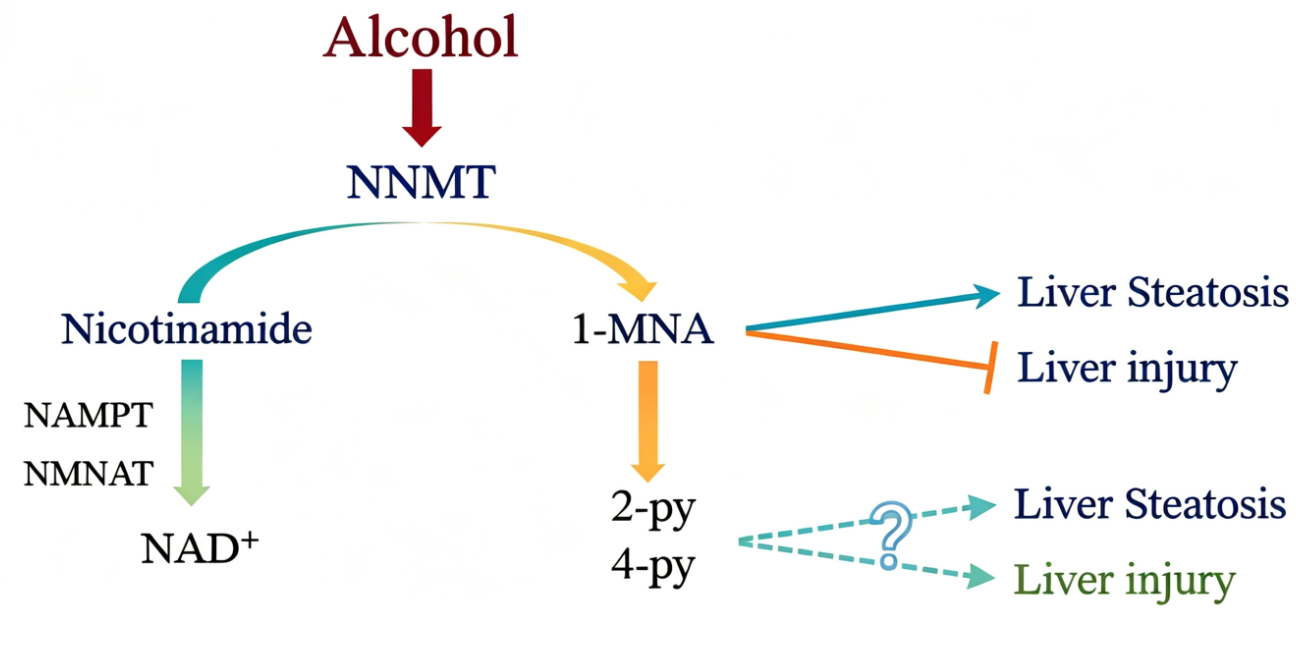
III. Differential Effects of NNMT Overexpression and 1-MNA Supplementation on Hepatic Lipid Metabolism
To investigate the role of NNMT in alcoholic liver disease, researchers systematically analyzed NNMT gene overexpression mouse models and metabolite supplementation experiments. The results revealed a striking phenomenon: under chronic alcohol exposure, either NNMT overexpression or direct supplementation of its product 1-MNA significantly exacerbated hepatic triglyceride (TG) deposition, indicating that this metabolic pathway may promote the worsening of hepatic steatosis. However, in stark contrast to its negative effects on TG accumulation, 1-MNA supplementation unexpectedly alleviated alcohol-induced hepatocyte injury. Specifically, serum levels of alanine aminotransferase (ALT) and aspartate aminotransferase (AST)—specific markers of liver damage—were significantly reduced, and the activation of the apoptotic executioner protein caspase-3 in hepatocytes was markedly inhibited.
IV. Dual Regulatory Roles of NNMT in Hepatic Steatosis and Hepatocyte Toxicity
These results clearly demonstrate that alcohol-induced NNMT activation in the liver exerts distinct regulatory effects on lipid metabolism and cell survival: on one hand, it promotes abnormal TG accumulation and exacerbates steatosis through its product 1-MNA; on the other hand, 1-MNA independently exerts hepatoprotective effects, effectively mitigating alcohol-induced cytotoxic injury and apoptosis. This bidirectional effect was further validated in NNMT systemic overexpression mouse models, confirming that NNMT activation significantly improves the parenchymal liver damage caused by chronic alcohol intake. This finding challenges the traditional view of metabolite functionality as singular, revealing the complex regulatory patterns of the same metabolic enzyme across different pathological dimensions.
V. Mechanisms and Biological Significance of the NNMT/1-MNA Signaling Axis
Integrating the research evidence, it can be inferred that hepatic NNMT-catalyzed nicotinamide degradation product 1-MNA plays a "double-edged sword" role in alcoholic liver disease. Its mechanism of exacerbating steatosis may involve interference with hepatic fatty acid oxidation, de novo lipogenesis, or lipoprotein secretion, while its anti-apoptotic and injury-alleviating effects may be related to the activation of specific cellular signaling pathways. This "decoupled" regulatory mode suggests that in the pathological context of alcoholic liver injury, changes in NNMT metabolic flux and its product accumulation can independently regulate metabolic disorders and cell damage repair processes through different targets or signaling networks. This provides a new perspective for understanding the complex pathogenesis of alcoholic liver disease and poses greater challenges for developing therapeutic strategies targeting the NNMT pathway, as both its effects on lipid metabolism and hepatocyte survival must be considered.
VI. Research Conclusions and Implications for Future Drug Development
In summary, this series of studies systematically reveals, for the first time, the dual biological effects of the hepatic NNMT/1-MNA axis in alcoholic liver injury: exacerbating hepatic TG deposition while alleviating hepatocyte damage. These findings not only enhance the understanding of the metabolic pathological mechanisms of alcoholic liver disease but also suggest that future NNMT-targeted interventions must be precisely regulated to reduce lipotoxicity while preserving its protective functions. As a key experimental tool, mouse-derived NNMT His-tagged protein plays an indispensable role in antibody screening, protein-protein interactions, and enzymatic activity assays, and will continue to facilitate in-depth exploration in this field.
Nanjing YouAi Biotechnology Co., Ltd. offers mouse-derived NNMT His-tagged protein-related products, such as NNMT His Tag Protein, Mouse. This product is a recombinant NNMT protein from mice, tagged with His, suitable for NNMT functional validation, antibody screening, and inhibitor activity evaluation in alcoholic liver disease and metabolic regulation research. The protein product undergoes strict quality control, ensuring high purity and activity, and serves as a reliable experimental tool for studying liver metabolism and injury mechanisms.
Disclaimer: This article partially utilizes artificial intelligence assistance in its creation. If any content involves copyright or intellectual property issues, please let us know and we promise to verify and remove it as soon as possible.
Purchase recombinant protein, choose Nanjing UA-Bio
UA protein focuses on providing various protein reagents, raw materials, and services required for drug research and development, cell therapy, gene therapy, and basic scientific research, including drug target proteins, immune checkpoint proteins, cytokines, tool enzymes, customized protein expression, and full-length transmembrane protein development. Youai is committed to providing customers with high-quality products and professional services, and building a high-tech enterprise with international competitiveness.
Target proteins | membrane proteins | cytokines | enzymes | viral antigens | protein customization
Nanjing UA Biotechnology Co., Ltd. Email:order@ua-bio.com Phone:0571-87565022

Product Information

Link:





©2021-2026 all rights reserved UA Biotechnology Co.,Ltd.

网站备案号 浙ICP备2022019033号-2 浙公网安备33010202004867号
 Business license (three certificates in one)
 Tel:+86-0571-87565022
E-mail:order@ua-bio.com
All products sold on this website shall not be used for clinical diagnosis or treatment of humans or animals, and shall only be used for non-medical purposes such as industrial or scientific research.
