Application Value of Rhesus Macaque-Derived NNMT His-Tagged Protein in Chronic Kidney Disease Research
I. Research Background: The Global Challenge and Treatment Dilemma of Chronic Kidney Disease
Chronic kidney disease is defined as a persistent abnormality in kidney function or structure lasting more than three months. Its global prevalence is rising sharply due to population aging and the spread of metabolic diseases. Statistics show that approximately 850 million people worldwide suffer from kidney diseases, a number roughly twice that of type 2 diabetes patients and over 20 times the global cancer patient population. Faced with such a vast patient population, current treatments can only delay disease progression and are unable to completely halt pathological deterioration in early stages. Without intervention, chronic kidney disease is projected to become the fifth leading cause of death globally by 2040. This严峻形势 underscores the urgency of深入探索 early pathological mechanisms and developing targeted intervention strategies.
II. Renal Tubular Epithelial Cell Senescence: The Core Driver of Disease Progression
In the progression of chronic kidney disease, the health status of renal tubular epithelial cells plays a decisive role. As the most abundant cell type in the kidneys, renal tubular epithelial cells are responsible for reabsorbing water and nutrients from the primary urine. Under healthy conditions, these cells possess strong regenerative capacity. However, in the early stages of chronic kidney disease, repeated metabolic负荷 or injury stimuli can lead to loss of regenerative capacity, causing damaged cells to cease division and enter a "cellular senescence" state.
Notably, these senescent cells are not静止无害 but rather secrete大量促炎 and pro-fibrotic factors—known as the senescence-associated secretory phenotype—triggering inflammatory immune responses and promoting epithelial-mesenchymal transition. This ultimately leads to irreversible fibrotic remodeling of kidney parenchyma and functional decline. Although "senolytic therapies" that清除衰老 cells have theoretical potential, the specific molecular mechanisms driving renal tubular cell senescence in early stages remained unresolved for a long time.
III. Discovery of NNMT: From Transcriptomics to Histopathological Evidence Chain
To identify key regulators of cellular senescence in chronic kidney disease, researchers conducted extensive mining of publicly available human kidney transcriptomic databases. After rigorous batch correction and gene set enrichment analysis, they found that as patients' estimated glomerular filtration rates declined, pathways related to inflammation, epithelial-mesenchymal transition, and cell cycle arrest were significantly activated. Among the众多表达变化的 genes, the expression level of the nicotinamide-N-methyltransferase (NNMT) gene showed the strongest negative correlation with renal function decline. Regardless of the etiology of kidney disease—especially the most common diabetic nephropathy—NNMT expression in kidney tissues was markedly elevated. The gene network highly correlated with NNMT expression was primarily集中在 cell senescence and renal fibrosis pathways.
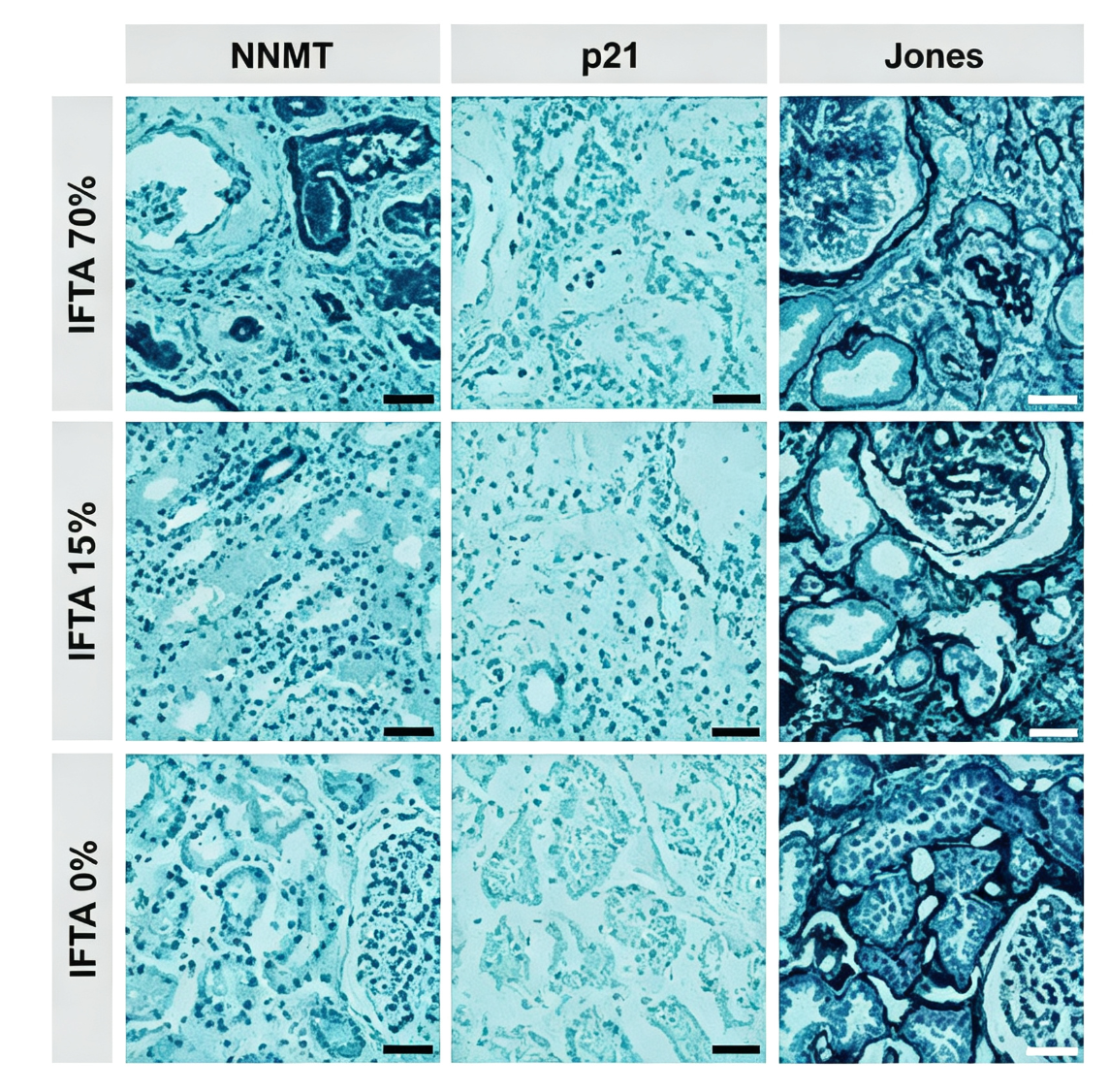
At the histopathological level, staining validation of kidney biopsy tissues from diabetic nephropathy patients revealed that the positive expression regions of NNMT protein in damaged tubules were highly positively correlated with interstitial fibrosis and tubular atrophy scores, which reflect the severity of renal fibrosis. More importantly, the spatial distribution of NNMT expression showed极强的同步性 with the classic senescence marker p21. Additionally, the NNMT enzymatic reaction end product Me6PY was significantly elevated in the urine of early-stage diabetic nephropathy patients, indicating that NNMT异常活跃 occurs before irreversible parenchymal damage, suggesting potential for early non-invasive diagnosis.
IV. Spatial Transcriptomics Analysis of the Inflammatory Microenvironment in NNMT-Positive Renal Tubules
To further解析 the molecular changes in NNMT-elevated renal tubules, the research team employed spatial transcriptomics technology to analyze diabetic nephropathy tissue sections. Fluorescent labeling was used to precisely demarcate and independently sequence NNMT-expressing tubules versus normal tubules and their surrounding microenvironments.
The results showed that NNMT-positive tubules underwent dramatic gene reprogramming: gene sets related to cellular senescence and epithelial-mesenchymal transition were overwhelmingly activated, accompanied by significant upregulation of key transcription factors such as Myc and TP53 that drive metabolic reprogramming and senescence. Deep analysis of the surrounding microenvironment revealed that NNMT-positive tubules were surrounded by a higher proportion of immune cells and exhibited elevated expression of inflammatory signals related to extracellular matrix remodeling, interferon response, and the complement system. This indicates that NNMT-overexpressing damaged tubules can actively create a pro-fibrotic恶性微环境 through the secretion of inflammatory factors.
V. Early Animal Models Confirm Synchronous Rise of NNMT and Senescence
To verify that NNMT elevation is a driver of early pathology rather than a late-stage consequence, researchers used two distinct early chronic kidney disease mouse models: 16-week-old genetically diabetic mice with kidney hyperfiltration and moderate proteinuria but no significant collagen deposition, and 24-month-old naturally aged mice with early fibrotic lesions but no substantial renal failure in blood or urine tests.
Despite their迥异 phenotypes and etiologies, both models showed significant cellular senescence features at the molecular level. Western blot experiments clearly demonstrated that NNMT protein levels and the senescence marker p21 were substantially elevated in both early disease models, with a strong statistical positive correlation between them. This provides compelling evidence that in early kidney lesions caused by metabolic damage or natural aging, NNMT upregulation and cellular senescence are synchronous and precede severe fibrosis as critical early events.
VI. NNMT Overexpression Directly Exacerbates Renal Tubular Cell Senescence and Fibrosis
To clarify whether NNMT is a "bystander" or "driver" of senescence, researchers conducted in vitro genetic manipulation. Forced overexpression of NNMT in renal tubular epithelial cells caused剧烈的代谢重塑: NNMT过度消耗 the substrate S-adenosylmethionine (SAM), leading to a sharp decline in the SAM/S-adenosylhomocysteine ratio, while nicotinamide was大量转化为 methylnicotinamide, though levels of the core energy metabolite NAD+ remained largely unaffected.
NNMT overexpression alone induced mild senescence and fibrotic tendencies in cells, along with reduced proliferative capacity, suggesting that high NNMT expression sets a "vulnerable" initial state. More critically, when low-dose transforming growth factor-β (TGF-β) was used to模拟病理损伤, NNMT-overexpressing cells exhibited失控恶化: proliferation nearly halted, the core epithelial-mesenchymal transition protein α-SMA surged, senescence protein p21 accumulated extensively, and senescence-associated β-galactosidase activity was极度增强. This conclusively证明 that NNMT overexpression directly amplifies and exacerbates senescence and pro-fibrotic responses under pathogenic stress.
VII. SAM Supplementation, Not NAM, Alleviates Damage Phenotypes
Given that NNMT catalysis consumes both nicotinamide and the methyl donor SAM, researchers designed metabolite "rescue" experiments to identify the root cause of pathology. After 14 weeks of nicotinamide dietary supplementation in naturally aged mice, despite increased renal nicotinamide flux and回升 NAD+ levels, histological sections showed that nicotinamide supplementation failed to改善 interstitial fibrosis or tubular atrophy and did not reduce p21 expression. In vitro cell experiments similarly confirmed that adding nicotinamide could not rescue impaired cell proliferation or reverse pro-fibrotic protein overexpression.
However, when the supplement was switched to the methyl donor SAM, the results fundamentally reversed. SAM显著下调 TGF-β-induced senescence and fibrosis-related gene clusters,大幅降低 α-SMA accumulation, restored damaged cell proliferation rates to near-normal levels, and significantly削弱 cellular senescence biochemical activity. This对比实验深刻揭示 that the core mechanism by which NNMT disrupts tubular health is not nicotinamide depletion or NAD+ deficiency but rather the massive depletion of the precious intracellular methyl donor SAM.
VIII. NNMT Inhibitors Effectively Protect Renal Tubules from Senescence and EMT Invasion
Researchers employed highly selective, cell-membrane-permeable small-molecule NNMT inhibitors for intervention. In vitro experiments showed that damaged tubular cells treated with inhibitors successfully restored SAM/SAH ratios to healthy levels. Transcriptome sequencing revealed that NNMT inhibitors systematically downregulated TGF-β-induced inflammatory, epithelial-mesenchymal transition, and senescence gene networks.
These transcriptional changes effectively translated into functional recovery: fibrotic marker proteins were strongly suppressed, senescence marker p21显著回落, damaged cell proliferative capacity increased by 70%, and cells彻底摆脱 senescence arrest. Mechanistically, whole-genome DNA methylation chips revealed that TGF-β stimulation caused widespread aberrant DNA demethylation of key senescence and fibrosis genes, leading to their erroneous activation. By preserving SAM reserves, NNMT inhibitors reversed this epigenetic collapse, re-establishing methylation silencing of critical pathogenic genes.
IX. Human Kidney Organoid Model Validates Protective Efficacy of NNMT Inhibitors
To bridge species gaps, researchers used human induced pluripotent stem cells to cultivate three-dimensional human kidney organoids. In an ischemic injury model, hypoxic stress disrupted the brush border structure of organoid tubules. However, when NNMT inhibitors were added during reoxygenation, the急剧上升的 senescence marker p21, pro-inflammatory factors, and multiple pro-fibrotic因子基因表达 were强力压制.
In organoid stress models simulating diabetic microenvironments, sustained metabolic toxicity同样诱发强烈的衰老 and epithelial-mesenchymal transition signals. NNMT inhibitors依然表现出稳定的保护效力,大幅削弱ing diabetes-induced damage molecule expression. Evidence from complex human multicellular tissue models irrefutably demonstrates the universality and therapeutic potential of targeting NNMT inhibition against various common early kidney injuries.
Nanjing Youai Biotechnology Co., Ltd. provides the NNMT His Tag Protein, Rhesus macaque recombinant protein product. This product is a rhesus macaque-derived NNMT protein with a His tag, suitable for NNMT functional validation, antibody screening, and inhibitor activity evaluation in chronic kidney disease research. The protein undergoes strict quality control, offering high purity and activity, and serves as a reliable experimental tool for studying renal senescence and fibrosis mechanisms.










 Business license (three certificates in one)