

Signal transduction mechanism of the CD3-TCR complex and new discoveries in the CD3L1 immune checkpoint
Views:6 


The CD3 molecule serves as a critical signaling subunit of the T-cell receptor complex, playing a central role in T-cell antigen recognition and the initiation of immune responses.
- Recent Advances
- Product Information
Recent Advances
Signaling Mechanism of CD3-TCR Complex and New Discoveries in CD3L1 Immune Checkpoint
Brief: CD3 molecules, as key signaling subunits of the T cell receptor complex, play a central role in T cell antigen recognition and immune response initiation. In recent years, the discovery of CD3L1 (ITPRIPL1) as a natural ligand of CD3ε and the approval of Teplizumab, a monoclonal antibody targeting CD3ε for type 1 diabetes treatment, have collectively deepened the understanding of CD3 molecular functions. This article discusses the structural basis of the CD3-TCR complex, its signaling mechanisms, the immunosuppressive function of CD3L1, and the clinical applications of CD3-targeted drugs, aiming to provide references for related research.
Structural Composition and Signaling Function of the CD3-TCR Complex
CD3 molecules are important markers on the T cell surface, which, together with the T cell receptor (TCR), assemble into the CD3-TCR complex. This complex is responsible for recognizing antigen peptides presented by the major histocompatibility complex (MHC) on the T cell surface, thereby activating T cells to initiate adaptive immune responses. The CD3 complex consists of four subunits: CD3δ, CD3ε, CD3γ, and CD3ζ, which assemble into three pairs of dimers on the cell membrane: the CD3εγ heterodimer, the CD3εδ heterodimer, and the CD3ζζ homodimer. These three dimers, together with the TCRαβ heterodimer, form the complete eight-subunit CD3-TCR complex.
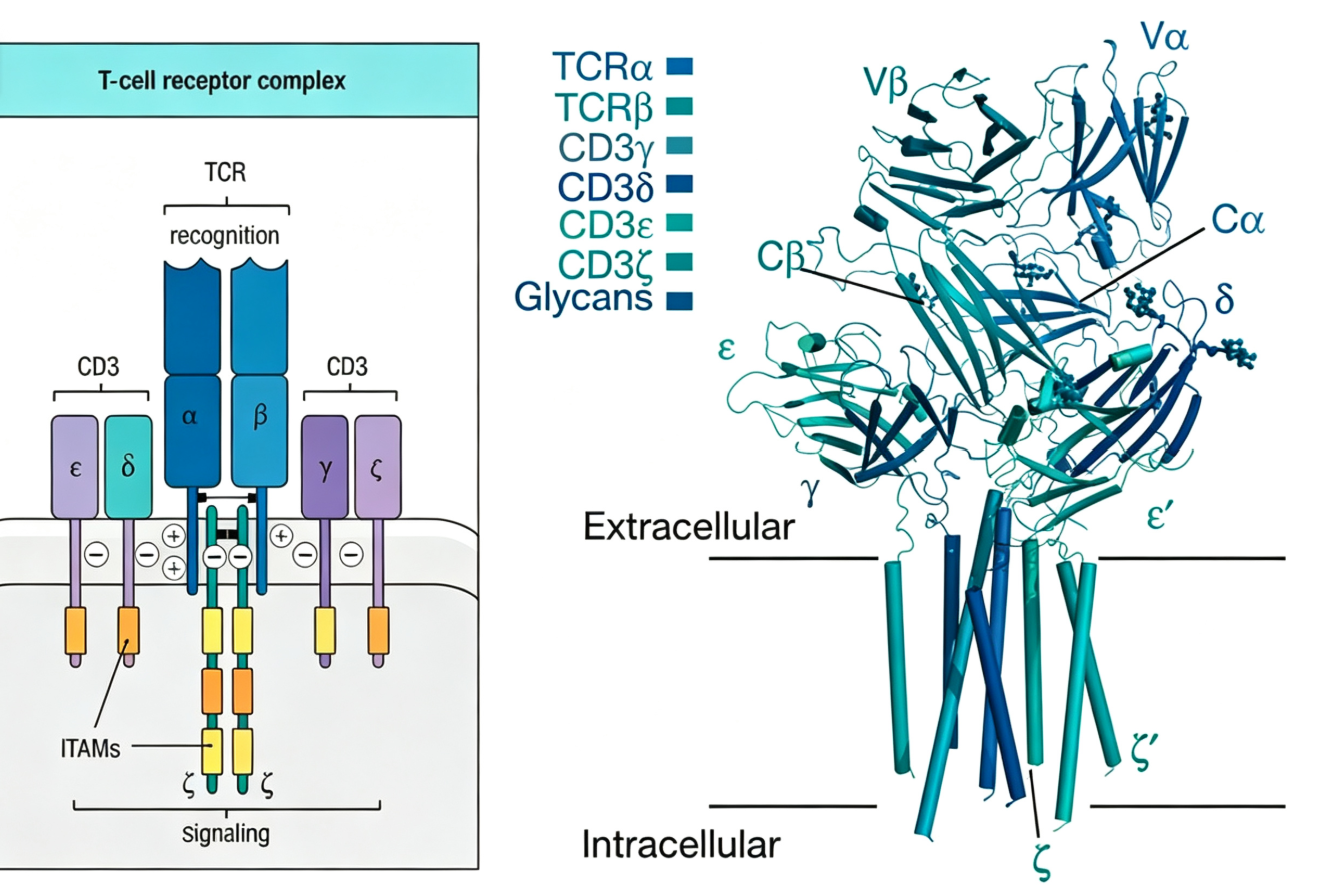
From a molecular structure perspective, CD3ε and CD3γ form a stable CD3εγ heterodimer through interactions in their extracellular domains, while CD3ε and CD3δ form the CD3εδ heterodimer. The extracellular regions of these heterodimers are important targets for anti-CD3 antibody recognition. Studies show that only when CD3ε and CD3γ form a heterodimer do they become immunogenic for binding by antibodies like OKT3; individual CD3ε or CD3γ subunits cannot be effectively recognized. The intracellular regions of CD3δ, CD3ε, CD3γ, and CD3ζ contain immunoreceptor tyrosine-based activation motifs (ITAMs), which enable the CD3 complex to perform signaling functions after TCR antigen recognition.
Signal Transduction Cascade Initiation of the CD3-TCR Complex
After TCR recognizes the antigen peptide-MHC complex, CD3 molecules act as a "bridge" to transmit the antigen recognition signal intracellularly. Specifically, the SRC family kinase LCK mediates the phosphorylation of tyrosine residues in the ITAMs of CD3 subunits. The phosphorylated ITAMs further recruit and phosphorylate the tyrosine kinase ZAP70, activating downstream MAPK, NF-κB, and calcineurin signaling pathways, ultimately initiating T cell proliferation, differentiation, and effector functions. The precise regulation of this signaling process is crucial for normal T cell development and function.
CD3L1 as a Natural Ligand of CD3ε Inhibits T Cell Activation
Researchers have discovered that ITPRIPL1 (named CD3L1, or CD3ε ligand 1) is a natural inhibitory ligand of CD3ε. CD3L1 binds directly to CD3ε on the T cell surface via its extracellular domain, significantly inhibiting calcium influx in stimulated T cells and competitively blocking the recruitment and phosphorylation of ZAP70, thereby exerting inhibitory effects at the "first signal" stage of TCR signaling.
Notably, CD3L1 binding to CD3ε does not affect the binding of anti-CD3 antibodies (such as OKT3) to CD3ε, indicating that anti-CD3 antibodies can serve as suitable activators for studying CD3L1 function. This discovery shifts the traditional understanding of the TCR complex from "TCR being responsible for antigen recognition, CD3 merely acting as a signaling bridge" to a new paradigm where "both TCR and CD3 can receive natural ligand signals and jointly regulate T cell activation." CD3L1 is normally expressed in immune-privileged tissues like the testes and is overexpressed in various solid tumors, particularly in PD-L1 low or non-expressing tumors. Anti-CD3L1 neutralizing antibodies can inhibit tumor growth and promote T cell infiltration in mouse models, suggesting CD3L1 is a promising new target in tumor immunotherapy.
Breakthroughs in Clinical Applications of CD3-Targeted Antibodies
Before the discovery of CD3L1 as a novel target, CD3 molecules, as core regulators of T cell activation, had already become a hotspot for drug development. Teplizumab is the first monoclonal antibody targeting CD3ε approved for clinical use, aimed at delaying the progression of type 1 diabetes. Its mechanism involves binding to CD3ε to modulate T cell activity, reducing autoimmune attacks on pancreatic β cells and thus preserving insulin secretion. Additionally, the anti-CD3 antibody OKT3, as the first FDA-approved immunosuppressant, was widely used for treating acute rejection in organ transplantation. In recent years, CD3 bispecific antibodies (such as BiTE molecules targeting CD3 and tumor-associated antigens) have shown promising prospects in tumor immunotherapy.
Application Value of CD3E&CD3G Heterodimer Protein in Research
Given the central role of the CD3E&CD3G heterodimer in T cell activation signaling, high-purity, high-activity recombinant CD3E&CD3G heterodimer proteins have become indispensable tools for immunology research and bispecific antibody drug development. These proteins are typically expressed using the HEK293 mammalian cell system to ensure proper post-translational modifications and maintain native conformation, and are provided with Fc tags to facilitate purification, detection, and antibody screening experiments.
Which Manufacturers Provide Human CD3E&CD3G Heterodimer Fc-Tagged Proteins?
Nanjing YouAi Biotechnology offers the human CD3E&CD3G heterodimer Fc-tagged protein (Product Name: CD3E&CD3G Heterodimer, Fc Tag&Fc Tag Protein, Human). This product is recombinantly expressed using the HEK293 system, fused with an Fc tag, and undergoes stringent quality control to ensure high purity (>95%), high bioactivity, and low endotoxin levels (<1.0 EU/μg). It has been validated in applications such as ELISA for binding activity with anti-CD3 antibodies and is suitable for antibody screening, SPR affinity testing, and T cell activation mechanism research.
Disclaimer: This article partially utilizes artificial intelligence assistance in its creation. If any content involves copyright or intellectual property issues, please let us know and we promise to verify and remove it as soon as possible.
Purchase recombinant protein, choose Nanjing UA-Bio
UA protein focuses on providing various protein reagents, raw materials, and services required for drug research and development, cell therapy, gene therapy, and basic scientific research, including drug target proteins, immune checkpoint proteins, cytokines, tool enzymes, customized protein expression, and full-length transmembrane protein development. Youai is committed to providing customers with high-quality products and professional services, and building a high-tech enterprise with international competitiveness.
Target proteins | membrane proteins | cytokines | enzymes | viral antigens | protein customization
Nanjing UA Biotechnology Co., Ltd. Email:order@ua-bio.com Phone:0571-87565022

Product Information

Link:





©2021-2026 all rights reserved UA Biotechnology Co.,Ltd.

网站备案号 浙ICP备2022019033号-2 浙公网安备33010202004867号
 Business license (three certificates in one)
 Tel:+86-0571-87565022
E-mail:order@ua-bio.com
All products sold on this website shall not be used for clinical diagnosis or treatment of humans or animals, and shall only be used for non-medical purposes such as industrial or scientific research.
