2-Hour Viral Titer Detection - Baculovirus Titer Detection Kit Now Available!


Baculovirus is a double-stranded circular DNA virus that specifically infects arthropods, encompassing the genera Nucleopolyhedrovirus and Granulovirus. Leveraging existing technologies, UA BIOSCIENCE has developed a Baculovirus Titer Detection Kit based on the insect-baculovirus expression system.
- Recent Advances
- Product Information
Insect-Baculovirus Expression System
Baculovirus is a double-stranded circular DNA virus that specifically infects arthropods, including the genera Nucleopolyhedrovirus and Granulovirus. Currently, the most commonly used baculoviruses for recombinant protein expression are Autographa californica multiple nucleopolyhedrovirus (AcMNPV) and Bombyx mori nucleopolyhedrovirus (BmNPV).
Commonly used insect cell lines include Sf9, Sf21, and High-Five. Among these, Sf9 exhibits greater tolerance to osmotic pressure, shear stress, and pH changes compared to Sf21, making it more advantageous for transfection and baculovirus amplification. High-Five cells have a shorter proliferation time and higher protein expression levels than Sf9, and they produce proteins with more complex glycosylation patterns.
Features of the Insect-Baculovirus Expression System:
High Protein Expression Capacity: Often driven by polyhedrin or P10 promoters, this system can produce recombinant proteins up to 50% of total cellular protein.
Large Gene Capacity: Can accommodate foreign genes up to 100 kb in size.
Co-Expression of Multiple Genes: Capable of expressing multiple foreign genes simultaneously.
High Safety: The natural host of baculovirus is insects, and it cannot replicate in mammalian cells.
Baculovirus Titer Detection
Why is Virus Titer Detection Necessary?
Confirm Viral Titer to Ensure Packaging Success: High MOI (multiplicity of infection) during virus amplification can lead to defective viruses.
Ensure Experimental Consistency: Accurate titer measurement is critical for reproducible results.
Determine MOI for Optimal Recombinant Protein Expression: An MOI of 1-5 is typically required to ensure synchronous infection and consistent production kinetics.
When Should Virus Titer Be Detected?
During virus amplification.
During recombinant protein production following cell infection.
Methods for Virus Titer Detection:
Common methods include plaque assay, flow cytometry, TCID50, LD50, EID50, real-time quantitative PCR (qPCR), immunofluorescence plaque assay, Western blot, immunoprecipitation, and ELISA.
Plaque Assay
Principle: Virus-infected cells form plaques during co-culture. Under standard conditions, one plaque corresponds to one virus particle, allowing titer calculation.
Calculation: Viral titer (PFU/mL) = (1/dilution factor) × (plaque count) × (1/inoculation volume per well).
Characteristics:
A classic and widely used method.
Time-consuming (4-10 days depending on the virus).
Requires cells in the logarithmic growth phase with >90% viability.
Not suitable for viruses that do not form plaques.
Poor reproducibility.
Flow Cytometry
Principle: Cells in good growth condition are infected with serially diluted virus and labeled with FITC, APC, or PE-conjugated antibodies. Flow cytometry quantifies infected cells to determine viral titer.
Calculation:

Characteristics:
Relatively fast.
Objective results with instrument analysis.
Complex operation requiring cell-based assays.
Real-Time Quantitative PCR (qPCR)
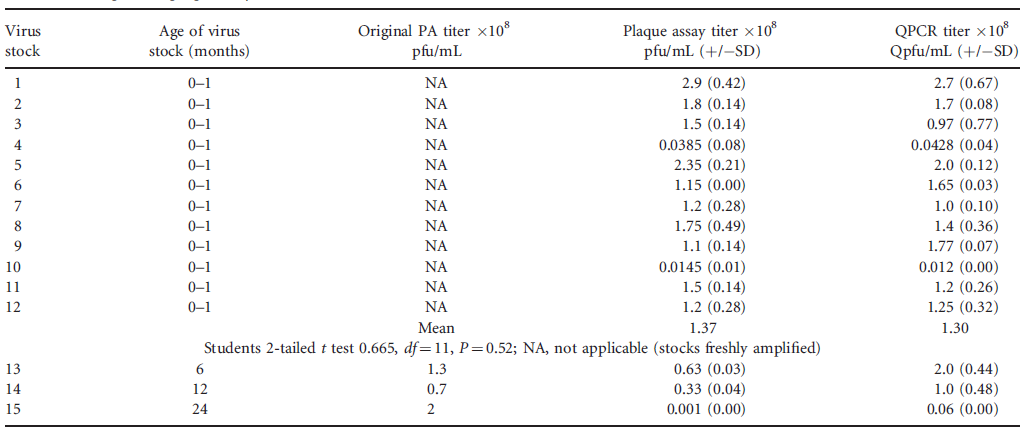
Principle: qPCR relies on DNA replication, with real-time fluorescence detection to generate a standard curve correlating Ct values with viral titer. Studies show qPCR results are consistent with plaque assays.
Characteristics:
High sensitivity.
Excellent reproducibility.
Simple and fast operation.
No need for cell infection or virus dilution.
High throughput.
UA BIOSCIENCE Baculovirus Titer Detection Kit Now Available!
UA BIOSCIENCE has developed a Baculovirus Titer Detection Kit based on the insect-baculovirus expression system. This kit targets the gp64 gene and provides viral titer results in just 2-3 hours, enabling rapid downstream cell infection steps while avoiding repeated freeze-thaw cycles that may compromise virus viability.
Product Code: UA070018
Product Name: Baculovirus Quantitative Titration Kit
Click on the product catalog numbers below to be redirected to the official website for more details.
This article is reviewed and published by the technical expert team of UA
Disclaimer: This article partially utilizes artificial intelligence assistance in its creation. If any content involves copyright or intellectual property issues, please let us know and we promise to verify and remove it as soon as possible.
Purchase recombinant protein, choose 
UA protein focuses on providing various protein reagents, raw materials, and services required for drug research and development, cell therapy, gene therapy, and basic scientific research, including drug target proteins, immune checkpoint proteins, cytokines, tool enzymes, customized protein expression, and full-length transmembrane protein development. Nanjing Univ is committed to providing customers with high-quality products and professional services, and building a High-tech Biological Enterprise with International Competitiveness.







 Business license (three certificates in one)