

FGFR4 chimeric protein: a key tool for studying the FGF19-FGFR4 signaling axis in liver cancer
Author: Senior Product Manager of UA Views:8 


This article focuses on the molecular characteristics and biological functions of fibroblast growth factor receptor 4 (FGFR4), systematically elaborating its domain composition and selective inhibition site features as a member of the receptor tyrosine kinase family, analyzing the molecular mechanisms by which the FGF19-FGFR4 signaling pathway participates in the occurrence and development of liver cancer through downstream cascades such as FRS2-GRB2-PI3K/AKT and RAS-RAF-MEK-ERK, and discussing the preclinical evidence of abnormal activation of FGFR4 in hepatocellular carcinoma and its targeted therapeutic value.
- Recent Advances
- Product Information
Recent Advances
FGFR4 Chimeric Protein: A Key Tool for Studying the FGF19-FGFR4 Signaling Axis in Liver Cancer
Brief Introduction: This article focuses on the molecular characteristics and biological functions of fibroblast growth factor receptor 4 (FGFR4), systematically elaborating on its domain composition and selective inhibition site features as a member of the receptor tyrosine kinase family, analyzing the molecular mechanisms by which the FGF19-FGFR4 signaling pathway participates in the occurrence and development of liver cancer through downstream cascades such as FRS2-GRB2-PI3K/AKT and RAS-RAF-MEK-ERK, and discussing the preclinical evidence of abnormal FGFR4 activation in hepatocellular carcinoma and its targeted therapeutic value.
I. Molecular Structure and Family Localization of FGFR4.
Fibroblast growth factor receptors, as members of the receptor tyrosine kinase family, participate in the regulation of various biological processes such as cell proliferation, migration, anti-apoptosis, and angiogenesis by binding to fibroblast growth factor ligands and activating downstream signaling pathways. Abnormal expression and regulation caused by FGFR gene amplification, missense mutations, and oncogenic fusions are associated with the occurrence and development of various cancers, and FGFR has become an important potential target in cancer therapy. Currently, most of these studies have focused on FGFR1 to FGFR3; however, increasing evidence indicates that FGFR4 plays an important and unique role in the occurrence of multiple tumors and in resistance to antitumor therapy. Abnormal activation of the FGF19-FGFR4 signaling pathway has been confirmed as a carcinogenic factor in liver cancer. Multiple FGFR4-selective inhibitors have entered clinical trials, making FGFR4 a promising target for treating liver cancer caused by abnormal FGF19-FGFR4 signaling.
FGFR4 is a member of the FGFR family and an important member of the receptor tyrosine kinase superfamily, playing key roles in embryonic development, tissue repair, tumor angiogenesis, and tumor progression. The human FGFR4 gene is located on chromosome 5 and is approximately 11.3 kb in length. The FGFR4 protein is encoded by two complete FGFR4 transcripts, comprising 802 amino acids, with a molecular weight between 95 and 110 kDa. The 802-amino-acid core region of the FGFR4 protein contains four parts: the signal peptide (amino acids 1 to 21), the extracellular region (amino acids 22 to 369), the transmembrane region (amino acids 70 to 390), and the intracellular region (amino acids 391 to 802).
II. Structural Features and Selective Inhibition Sites of FGFR4.
The extracellular domain of FGFR4 consists of three immunoglobulin-like domains. Between IgI and IgII, there is a serine-rich sequence called the acid box, which, together with the IgI domain, inhibits FGFR binding to ligands. IgII and IgIII support ligand binding and determine ligand specificity. Based on alternative splicing of the C-terminal portion of the IgIII region, FGFR1 to FGFR3 can be spliced into two isoforms, IIIb and IIIc, whereas only the IIIc isoform has been found in FGFR4 to date. Therefore, the single ligand-binding domain of FGFR4 enables high-affinity binding to specific ligands, implying that it is possible to develop highly specific FGFR4 inhibitors.
The intracellular kinase domain of FGFR4 is composed of an N-terminal lobe and a C-terminal large lobe. The N-terminus consists of five antiparallel β-sheets and one α-helix, while the C-terminus consists of seven α-helices. The active site for ATP and substrate protein binding is located at the hinge region between the two lobes, where the two positions after the gatekeeper amino acid include a less conserved amino acid: in FGFR1 to FGFR3 it is the bulkier tyrosine, whereas in FGFR4 it is the smaller cysteine. Therefore, this site can be used to develop FGFR4-selective inhibitors. This structural difference is the molecular basis for the design of FGFR4-selective inhibitors and is also the reason why FGFR4 chimeric proteins have unique value in drug screening.
III. Activation Mechanism of the FGF19-FGFR4 Downstream Signaling Pathway.
β-Klotho interacts with FGFR4 to form a 1:1 complex, promoting the binding between FGF19 and FGFR4. Subsequently, FGF19 binds to the complex of β-klotho and FGFR4 to form a homodimeric receptor complex, activating downstream signaling pathways. After receptor dimerization, the kinase domain transitions from the previously inactive state to the active state and catalyzes the transfer of the γ-phosphate from ATP to protein tyrosine residues, achieving receptor autophosphorylation and activating its tyrosine kinase activity. The activated FGFR then approaches and mutually phosphorylates intracellular kinases, thereby activating a series of related downstream signaling pathways.
Fibroblast growth factor receptor substrate 2 is a class of adaptor proteins that plays a very important role in FGF/FGFR signal transduction. FRS2 is first phosphorylated by activated FGFR, which then recruits growth factor receptor-bound protein GRB2. GRB2 protein can directly activate the PI3K/AKT pathway on the one hand; on the other hand, by binding guanine nucleotide release protein SOS, it promotes the formation of the GRB2/SOS complex and activates the downstream mitogen-activated protein kinase pathway. In addition, activated FGFR can also phosphorylate intracellular Janus kinase, activating the JAK/STAT pathway; and phosphorylate phospholipase Cγ, producing diacylglycerol and activating protein kinase C, thereby participating in the regulation of certain cellular biochemical reactions, as well as transcription and gene expression in the nucleus. This complex signaling network makes FGFR4 a core node regulating hepatocyte proliferation and survival.
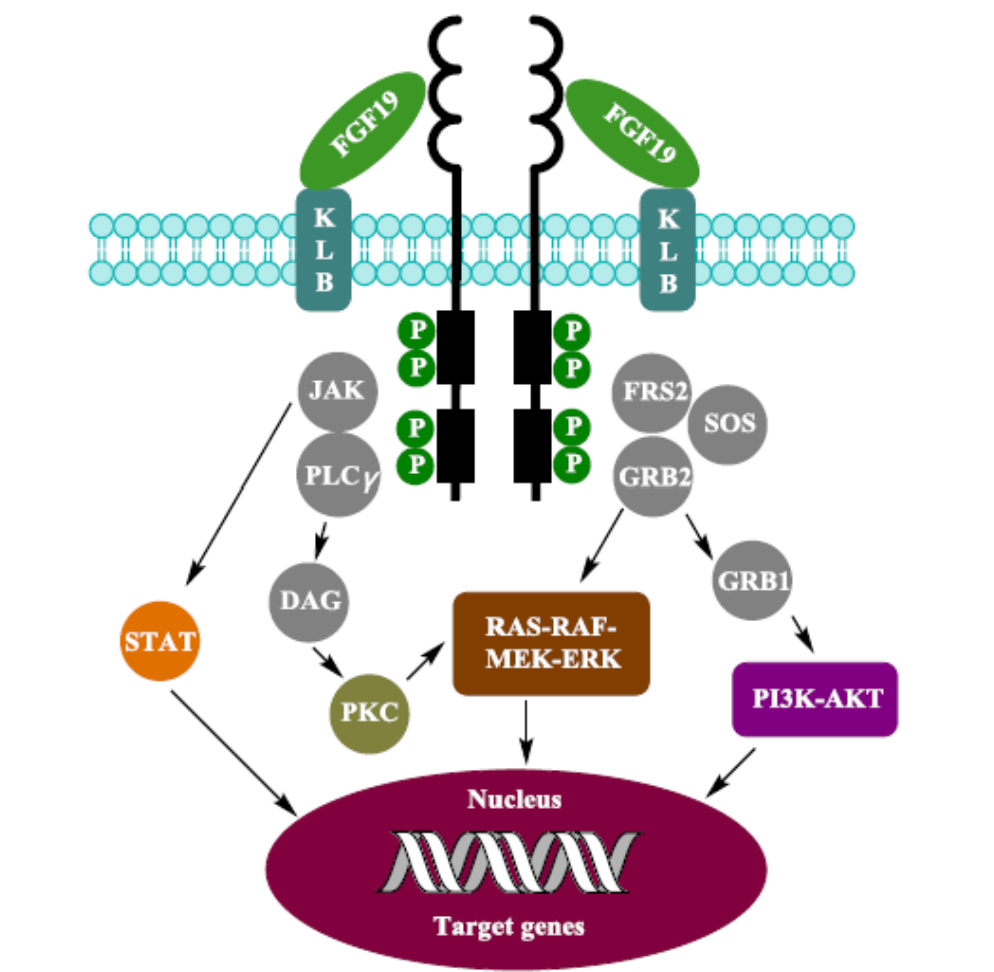
IV. Abnormal Activation and Carcinogenic Effects of FGFR4 in Liver Cancer.
The importance of FGFR4 in liver carcinogenesis has been confirmed both in vitro and in vivo. Research first demonstrated that transgenic mice overexpressing FGF19 in skeletal muscle develop multiple hepatocellular carcinomas early in life, while other tissues are unaffected. Later, researchers found that FGF19 induces liver cancer by activating FGFR4 to increase hepatocyte proliferation. Studies have shown that upregulation of FGFR4 in vitro promotes the invasiveness and tumorigenicity of hepatocellular carcinoma, while downregulation of FGFR4 by small interfering RNA inhibits the carcinogenesis and invasion of hepatocellular carcinoma. Researchers bred FGF19 transgenic mice with FGFR4 knockout and found that only FGFR4 wild-type mice could develop hepatocellular carcinoma, confirming that FGFR4 is necessary for FGF19-mediated carcinogenesis. At the same time, immunohistochemistry revealed that FGFR4 showed an increasing trend in 33% of hepatocellular carcinoma patients, and qualitative real-time polymerase chain reaction confirmed in 23 samples that FGFR4 was overexpressed in 30% of tumors. In addition, FGF19 and its receptor FGFR4 have been shown to participate in the epithelial-mesenchymal transition process of liver cancer cells by regulating the GSK3β/β-catenin signaling cascade. These data indicate that targeting FGF19/FGFR4-mediated signal transduction provides a new promising strategy for liver cancer treatment.
V. Conclusion.
In FGFR4-related basic research and drug development, high-quality recombinant FGFR4 protein is a core tool for dissecting its binding mechanism with the ligand FGF19 and the co-receptor β-Klotho and for evaluating the activity of selective inhibitors. Fc chimeric FGFR4 protein forms dimers through the Fc fragment, more closely resembling the dimerization conformation of the natural receptor on the cell surface, and can be used for high-affinity ligand binding analysis and antibody screening. In response to the needs of FGFR4 functional research and liver cancer-targeted drug screening, UniV provides FGF R4 Fc Chimera Protein, Human. This product is suitable for applications such as ligand binding activity analysis of FGFR4 with FGF19 and β-Klotho, in vitro screening and evaluation of FGFR4-selective inhibitors, mechanistic research on the FGF19-FGFR4 signaling pathway, and the development of targeted therapeutic strategies for liver cancer.
This article is reviewed and published by the technical expert team of UA
Disclaimer: This article partially utilizes artificial intelligence assistance in its creation. If any content involves copyright or intellectual property issues, please let us know and we promise to verify and remove it as soon as possible.
Purchase recombinant protein, choose 
UA protein focuses on providing various protein reagents, raw materials, and services required for drug research and development, cell therapy, gene therapy, and basic scientific research, including drug target proteins, immune checkpoint proteins, cytokines, tool enzymes, customized protein expression, and full-length transmembrane protein development. Nanjing Univ is committed to providing customers with high-quality products and professional services, and building a High-tech Biological Enterprise with International Competitiveness.
Target proteins | membrane proteins | cytokines | enzymes | viral antigens | protein customization
Nanjing UNIV Biotechnology Co., Ltd. Email:order@ua-bio.com Phone:+86-25-56221161

Product Information

Link:





©2021-2026 all rights reserved UNIV Biotechnology Co.,Ltd.
Privacy Policy
网站备案号 苏ICP备2025207586号-2 浙公网安备33010202004867号
 Business license (three certificates in one)
Tel:+86-25-56221161
E-mail:order@ua-bio.com
All products sold on this website shall not be used for clinical diagnosis or treatment of humans or animals, and shall only be used for non-medical purposes such as industrial or scientific research.