




KLRG1 Fc Chimera Protein: A Key Tool for Immune Checkpoint Regulation and Dual-Domain Therapeutic Research
Author: Senior Product Manager of UA Views:13 


This article focuses on the molecular characteristics and immunoregulatory functions of KLRG1, systematically elaborating its molecular mechanism as a member of the C-type lectin-like receptor family that delivers inhibitory signals through the ITIM motif, analyzing the expression characteristics of KLRG1 in terminally differentiated T cells and NK cells and its differentiated positioning relative to classical immune checkpoints, and exploring the dual therapeutic potential of KLRG1 in the two major fields of autoimmune diseases and tumor immunity.
- Recent Advances
- Product Information
Recent Advances
KLRG1 Fc Chimera Protein: A Key Tool for Immune Checkpoint Regulation and Dual-Field Therapeutic Research
Brief: This article focuses on the molecular characteristics and immune regulatory functions of KLRG1, systematically elaborating on its molecular mechanism as a member of the C-type lectin-like receptor family that delivers inhibitory signals through ITIM motifs, analyzing the expression characteristics of KLRG1 in terminally differentiated T cells and NK cells and its differentiated positioning relative to classical immune checkpoints, and exploring the dual-sided therapeutic potential of KLRG1 in the two major fields of autoimmune diseases and tumor immunology.
I. Molecular Structure and Family Positioning of KLRG1.
KLRG1 is positioned within the killer cell lectin-like receptor family. By virtue of its unique molecular mechanism and expression characteristics, it has become a highly differentiated potential target in the field of immunotherapy——it can serve as a tool to eliminate abnormal immune cells, and can also become a key to awaken anti-tumor immunity, with the core of its development lying in precisely balancing the scale of its functional regulation. KLRG1 belongs to the C-type lectin-like receptor superfamily and is a typical type II transmembrane glycoprotein, existing on the cell surface mostly as disulfide-linked homodimers, with each subunit having a molecular weight of approximately 30 to 38 kDa. The ingenuity of its molecular structure lies in two key domains: the extracellular C-type lectin-like domain is the region for ligand recognition, and the intracellular classical ITIM immunoreceptor tyrosine-based inhibitory motif is the core switch for its immunosuppressive function. This structural feature also naturally endows it with the characteristics of an immune checkpoint.
II. Ligand Recognition Characteristics and Differentiated Positioning of KLRG1.
Unlike classical immune checkpoints such as KIRS and NKG2A, KLRG1 does not recognize MHC molecules. Its exclusive ligands are E-Cadherin, N-Cadherin, and R-Cadherin of the cadherin family, among which E-Cadherin is the core target. It precisely binds to the EC1-EC2 domains of cadherins, and the expression characteristics of this ligand also foreshadow the clinical application of KLRG1: E-Cadherin is often downregulated in solid tumors such as breast cancer and colorectal cancer due to epithelial-mesenchymal transition, but in many early-stage or well-differentiated tumors, it still maintains a high expression state, which also gives KLRG1 a dedicated space for action in the treatment of such tumors. This MHC-independent ligand recognition pattern gives KLRG1 a unique targeting positioning within the immune checkpoint family.
III. KLRG1-Mediated Immunosuppressive Signaling Pathway.
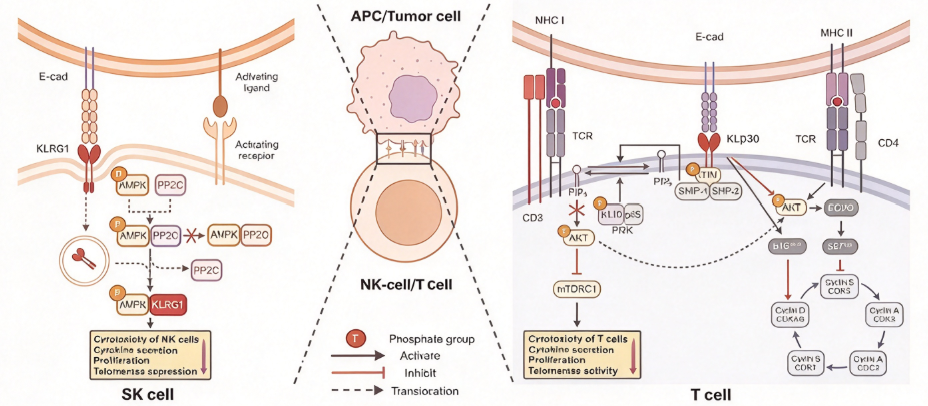
When KLRG1 completes binding with its ligand, a clear inhibitory signaling pathway is activated: after KLRG1 on the surface of T cells or NK cells binds to E-Cadherin on tumor cells, the tyrosine residues of the intracellular ITIM undergo phosphorylation, thereby recruiting SHIP-1 and SHP-2 phosphatases. These phosphatases dephosphorylate downstream signaling molecules such as Akt and ERK, directly blocking the PI3K/Akt and MAPK pathways. The ultimate result is that the cytotoxic killing function of immune cells is inhibited, proliferative capacity declines, and the secretion of key cytokines such as IFN-y and TNF-α is also reduced, thereby suppressing the anti-tumor immune response. The elucidation of this signaling pathway provides a clear molecular basis for KLRG1-targeted intervention.
IV. Expression Profile and Functional Characteristics of KLRG1.
The expression profile of KLRG1 makes its research and development value more three-dimensional. It is not a marker of early activation of immune cells, but rather an identity label of terminal differentiation or senescence. In NK cells, it is mainly expressed in the mature CD56-CD16+ subset with strong killing capacity; in T cells, it is concentrated in TEMRA and effector memory T cells. Notably, unlike PD-1-high exhausted T cells, KLRG1-high T cells still retain extremely strong cytotoxic potential, with consistently high expression levels of perforin and granzyme, but their proliferative capacity is locked by the inhibitory signal of KLRG1——like a sharp blade that has been locked. The blade itself remains sharp; one only needs to find the right key to unlock it. In addition, a small subset of highly suppressive Tregs also expresses KLRG1, which adds another layer of complexity to its regulatory network. This phenotypic feature of “retaining killing potential but inhibiting proliferation” makes KLRG1 a unique target distinct from classical exhaustion markers.
V. Dual-Field Therapeutic Potential and Drug Development Strategies of KLRG1.
It is precisely these biological characteristics that have led KLRG1 drug development down two completely different paths, like holding a double-edged sword whose two sides point respectively to the two major fields of autoimmune diseases and tumor immunology, while the “edge design” of the sword, that is, the functional type of the antibody, directly determines the therapeutic efficacy and safety. In the field of autoimmune diseases, enhancing the inhibitory signal of KLRG1 through agonistic antibodies can suppress overactivated autoreactive T cells and reduce tissue damage. In the field of tumor immunology, blocking antibodies can release the inhibition of KLRG1 on tumor-specific T cells and NK cells, thereby restoring their anti-tumor proliferative capacity and cytokine secretion function. This development strategy with completely opposite functional directions makes KLRG1 an extremely challenging and attractive target in the field of immunotherapy.
VI. Conclusion.
In KLRG1-related basic research and drug development, high-quality recombinant KLRG1 protein is a core tool for analyzing its ligand-binding mechanism and evaluating the activity of targeted drugs. Fc chimeric KLRG1 protein forms dimers through the Fc fragment, more closely resembling the natural homodimeric conformation of KLRG1 on the cell surface, and can be used for high-affinity ligand binding analysis and antibody screening. In response to the needs of KLRG1 functional research and drug screening, UA provides KLRG1 Fc Chimera Protein, Human. This product is suitable for applications such as binding activity analysis of KLRG1 with E-Cadherin/N-Cadherin/R-Cadherin, in vitro screening and evaluation of KLRG1-targeted antibody drugs, research on KLRG1-mediated immunosuppressive signaling pathways, and development of therapeutic strategies for autoimmune diseases and tumor immunology.
As a unique MHC-independent immune checkpoint in the C-type lectin-like receptor family, KLRG1, by virtue of its molecular mechanism of delivering inhibitory signals through ITIM motifs, its characteristic expression profile in terminally differentiated T cells and NK cells, and its functional phenotype of retaining killing potential but inhibiting proliferation, has become a highly differentiated potential target in the two major therapeutic fields of autoimmune diseases and tumor immunology. KLRG1 Fc Chimera Protein, Human provides reliable tool support for research on the ligand-binding mechanism of KLRG1 and the development of targeted drugs, and will continue to drive innovative exploration in the field of immune checkpoint therapy.
This article is reviewed and published by the technical expert team of UA
Disclaimer: This article partially utilizes artificial intelligence assistance in its creation. If any content involves copyright or intellectual property issues, please let us know and we promise to verify and remove it as soon as possible.
Purchase recombinant protein, choose 
UA protein focuses on providing various protein reagents, raw materials, and services required for drug research and development, cell therapy, gene therapy, and basic scientific research, including drug target proteins, immune checkpoint proteins, cytokines, tool enzymes, customized protein expression, and full-length transmembrane protein development. Nanjing Univ is committed to providing customers with high-quality products and professional services, and building a High-tech Biological Enterprise with International Competitiveness.
Target proteins | membrane proteins | cytokines | enzymes | viral antigens | protein customization
Nanjing UNIV Biotechnology Co., Ltd. Email:order@ua-bio.com Phone:+86-25-56221161

Product Information

Link:





©2021-2026 all rights reserved UNIV Biotechnology Co.,Ltd.
Privacy Policy
网站备案号 苏ICP备2025207586号-2 浙公网安备33010202004867号
 Business license (three certificates in one)
 Tel:+86-25-56221161
E-mail:order@ua-bio.com
All products sold on this website shall not be used for clinical diagnosis or treatment of humans or animals, and shall only be used for non-medical purposes such as industrial or scientific research.


