




Epidermal Growth Factor EGF: A Classic Molecular Tool Driving Cell Regeneration Research
Author: Senior Product Manager of UA Views:5 


This article focuses on the molecular characteristics and biological functions of epidermal growth factor (EGF), systematically elaborating its core role as a small-molecule bioactive polypeptide composed of 53 amino acids in promoting epidermal cell proliferation and differentiation, reviewing the discovery history of EGF and its profound impact on life science research, analyzing the application value of EGF in skin injury repair and tissue regeneration, and discussing the widespread application of EGF recombinant protein in cell culture and mechanistic research.
- Recent Advances
- Product Information
Recent Advances
Epidermal Growth Factor EGF: A Classic Molecular Tool Driving Cell Regeneration Research
Brief Introduction: This article focuses on the molecular characteristics and biological functions of epidermal growth factor (EGF), systematically elaborating on its core role as a small-molecule active polypeptide composed of 53 amino acids in promoting epidermal cell proliferation and differentiation, reviewing the discovery history of EGF and its profound impact on life science research, analyzing the application value of EGF in skin injury repair and tissue regeneration, and discussing the broad applications of EGF recombinant protein in cell culture and mechanistic research.
I. Molecular Characteristics and Structural Basis of EGF.
EGF is the abbreviation for epidermal growth factor, a small-molecule protein widely present in human skin cells, an active polypeptide composed of 53 amino acids, with a molecular weight of 6,216 daltons. The molecular structure of EGF contains three pairs of disulfide bonds, which play a decisive role in maintaining its three-dimensional conformation and biological activity. From the perspective of structural biology, EGF adopts a characteristic β-sheet conformation, and its molecular surface is responsible for specific binding to the epidermal growth factor receptor, thereby initiating downstream signal transduction cascades. The molecular structure of EGF is highly conserved across different species, with approximately 70% homology between animals and humans, which provides a molecular basis for its cross-species research and clinical applications.
II. The Discovery History and Scientific Significance of EGF.
In daily life, we can often see that some cats, dogs, mice, and other animals instinctively keep licking their wounds after being injured, thereby promoting wound healing. This instinctive phenomenon in animals attracted the attention of scientists. American scientist Dr. Cohen and Professor Montalcini had long been engaged in growth factor research. In 1962, they discovered an active component in the mouse submandibular gland that could promote eyelid opening and tooth eruption in newborn mice. They added this active component to cultured skin and found that it could promote the growth of epidermal cells.
Later, Dr. Cohen extracted this component from human placenta and urine. It could accelerate the growth rate of human skin cells, and its content directly affected the number of new skin cells growing and proliferating, thereby determining the youthful degree of the skin. The scientific community named this component “epidermal growth factor,” abbreviated as EGF. Dr. Cohen became a winner of the 1986 Nobel Prize in Physiology or Medicine for his research on EGF. The Nobel Prize jury gave high praise to this achievement, stating that it “opened up a new field of broad importance for life science research.” The discovery of EGF turned humanity’s dream of resisting skin aging into reality and made it possible for aged skin to become young again.
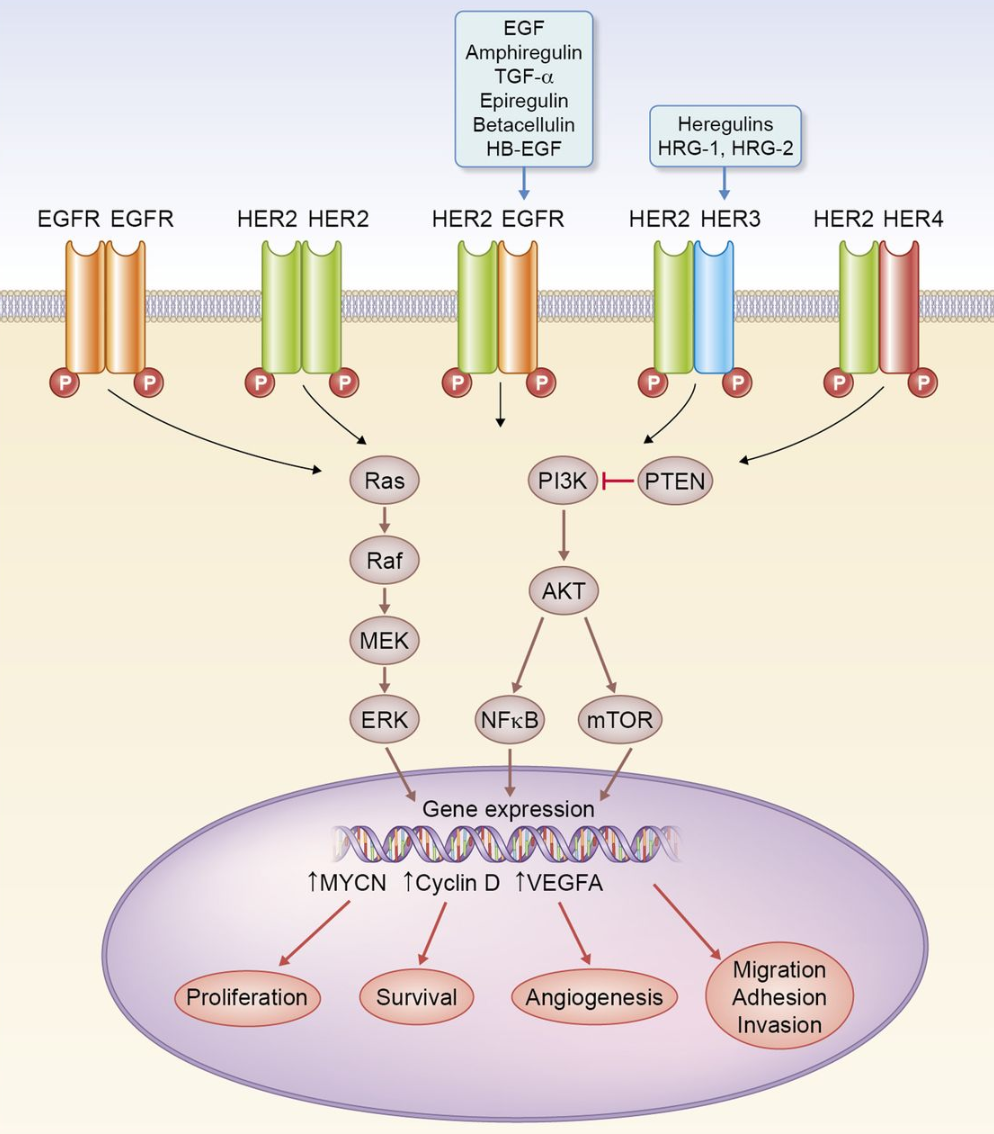
III. Biological Functions and Mechanisms of Action of EGF.
The main function of EGF is to promote the proliferation and differentiation of epidermal cells and accelerate the generation of new cells. EGF specifically binds to epidermal growth factor receptors on the cell membrane surface, activates receptor tyrosine kinase activity, and thereby initiates multiple downstream signaling cascades including RAS-RAF-MEK-ERK and PI3K-AKT. The synergistic activation of these signaling pathways ultimately drives cell cycle progression, proliferation, and migration. Using EGF after skin injury can improve the regeneration and repair capacity of skin tissue. Experiments have shown that after using EGF, the wound healing speed can be increased by 3 to 4 times. EGF promotes the division of skin cells, stimulates the growth of epithelial cells and endothelial cells, continuously generates new epidermal cells, enhances the vitality of epidermal cells, pushes the dead skin layer to gradually shed, maintains delicate and smooth skin, and keeps each component of the skin in the optimal physiological state.
IV. The Essential Difference Between EGF and Traditional Skincare Products.
Traditional beauty and skincare products focus on supplementing external nutrition to the skin and covering aged skin, whereas EGF changes skin quality by promoting cell proliferation. There are essential differences between the two in terms of mechanism of action and effects: the former cannot stop the process of skin aging, while the latter can make aged skin young again. As a cell activator, the core value of EGF lies in improving skin quality by regulating cell proliferation and differentiation, rather than merely providing surface nutrition or covering effects. This mechanistic difference gives EGF unique technical advantages in the fields of skin repair and anti-aging. Because EGF can make aged skin young again, it is hailed by the scientific community as the “beauty factor.” In 1999, EGF research results were rated by the world-authoritative academic journal Science as the top of the year’s ten major scientific achievements.
V. Applications of EGF Recombinant Protein in Cell Culture and Research.
In life science research and biopharmaceutical development, EGF recombinant protein is an indispensable core additive factor in cell culture systems. In the field of cell culture, EGF is widely used to promote the in vitro proliferation of various epithelial cells, fibroblasts, and endothelial cells, and is an important supplemental factor for maintaining cell growth and function. In stem cell research, EGF participates in maintaining the self-renewal capacity of neural stem cells and mesenchymal stem cells. In tissue engineering research, EGF is used to promote the in vitro construction of artificial skin and corneal epithelium. In mechanistic research, EGF, as a classic ligand of the EGFR signaling pathway, is widely used to analyze the molecular mechanisms of receptor tyrosine kinase signal transduction.
In experimental design, the following key factors need attention. The working concentration of EGF needs to be optimized according to cell type and experimental purpose, usually in the range of nanograms to micrograms per milliliter. The activity of EGF is affected by the integrity of disulfide bonds, and reducing agents and high-temperature conditions should be avoided during storage and use. For long-term culture experiments, fresh EGF needs to be supplemented regularly to maintain its active concentration. In addition, it is recommended to set positive and negative controls to verify the effectiveness of the experimental system.
VI. Conclusion.
In EGF-related basic research and application development, high-quality recombinant EGF protein is a core tool for analyzing its signal transduction mechanisms and evaluating its biological functions. To meet the needs of EGF function research and cell culture applications, UniProt provides EGF Protein, Human. This product is suitable for in vitro proliferation research of human epithelial cells and fibroblasts, exploration of EGFR signaling pathway mechanisms, tissue repair and regeneration research, and the establishment and validation of EGF immunoassay methods.
As a small-molecule active polypeptide composed of 53 amino acids, EGF, with its core functions of promoting epidermal cell proliferation and differentiation and accelerating tissue repair and regeneration, as well as its scientific status as a Nobel Prize achievement, has become an important tool in life science research and clinical application. From Dr. Cohen’s classic discovery to the broad application of modern recombinant EGF protein, EGF continues to drive in-depth development in the fields of cell biology, tissue engineering, and skin medicine. EGF Protein, Human provides reliable tool support for mechanistic research on the EGF signaling network and related application development, and will continue to support innovative exploration in life science research and translational application fields.
This article is reviewed and published by the technical expert team of UA
Disclaimer: This article partially utilizes artificial intelligence assistance in its creation. If any content involves copyright or intellectual property issues, please let us know and we promise to verify and remove it as soon as possible.
Purchase recombinant protein, choose 
UA protein focuses on providing various protein reagents, raw materials, and services required for drug research and development, cell therapy, gene therapy, and basic scientific research, including drug target proteins, immune checkpoint proteins, cytokines, tool enzymes, customized protein expression, and full-length transmembrane protein development. Nanjing Univ is committed to providing customers with high-quality products and professional services, and building a High-tech Biological Enterprise with International Competitiveness.
Target proteins | membrane proteins | cytokines | enzymes | viral antigens | protein customization
Nanjing UNIV Biotechnology Co., Ltd. Email:order@ua-bio.com Phone:+86-25-56221161

Product Information

Link:





©2021-2026 all rights reserved UNIV Biotechnology Co.,Ltd.
Privacy Policy
网站备案号 苏ICP备2025207586号-2 浙公网安备33010202004867号
 Business license (three certificates in one)
 Tel:+86-25-56221161
E-mail:order@ua-bio.com
All products sold on this website shall not be used for clinical diagnosis or treatment of humans or animals, and shall only be used for non-medical purposes such as industrial or scientific research.


