




IL‑10 Recombinant Protein: A Core Cytokine for Immunosuppressive Regulation and Inflammatory Balance
Author: Senior Product Manager of UA Views:9 


This article focuses on the molecular characteristics and biological functions of interleukin‑10 (IL‑10). It systematically elaborates the molecular mechanism by which this potent anti-inflammatory cytokine suppresses the expression of inflammatory factors via the IL‑10R/JAK‑STAT signaling pathway, analyzes the dual regulatory roles of IL‑10 in acute infection, persistent infection and viral immune escape, and explores the association between IL‑10 gene polymorphisms and disease susceptibility as well as therapeutic strategies for IL‑10-related diseases.
- Recent Advances
- Product Information
Recent Advances
IL-10 Recombinant Protein: A Core Cytokine in Immunosuppressive Regulation and Inflammatory Balance
Brief Summary: Focusing on the molecular characteristics and biological functions of interleukin-10 (IL-10), this article systematically describes the molecular mechanism by which this potent anti-inflammatory cytokine inhibits inflammatory cytokine expression through the IL-10R/JAK-STAT signaling pathway, analyzes the dual regulatory roles of IL-10 in acute infection, persistent infection, and viral immune evasion, and discusses the association between IL-10 gene polymorphisms and disease susceptibility as well as therapeutic strategies for IL-10-related diseases.
I. Molecular Characteristics and Cellular Sources of IL-10.
Interleukin-10 (IL-10) is a pleiotropic cytokine with potent anti-inflammatory properties, primarily secreted by antigen-presenting cells such as activated T cells, monocytes, B cells, and macrophages. IL-10 inhibits the expression of inflammatory cytokines such as TNF-α, IL-6, and IL-1 by activating macrophages, playing a central role in the negative regulation of immune responses. Aberrant IL-10 expression is closely associated with the development and progression of various diseases, and fine regulation of its expression levels is essential for maintaining immune homeostasis.
II. IL-10 Receptor Complex and Signal Transduction Mechanism.
The functional IL-10R complex is a tetramer composed of two ligand-binding subunits (IL-10Rα or IL-10R1) and two accessory signaling subunits (IL-10Rβ or IL-10R2). Binding of IL-10 to the extracellular domain of IL-10R1 activates phosphorylation of the receptor-associated JAK1 and TYK2 kinases, which are constitutively associated with IL-10R1 and IL-10R2. These kinases then phosphorylate specific tyrosine residues (Y446 and Y496) on the intracellular domain of the IL-10R1 chain. Once phosphorylated, these tyrosine residues and their flanking peptide sequences serve as temporary docking sites for the latent transcription factor STAT3.
STAT3 binds to these sites through its SH2 domain and is then phosphorylated on tyrosine by receptor-associated JAKs. Subsequently, STAT3 homodimerizes and translocates to the nucleus, where it binds with high affinity to STAT-binding elements in the promoters of various IL-10-responsive genes. Constitutively active forms of STAT3 increase transcription of anti-apoptotic and cell cycle progression genes such as BCLXL, Cyclin-D1, Cyclin-D2, Cyclin-D3 and Cyclin-A, Pim1, c-Myc, and p19. IL-10 also activates another major survival pathway, composed of PI3K and its downstream substrates p70S6K and Akt/PKB. Although the anti-inflammatory effects of IL-10 are not mediated through PI3K, the ability of IL-10 to promote astrocyte survival or induce mast cell proliferation depends on PI3K activation.
IL-10 also interferes with the activation potential of the p38/MAPK pathway, which is required for activating TNF translation. Third, and most importantly, TTP has potent destabilizing activity on TNF mRNA without imposing translational control. Two RNA-binding proteins recently shown to possess TNF-ARE binding capability are TiaR and Tia1. The detailed mechanism by which IL-10 targets MAPK/SAPK signaling remains unclear, and this area still requires further exploration.
III. Dual Regulatory Role of IL-10 in Acute and Persistent Infection.
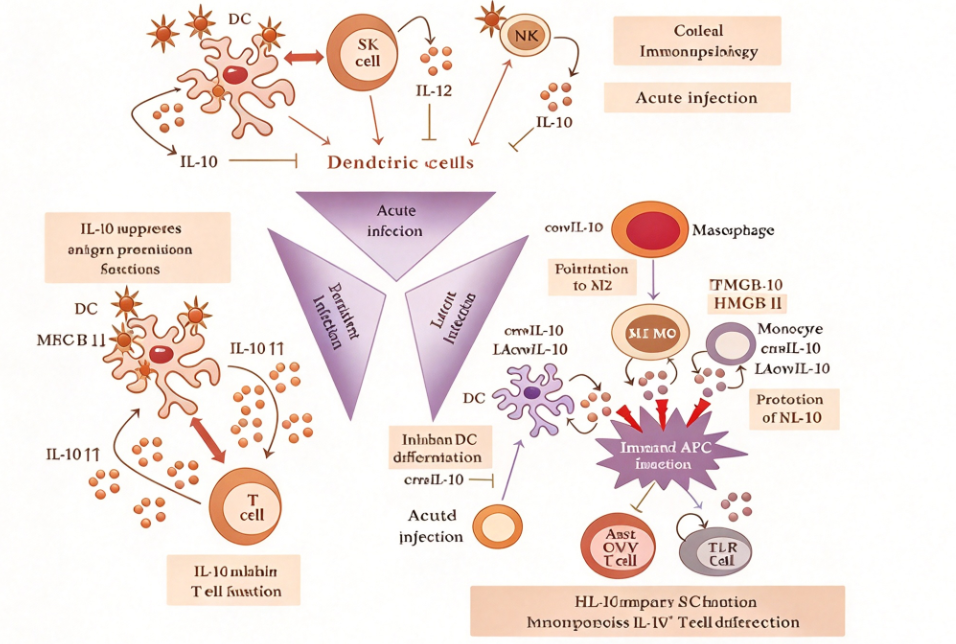
IL-10 is a pleiotropic cytokine with important immunoregulatory functions that participates in the activities of multiple cell types in the immune system. During acute infection, DCs generate pro-inflammatory signals after recognizing pathogen patterns. Simultaneously, NK cells that recognize pathogen patterns and/or are stimulated by pro-inflammatory signals further enhance inflammation. In this pro-inflammatory context, DCs can promote antiviral T cell responses that clear the infection. Activation of DCs, T cells, and NK cells also leads to the production of the immunoregulatory cytokine IL-10 to balance inflammation. In this scenario, IL-10 expression controls immunopathology and, once the pathogen is cleared, leads to resolution of inflammation and T cell responses.
During persistent infection, viruses exploit DC-produced IL-10 to deplete antiviral T cells. High levels of IL-10 produced by DCs inhibit their antigen-presenting capacity, resulting in inefficient T cell activation. The presence of chronic antigen further depletes T cells and induces IL-10 production. Consequently, T cells become "tolerant" to viral antigens, and the infection persists. To establish chronic and latent infection, viruses produce viral IL-10 homologs that favor anti-inflammatory responses.
In human cytomegalovirus infection, cytomegalovirus-encoded IL-10 and latency-associated cytomegalovirus-encoded IL-10 are produced in myeloid cells and impair their function. cmvIL-10 induces human IL-10 production by DCs, macrophages, and monocytes, impairs DC differentiation, and promotes M2 polarization of macrophages. cmvIL-10 also promotes human IL-10 production by DCs and monocytes and impairs the presenting capacity of monocytes. IL-10 viral homologs induce human IL-10 production in myeloid cells, leading to impaired antigen-presenting cell function. This in turn may limit anti-CMV T cell responses and promote the development of IL-10+ T cells. Impaired APC function allows chronic infection, while IL-10+ T cells allow latent infection to persist.
IV. IL-10 Gene Polymorphisms and Disease Susceptibility.
Three polymorphic single nucleotides in the IL-10 gene promoter region (-1082 (G/A), -819 (C/T), -592 (C/A)) have been shown to alter IL-10 mRNA and protein levels. Compared with controls, high expression of the -1082G allele in patients is associated with systemic lupus erythematosus, Crohn's disease, and tumors (non-small cell lung cancer, diffuse large B-cell lymphoma, cervical cancer, and oral cancer), and promotes the pathological progression of these diseases. The -1082AA genotype is more prevalent in asthma. The 819TT genotype is associated with low IL-10 levels in colon cancer patients. In asthma, prostate cancer, and colon cancer patients, the frequency of the low IL-10-producing genotype -592AA is higher than in controls. However, additional studies are necessary to fully understand the association of IL-10 polymorphisms with disease susceptibility and underlying pathological processes.
Both overexpression (systemic lupus erythematosus, tuberculosis) and IL-10 deficiency (inflammatory bowel disease, psoriasis, asthma, rheumatoid arthritis) may have pathophysiological significance. Therefore, neutralizing the cytokine may be an effective approach for treating the former group of diseases, while applying IL-10 itself may help treat the latter group. In August 2020, Science Advances published online a research paper titled "Extracellular vesicle-encapsulated IL-10 as novel nanotherapeutics against ischemic AKI," the first report of using extracellular vesicles as carriers to deliver IL-10 as a novel nanotherapy for acute kidney injury. Furthermore, IL-10 intervention can significantly reduce RST-induced depressive behaviors in mice, including anhedonia, reduced spontaneous activity, reduced exploratory behavior, and anxiety-like emotions. This finding deepens the understanding of depression and provides a new direction for developing novel antidepressant drugs.
V. Conclusion.
In IL-10-related basic research and drug development, high-quality recombinant IL-10 protein is a core tool for dissecting its signal transduction mechanisms and evaluating its immunoregulatory functions. To address the needs of IL-10 functional research and disease model establishment, UniBio provides IL-10 Protein, Mouse. This product is suitable for application scenarios including mouse IL-10/IL-10R signaling pathway mechanism research, macrophage and T cell functional regulation research, IL-10 functional research in inflammatory disease and autoimmune disease models, and establishment and validation of IL-10 immunoassays.
As one of the most potent anti-inflammatory cytokines in the immune system, IL-10, by virtue of its unique mechanism of inhibiting inflammatory cytokine expression and regulating immune cell functions through the IL-10R/JAK-STAT signaling pathway, plays an irreplaceable dual regulatory role in the resolution of inflammation during acute infection, immune evasion during persistent infection, and the pathological processes of autoimmune diseases. The association of its gene polymorphisms with susceptibility to various diseases, as well as the therapeutic potential of IL-10 in acute kidney injury and depression, provides new directions for intervention strategies for related diseases. IL-10 Protein, Mouse provides reliable tool support for in-depth analysis of the IL-10 signaling network and the development of related disease treatment strategies, and will continue to drive in-depth exploration in the field of immune regulation.
This article is reviewed and published by the technical expert team of UA
Disclaimer: This article partially utilizes artificial intelligence assistance in its creation. If any content involves copyright or intellectual property issues, please let us know and we promise to verify and remove it as soon as possible.
Purchase recombinant protein, choose 
UA protein focuses on providing various protein reagents, raw materials, and services required for drug research and development, cell therapy, gene therapy, and basic scientific research, including drug target proteins, immune checkpoint proteins, cytokines, tool enzymes, customized protein expression, and full-length transmembrane protein development. Nanjing Univ is committed to providing customers with high-quality products and professional services, and building a High-tech Biological Enterprise with International Competitiveness.
Target proteins | membrane proteins | cytokines | enzymes | viral antigens | protein customization
Nanjing UNIV Biotechnology Co., Ltd. Email:order@ua-bio.com Phone:+86-25-56221161

Product Information

Link:





©2021-2026 all rights reserved UNIV Biotechnology Co.,Ltd.
Privacy Policy 
网站备案号 苏ICP备2025207586号-2 浙公网安备33010202004867号
 Business license (three certificates in one)
 Tel:+86-25-56221161
E-mail:order@ua-bio.com
All products sold on this website shall not be used for clinical diagnosis or treatment of humans or animals, and shall only be used for non-medical purposes such as industrial or scientific research.


