




GDF-2/BMP-9 Recombinant Protein: A Core Molecule for Endothelial Protection in Pulmonary Hypertension and IL-33 Signaling Regulation
Author: Senior Product Manager of UA Views:13 


This article focuses on the molecular characteristics and biological functions of GDF‑2/BMP‑9. It systematically elaborates its protective mechanism in pulmonary hypertension, which neutralizes IL‑33 signaling and inhibits endothelial‑mesenchymal transition by upregulating the decoy receptor sST2, analyzes the pathological driving effect of the IL‑33 signaling pathway on pulmonary endothelial dysfunction, and discusses the translational potential of the BMP9‑sST2 axis as a novel therapeutic target for pulmonary hypertension.
- Recent Advances
- Product Information
Recent Advances
GDF-2/BMP-9 Recombinant Protein: A Core Molecule in Pulmonary Arterial Hypertension Endothelial Protection and IL-33 Signaling Regulation
Brief Summary: Focusing on the molecular characteristics and biological functions of GDF-2/BMP-9, this article systematically describes its protective mechanism in pulmonary arterial hypertension through upregulation of the decoy receptor sST2 to neutralize IL-33 signaling and inhibit endothelial-to-mesenchymal transition, analyzes the pathological driving role of the IL-33 signaling pathway in pulmonary endothelial dysfunction, and discusses the translational potential of the BMP9-sST2 axis as a novel therapeutic target for pulmonary arterial hypertension.
I. Disease Characteristics of Pulmonary Arterial Hypertension and the Central Role of Endothelial Dysfunction.
Pulmonary arterial hypertension is a serious and rare disease, defined as pulmonary artery pressure greater than 20 mmHg and pulmonary vascular resistance greater than 2 Wood units. Pulmonary arterial hypertension is characterized by progressive obliterative remodeling of distal pulmonary vessels, leading to elevated pulmonary artery pressure, right ventricular dysfunction, right ventricular failure, and ultimately death if untreated. Key pathological processes include dysregulated proliferation of endothelial cells and smooth muscle cells, inflammation, apoptosis, and thrombosis. Structural abnormalities of the pulmonary arteries, such as medial and intimal thickening, capillary rarefaction, and formation of disorganized plexiform lesions, are hallmark features of pulmonary arterial hypertension. Within this complex pathological network, endothelial dysfunction is considered the core link initiating and driving vascular remodeling, and endothelial-to-mesenchymal transition is one of the key features of endothelial dysfunction.
II. Activation and Pathological Role of the IL-33 Signaling Pathway in Pulmonary Arterial Hypertension.
A recent study highlighted that BMP9 exerts a protective effect against IL-33-induced endothelial-to-mesenchymal transition in pulmonary artery endothelial cells by upregulating sST2 expression and neutralizing IL-33, suggesting that targeting the IL-33 signaling pathway may become a potential therapeutic strategy to alleviate endothelial-to-mesenchymal transition in pulmonary arterial hypertension.
IL-33 expression was evaluated in lung tissue sections of Sugen/hypoxia model mice and control mice. Immunostaining revealed that IL-33 was significantly increased in pulmonary vascular endothelial cells of Sugen/hypoxia mice compared with normoxic controls, confirming the upregulation of IL-33 under hypoxic conditions. To investigate the role of IL-33 in the pathophysiology of pulmonary arterial hypertension, researchers evaluated its expression in human pulmonary artery endothelial cells. Compared with controls, IL-33 mRNA and secreted IL-33 protein levels were significantly elevated in pulmonary arterial hypertension-derived human pulmonary artery endothelial cells. Analysis of downstream IL-33 signaling revealed increased MYD88 and IL1RAP mRNA expression in pulmonary arterial hypertension human pulmonary artery endothelial cells. Western blot further confirmed the upregulation of IL-33 and its receptor accessory protein IL-1RACP, reinforcing the transcriptomic data and supporting the activation of the IL-33 pathway in pulmonary arterial hypertension. These findings indicate enhanced activation of the IL-33 signaling pathway in the context of pulmonary arterial hypertension.
III. Molecular Mechanism by Which GDF-2/BMP-9 Induces sST2 Expression via the ALK1 Receptor.
Endothelial-to-mesenchymal transition is a key feature of endothelial dysfunction in pulmonary arterial hypertension. Although IL-6 can promote endothelial-to-mesenchymal transition in pulmonary arterial hypertension microvascular endothelial cells under prolonged BMP9 exposure, IL-33 can also induce endothelial-to-mesenchymal transition during tissue regeneration. Researchers investigated whether IL-33 alone is sufficient to induce endothelial-to-mesenchymal transition in pulmonary artery endothelial cells, or whether BMP9 modulates this response. BMP9 alone had no phenotypic effect on control pulmonary artery endothelial cells, but IL-33 stimulation significantly decreased the endothelial marker CD31 and increased the mesenchymal marker SM22α, indicating that endothelial-to-mesenchymal transition occurred. However, BMP9 co-treatment maintained the resting endothelial phenotype and prevented IL-33-induced endothelial-to-mesenchymal transition.
Based on the protective effect of BMP9, researchers further explored its interaction with the IL-33/ST2 axis and the TGF-β/BMP signaling pathways. The study employed a commonly used 16-hour stimulation protocol for assessing TGF-β responses in endothelial cells, and additionally performed 3-hour stimulation experiments with TGF-β1 and Activin A. In both cases, TGF-β1 and Activin A did not alter sST2 expression, whereas BMP9 and BMP10 significantly upregulated sST2, indicating a specific regulatory effect. Consistent with this, BMP9 and BMP10 also strongly induced the canonical BMP target genes ID1 and ID3, confirming their activity under the experimental conditions.
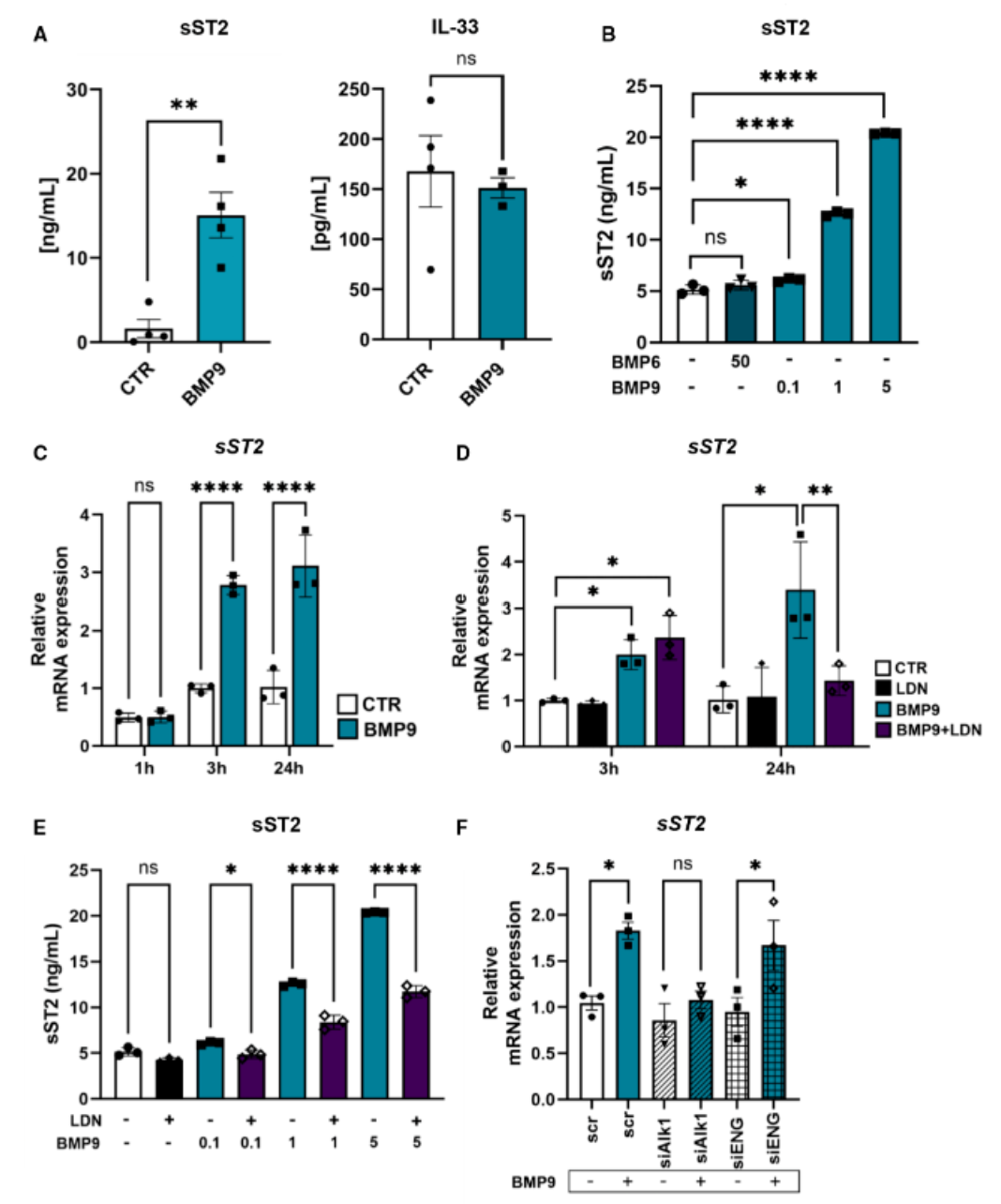
Given that BMP9 strongly induces sST2 upregulation in pulmonary artery endothelial cells, researchers further validated this effect across multiple donors. BMP9 significantly increased sST2 mRNA and secreted protein levels but did not affect IL-33 mRNA expression or secretion. This induction was dose-dependent: upregulation was weak at 0.1 ng/mL BMP9, with mRNA and protein levels gradually increasing at 1 ng/mL and 5 ng/mL. Time-course analysis showed no induction effect at 1 hour of 1 ng/mL BMP9 stimulation, whereas significant sST2 expression was detected at 3 and 24 hours, indicating that the response has temporal regulatory characteristics. In endothelial cells, BMP9 has high affinity for ALK1, which forms a signaling complex with the type II receptor BMPR2.
Therefore, researchers examined whether ALK1 activity mediates BMP9-induced sST2 expression. Pretreatment with the selective kinase inhibitor LDN-193189 significantly reduced transcriptional activation of ID1 and ID3 but did not affect BMP9-induced sST2 upregulation at 3 hours. However, at 24 hours, LDN significantly reduced sST2 transcript levels. Importantly, LDN attenuated BMP9-induced sST2 protein secretion and mRNA expression in a concentration-independent manner. To directly verify the receptor mediating BMP9-induced sST2 expression, researchers performed siRNA knockdown experiments for ALK1 and ENG. Silencing ALK1 completely blocked BMP9-induced sST2 mRNA induction at 3 hours, whereas ENG knockdown had no effect. These results confirm that BMP9 specifically induces sST2 expression through ALK1, and this process is independent of ENG.
IV. Protective Effect of GDF-2/BMP-9 Against IL-33-Induced Endothelial-to-Mesenchymal Transition.
Since BMP9 can upregulate sST2 expression, researchers further investigated whether this mechanism mediates the protective effect of BMP9 against IL-33-induced endothelial-to-mesenchymal transition. Immunofluorescence staining confirmed that IL-33 decreased CD31 expression and increased SM22α expression, indicating that endothelial-to-mesenchymal transition occurred; whereas pretreatment with BMP9 or recombinant sST2 prevented these changes and maintained endothelial integrity. Notably, based on the more preserved VE-cadherin expression results, BMP9 was more effective than anti-ST2L antibody treatment in preventing IL-33-induced endothelial-to-mesenchymal transition.
To investigate whether the protective effect of BMP9 extends beyond the sST2 induction mechanism, researchers analyzed downstream IL-33 signaling. Western blot showed that IL-33 treatment led to time-dependent increases in phosphorylated p38 mitogen-activated protein kinase and phosphorylated nuclear factor κB inhibitor α, indicating pathway activation. Recombinant sST2 slightly reduced their phosphorylation levels, whereas BMP9 almost completely eliminated the activation effects induced by IL-33. Simultaneously, BMP9 significantly reduced IL-33 target gene expression within 3 hours of treatment. Therefore, BMP9 not only induces sST2 expression but also inhibits IL-33 signaling, thereby further protecting pulmonary artery endothelial cells from IL-33-induced endothelial-to-mesenchymal transition.
V. Protective Effects of GDF-2/BMP-9 in Endothelial Cells from Pulmonary Arterial Hypertension Patients and Clinical Associations.
Compared with controls, endothelial cells from pulmonary arterial hypertension patients exhibited altered responses to BMP9 and IL-6. In pulmonary arterial hypertension microvascular endothelial cells, prolonged BMP9 exposure induced endothelial-to-mesenchymal transition-like changes, including VE-cadherin loss and increased SM22α expression. To determine whether BMP9 can protect pulmonary arterial hypertension pulmonary artery endothelial cells from IL-33-induced endothelial-to-mesenchymal transition, researchers conducted similar experiments. Consistent with the results in control pulmonary artery endothelial cells, BMP9 alone had no effect, whereas IL-33 significantly decreased CD31 and increased SM22α, indicating that endothelial-to-mesenchymal transition occurred. However, BMP9 co-treatment preserved CD31 and suppressed SM22α expression, confirming the protective effect of BMP9 in pulmonary arterial hypertension pulmonary artery endothelial cells. To further evaluate the role of BMP9 in regulating the IL-33/ST2 axis, researchers examined sST2 expression in pulmonary arterial hypertension pulmonary artery endothelial cells and microvascular endothelial cells. Neither TGF-β1 nor Activin A was able to induce sST2 expression in pulmonary arterial hypertension pulmonary artery endothelial cells, control microvascular endothelial cells, or pulmonary arterial hypertension microvascular endothelial cells. In contrast, BMP9 and BMP10 significantly upregulated sST2, highlighting their unique regulatory role in the IL-33/ST2 pathway of pulmonary endothelial cells in the pathogenesis of pulmonary arterial hypertension.
In terms of clinical associations, sST2 levels were significantly elevated in male patients, patients older than 67 years, and patients with New York Heart Association functional class III to IV, whereas BMP9 levels showed no significant differences among groups. In male patients and patients older than 67 years, circulating sST2 was positively correlated with BMP9, but this association was not found in female patients, younger patients, or patients with functional class I to II. To confirm elevated IL-33 expression in pulmonary arterial hypertension, researchers performed immunofluorescence detection on lung sections from control patients and idiopathic pulmonary arterial hypertension patients. Compared with healthy controls, IL-33 expression was significantly higher in pulmonary vascular endothelial cells of idiopathic pulmonary arterial hypertension patients.
VI. Conclusion.
This study revealed a novel role for IL-33 as a driver of endothelial-to-mesenchymal transition in pulmonary arterial hypertension, characterized by elevated IL-33 expression observed in both patient-derived endothelial cells and Su/Hx mouse models. Researchers identified a protective mechanism in which BMP9 antagonizes IL-33 signaling and alleviates endothelial dysfunction by upregulating the decoy receptor sST2. This BMP9-sST2 axis provides a new perspective for understanding the mechanisms maintaining vascular homeostasis in pulmonary arterial hypertension. To address the needs of BMP9-related mechanism research and drug development, UniBio provides GDF-2/BMP-9 Protein, Mouse. This product is suitable for application scenarios including research on endothelial dysfunction mechanisms in pulmonary arterial hypertension, BMP9-ALK1 signaling pathway analysis, and IL-33/ST2 axis regulation studies.
As a core regulatory molecule in pulmonary arterial hypertension endothelial protection, GDF-2/BMP-9, by virtue of its unique mechanism of specifically inducing decoy receptor sST2 expression through the ALK1 receptor, neutralizing IL-33 signaling, and inhibiting endothelial-to-mesenchymal transition, provides a new molecular framework for understanding the maintenance of vascular homeostasis in pulmonary arterial hypertension. Its protective effects demonstrated in endothelial cells from pulmonary arterial hypertension patients and animal models, as well as the clinical associations between circulating sST2 and BMP9 levels, suggest that the BMP9-sST2 axis may become a novel therapeutic target for pulmonary arterial hypertension. GDF-2/BMP-9 Protein, Mouse provides reliable tool support for BMP9-related mechanism research and targeted strategy development, and will continue to drive in-depth exploration in the field of pulmonary arterial hypertension treatment.
This article is reviewed and published by the technical expert team of UA
Disclaimer: This article partially utilizes artificial intelligence assistance in its creation. If any content involves copyright or intellectual property issues, please let us know and we promise to verify and remove it as soon as possible.
Purchase recombinant protein, choose 
UA protein focuses on providing various protein reagents, raw materials, and services required for drug research and development, cell therapy, gene therapy, and basic scientific research, including drug target proteins, immune checkpoint proteins, cytokines, tool enzymes, customized protein expression, and full-length transmembrane protein development. Nanjing Univ is committed to providing customers with high-quality products and professional services, and building a High-tech Biological Enterprise with International Competitiveness.
Target proteins | membrane proteins | cytokines | enzymes | viral antigens | protein customization
Nanjing UNIV Biotechnology Co., Ltd. Email:order@ua-bio.com Phone:+86-25-56221161

Product Information

Link:





©2021-2026 all rights reserved UNIV Biotechnology Co.,Ltd.
Privacy Policy 
网站备案号 苏ICP备2025207586号-2 浙公网安备33010202004867号
 Business license (three certificates in one)
 Tel:+86-25-56221161
E-mail:order@ua-bio.com
All products sold on this website shall not be used for clinical diagnosis or treatment of humans or animals, and shall only be used for non-medical purposes such as industrial or scientific research.


