




BAFF Trimer Protein: A Core Molecule for B-Cell Homeostasis Regulation and the Pathological Mechanism of Systemic Lupus Erythematosus
Author: Senior Product Manager of UA Views:6 


This article focuses on the molecular characteristics and biological functions of B-cell activating factor (BAFF). It systematically describes the signaling network by which this member of the TNF ligand superfamily regulates B-cell survival and immunoglobulin synthesis via three receptors, analyzes the differential roles of the three existing forms of BAFF in maintaining normal immunity and disease states, and explores the pathological driving mechanism of soluble BAFF trimers in renal injury associated with systemic lupus erythematosus.
- Recent Advances
- Product Information
Recent Advances
BAFF Trimeric Protein: A Core Molecule in B Cell Homeostasis Regulation and the Pathogenesis of Systemic Lupus Erythematosus
Brief Summary: Focusing on the molecular characteristics and biological functions of B cell activating factor (BAFF), this article systematically describes its signaling network as a TNF ligand superfamily member that regulates B cell survival and immunoglobulin synthesis through three receptors, analyzes the differential roles of the three forms of BAFF in maintaining normal immunity and in disease, and discusses the pathological driving mechanism of soluble BAFF trimers in kidney injury in systemic lupus erythematosus.
I. Molecular Characteristics and Receptor System of BAFF.
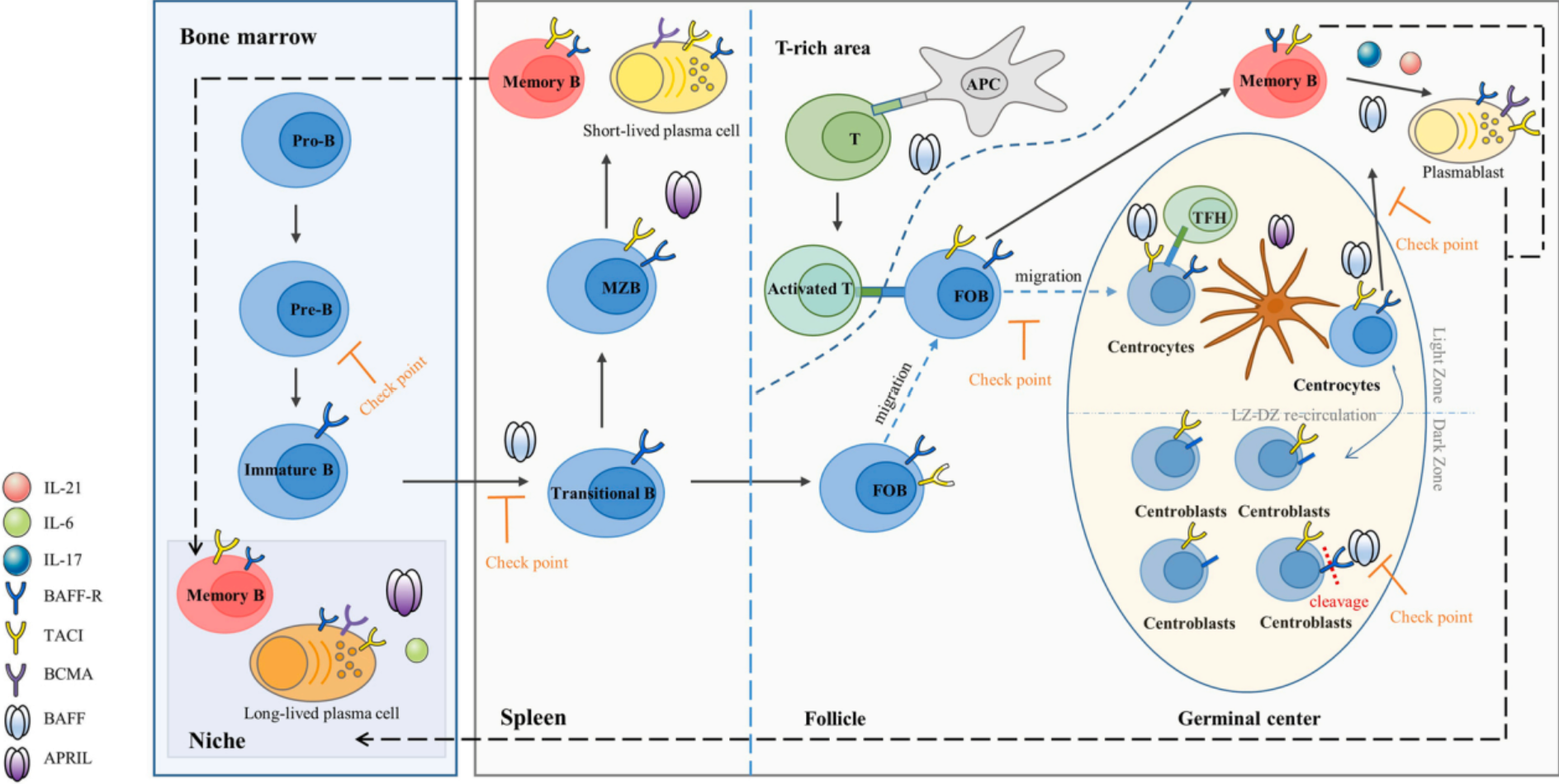
B cell activating factor (BAFF), also known as BLyS, zTNF4, TNFSF13B, THANK, and TALL-1, is a cytokine belonging to the tumor necrosis factor ligand superfamily. Its receptors are BAFF-R (BR3), TACI (transmembrane activator and calcium modulator and cyclophilin ligand interactor), and BCMA (B cell maturation antigen). The interaction between BAFF and its receptors triggers signals necessary for B cell formation and maintenance, thereby synthesizing immunoglobulins in response to foreign invasion. Appropriate BAFF levels in patients help maintain normal immunity, while insufficient levels may cause immunodeficiency, and excessive levels may cause abnormally high antibody production. When patients exhibit autoimmunity, it produces antibodies against their own tissues. Systemic lupus erythematosus and rheumatoid arthritis are both caused by higher levels of BAFF in the body. Therefore, regulating BAFF levels is quite important for the treatment of autoimmune diseases.
II. Three Forms of BAFF and Their Functional Differences.
BAFF exists in the body in three forms: the membrane-bound form, the soluble trimeric BAFF form, and the multimeric form composed of 60 BAFF monomers. These three forms differ significantly in structural characteristics and biological functions. Membrane-bound BAFF is expressed on the cell surface and mediates local signal transduction through cell-to-cell contact. Soluble trimeric BAFF is the primary form through which BAFF exerts systemic regulatory functions in the body, acting on distant target cells via the bloodstream. BAFF 60mer is a virus-like particle structure formed by 20 trimers linked through the DE loop region, with B cell proliferation-inducing activity significantly stronger than the trimeric form, possibly due to its more complete multivalent binding to B cell surface receptors. The roles of the various forms of BAFF in maintaining normal immunity and in disease have not been fully elucidated, and this knowledge gap drives in-depth research into the functions of different BAFF forms.
III. Pathological Role of Soluble BAFF Trimers in Systemic Lupus Erythematosus.
Soluble BAFF is expressed at high levels in individuals with systemic lupus erythematosus and in inflamed target organs such as the kidney. Soluble BAFF serves as a key factor for B cell homeostasis and survival. BAFF-dependent autoantibody formation by B cells causes glomerular immune complex deposition, initially at the glomerular basement membrane, glomerular mesangium, and interstitial tissue within proximal tubular epithelial cells.
These immune complex deposits cause complement fixation and neutrophil activation, leading to local kidney injury. Inflammatory mediators (such as IL-6, IL-8, and MCP-1) produced by damaged kidney cells promote the inflammatory cycle by increasing immune cell infiltration. Infiltrating immune cells include B cells, T cells, dendritic cells, neutrophils, and macrophages. This positive feedback loop continuously amplifies kidney inflammation, ultimately leading to progressive impairment of kidney function. Therefore, soluble BAFF trimers are not only markers of SLE disease activity but also key pathogenic mediators driving kidney injury.
IV. Application of BAFF Trimeric Protein in B Cell Function Research.
In BAFF-related basic research and drug development, high-quality BAFF trimeric protein is a core tool for dissecting its signal transduction mechanisms and evaluating targeted intervention strategies. BAFF trimeric protein can be used in the following research scenarios: as a standard for the establishment and validation of BAFF immunoassays; as a survival factor in in vitro B cell culture systems to maintain long-term survival and proliferation of B cells; for binding activity analysis of BAFF with BAFF-R, TACI, and BCMA receptors; and for anti-BAFF antibody drug screening and evaluation.
In experimental design, the following key factors should be considered. The concentration of BAFF trimers should be optimized according to the experimental system to achieve optimal effects in B cell survival and proliferation assays. Buffer components should avoid substances that interfere with the structural stability of BAFF trimers. For long-term culture experiments, fresh BAFF should be supplemented periodically to maintain its active concentration. Additionally, positive and negative controls are recommended to validate the effectiveness of the experimental system.
V. Conclusion.
To address the practical needs of BAFF-related research, UniBio provides BAFF Protein, Human. This product is suitable for application scenarios including in vitro survival and proliferation studies of human B cells, binding activity analysis of BAFF with BAFF-R/TACI/BCMA receptors, in vitro screening and evaluation of anti-BAFF antibody drugs, and BAFF function research in autoimmune disease models such as systemic lupus erythematosus. As a core factor in B cell survival regulation and a key driving molecule in the pathogenesis of systemic lupus erythematosus, BAFF trimers, by virtue of their precise regulation of B cell survival, proliferation, and immunoglobulin synthesis through three receptors, have become one of the most promising targets in the field of autoimmune disease treatment. Their high-level expression in the serum and inflamed target organs of SLE patients, as well as the pathological mechanism of driving kidney injury through immune complex deposition, provide a solid theoretical basis for BAFF-targeted therapeutic strategies. BAFF Protein, Human provides reliable tool support for mechanism research of the BAFF signaling pathway and targeted drug development, and will continue to drive innovation in the field of autoimmune disease treatment.
This article is reviewed and published by the technical expert team of UA
Disclaimer: This article partially utilizes artificial intelligence assistance in its creation. If any content involves copyright or intellectual property issues, please let us know and we promise to verify and remove it as soon as possible.
Purchase recombinant protein, choose 
UA protein focuses on providing various protein reagents, raw materials, and services required for drug research and development, cell therapy, gene therapy, and basic scientific research, including drug target proteins, immune checkpoint proteins, cytokines, tool enzymes, customized protein expression, and full-length transmembrane protein development. Nanjing Univ is committed to providing customers with high-quality products and professional services, and building a High-tech Biological Enterprise with International Competitiveness.
Target proteins | membrane proteins | cytokines | enzymes | viral antigens | protein customization
Nanjing UNIV Biotechnology Co., Ltd. Email:order@ua-bio.com Phone:+86-25-56221161

Product Information

Link:





©2021-2026 all rights reserved UNIV Biotechnology Co.,Ltd.
Privacy Policy 
网站备案号 苏ICP备2025207586号-2 浙公网安备33010202004867号
 Business license (three certificates in one)
 Tel:+86-25-56221161
E-mail:order@ua-bio.com
All products sold on this website shall not be used for clinical diagnosis or treatment of humans or animals, and shall only be used for non-medical purposes such as industrial or scientific research.


