

TK Kinase Activity Assay Kit: The Core Tool for Tyrosine Kinase-Targeted Drug Screening
Author: Senior Product Manager of UA Views:12 


This article systematically elucidates the central role of tyrosine kinases in cellular signal transduction and their significant value as drug targets, focusing on the technical principles and application systems of the TK kinase activity detection kit. It analyzes the advantages of the homogeneous detection method based on ADP quantification compared to traditional techniques and explores the application strategies of this kit in the screening of tyrosine kinase inhibitors, structure-activity relationship studies, and mechanism of action analysis.
- Recent Advances
- Product Information
Recent Advances
TK Kinase Activity Assay Kit: A Core Tool for Tyrosine Kinase-Targeted Drug Screening
Summary
This article systematically elaborates on the technical principles and application systems of the TK kinase activity assay kit, highlighting the central role of tyrosine kinases in cellular signal transduction and their significance as drug targets. It analyzes the advantages of the homogeneous ADP quantification-based detection method over traditional techniques and explores the application strategies of the kit in tyrosine kinase inhibitor screening, structure-activity relationship studies, and mechanism analysis.
This article systematically elaborates on the technical principles and application systems of the TK kinase activity assay kit, highlighting the central role of tyrosine kinases in cellular signal transduction and their significance as drug targets. It analyzes the advantages of the homogeneous ADP quantification-based detection method over traditional techniques and explores the application strategies of the kit in tyrosine kinase inhibitor screening, structure-activity relationship studies, and mechanism analysis.
I. The Central Role of Tyrosine Kinases in Cellular Signal Transduction and Disease.
Tyrosine kinases (TKs) are a family of protein kinases that catalyze the transfer of the terminal phosphate group from ATP to the hydroxyl group of tyrosine residues in protein substrates. The human genome encodes approximately 90 tyrosine kinases, including receptor tyrosine kinases (e.g., EGFR, HER2, VEGFR, PDGFR) and non-receptor tyrosine kinases (e.g., BCR-ABL, JAK, SRC, BTK). Receptor tyrosine kinases initiate downstream signaling cascades through ligand-induced dimerization and autophosphorylation, regulating key processes such as cell proliferation, differentiation, migration, and survival. Abnormal activation of tyrosine kinases due to gene mutations, amplifications, or chromosomal rearrangements can drive the development of various malignancies. Tyrosine kinases have become one of the most important target classes in anticancer drug development, with dozens of tyrosine kinase inhibitors approved for clinical use. Therefore, accurate and efficient measurement of tyrosine kinase activity is a fundamental technical requirement for targeted drug discovery and mechanistic research.
II. Technical Principles and Evolution of TK Kinase Activity Assays.
The core of TK kinase activity assays lies in the quantitative measurement of phosphorylation reaction progress. Traditional detection methods include radioactive isotope labeling, antibody-based detection, and fluorescence polarization assays. While radioactive methods offer high sensitivity, they involve safety concerns related to radioactive materials. Antibody-based detection relies on specific phospho-antibodies, limiting throughput and increasing costs. Fluorescence polarization assays allow homogeneous operation but are prone to interference from compound fluorescence.
ADP quantification-based detection methods have advanced significantly in recent years. The core logic is that in the kinase-catalyzed phosphotransfer reaction, each molecule of ATP consumed generates one molecule of ADP. Thus, by quantitatively measuring ADP production, kinase catalytic activity can be indirectly assessed. TK kinase activity assay kits typically employ a coupled enzyme chemiluminescence detection system—first, an ATP removal reagent is added to terminate the kinase reaction and eliminate interference from residual ATP. Then, an ADP detection reagent converts the generated ADP back into ATP, producing a bioluminescent signal proportional to ADP concentration via the luciferase/luciferin system. This design establishes a precise quantitative relationship between luminescence intensity and kinase activity, with detection sensitivity reaching picomolar levels.
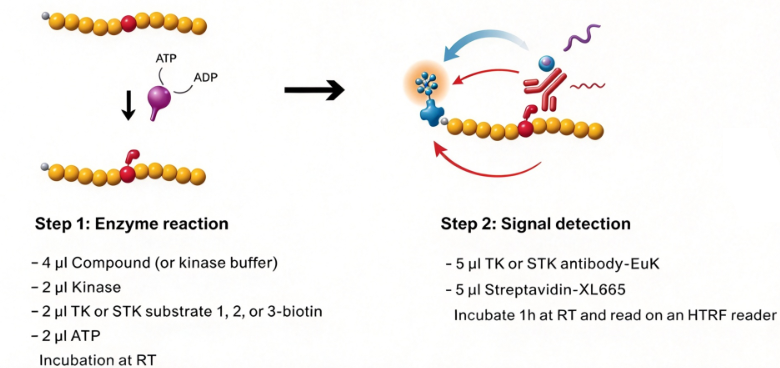
III. Advantages of Homogeneous ADP Quantification-Based Detection Methods.
Compared to traditional methods, ADP quantification-based TK kinase activity assay kits offer multiple technical advantages. In terms of substrate compatibility, they effectively detect activity whether the substrate is a peptide, intact protein, lipid, or carbohydrate, making them suitable for most tyrosine kinases and ATPase activity analyses. Regarding ATP concentration adaptability, the system accommodates a wide range of ATP concentrations, from low micromolar to high millimolar levels, enabling researchers to determine inhibitor competition types by varying ATP concentrations. In operational convenience, the homogeneous "add-mix-detect" format eliminates washing or separation steps and is compatible with high-throughput 96- and 384-well plates. For high-throughput screening, the optimized "glow-type" luminescent signal has a half-life of several hours, supporting batch processing, with Z-factors typically exceeding 0.7, meeting the reproducibility requirements of high-throughput screening. Additionally, the method is unaffected by compound fluorescence, making it suitable for screening diverse chemical libraries.
IV. Application Strategies of TK Kinase Activity Assay Kits in Drug Discovery.
TK kinase activity assay kits are integral to multiple key stages of targeted drug discovery. In compound screening, the kits enable high-throughput screening platforms to identify lead compounds with inhibitory activity from large compound libraries. In structure-activity relationship studies, systematic measurement of half-maximal inhibitory concentrations (IC50) reveals patterns between compound structure and activity, guiding structural optimization. In selectivity evaluation, the kits assess compound selectivity against family kinases or off-target kinases, reducing potential side effects. In mechanism studies, varying ATP concentrations helps determine inhibitor competition types—competitive inhibitors exhibit lower IC50 at low ATP concentrations, while non-competitive inhibitors' IC50 remains unaffected by ATP concentration. Additionally, the kits facilitate resistance mechanism studies of tyrosine kinase mutants and enzyme kinetic parameter determination.
In experimental design, key factors must be considered. Substrate and ATP concentrations should be optimized to ensure the detection system operates within the optimal linear range. Reaction time and temperature should be standardized based on kinase characteristics. Positive and negative controls are recommended to validate the experimental system. For different tyrosine kinase targets, appropriate substrate types can be selected based on their substrate preferences.
V. Conclusion.
In practical applications of TK kinase activity assays, high-quality detection reagents are critical for ensuring data reliability and experimental reproducibility. To meet kinase activity detection needs, UA offers the UA-Glo® Kinase ADP Max Assay Kit. This product features an optimized coupled enzyme chemiluminescence system with the following core characteristics: high sensitivity for quantifying very low levels of ADP production, suitable for low-activity tyrosine kinases; excellent substrate compatibility for peptides, proteins, lipids, and carbohydrates; broad ATP concentration adaptability to distinguish competitive and non-competitive inhibitors; homogeneous operation without washing or separation steps, compatible with high-throughput automation platforms; and stable "glow-type" luminescent signals supporting flexible time windows. The kit is suitable for tyrosine kinase inhibitor screening and structure-activity analysis, kinase activity regulation mechanism studies, and various enzymatic reactions where ADP is a product.
As a core tool in tyrosine kinase-targeted drug development, the TK kinase activity assay kit, with its homogeneous ADP quantification-based detection method and optimized chemiluminescence system, provides a systematic solution for kinase inhibitor discovery and optimization. From receptor tyrosine kinases to non-receptor tyrosine kinases, and from compound screening to mechanism studies, the TK kinase activity assay kit continues to play an irreplaceable supporting role. The UA-Glo® Kinase ADP Max Assay Kit offers a reliable tool for tyrosine kinase activity detection, driving innovation in kinase-targeted drug development.
This article is reviewed and published by the technical expert team of UA
Disclaimer: This article partially utilizes artificial intelligence assistance in its creation. If any content involves copyright or intellectual property issues, please let us know and we promise to verify and remove it as soon as possible.
Purchase recombinant protein, choose Nanjing UA-Bio
UA protein focuses on providing various protein reagents, raw materials, and services required for drug research and development, cell therapy, gene therapy, and basic scientific research, including drug target proteins, immune checkpoint proteins, cytokines, tool enzymes, customized protein expression, and full-length transmembrane protein development. Youai is committed to providing customers with high-quality products and professional services, and building a High-tech Biological Enterprise with International Competitiveness.
Target proteins | membrane proteins | cytokines | enzymes | viral antigens | protein customization
Nanjing UA Biotechnology Co., Ltd. Email:order@ua-bio.com Phone:+86-25-56221161

Product Information

Link:





©2021-2026 all rights reserved UA Biotechnology Co.,Ltd.
Privacy Policy 
网站备案号 浙ICP备2022019033号-2 浙公网安备33010202004867号
 Business license (three certificates in one)
 Tel:+86-25-56221161
E-mail:order@ua-bio.com
All products sold on this website shall not be used for clinical diagnosis or treatment of humans or animals, and shall only be used for non-medical purposes such as industrial or scientific research.