TR-FRET Kinase Activity Assay: A Technical Platform from Energy Transfer to High-Sensitivity Screening
Overview
This article focuses on the molecular principles of TR-FRET technology and its application in kinase activity assays. It systematically explains the physical mechanism of time-resolved fluorescence resonance energy transfer (TR-FRET) and its unique advantages in eliminating background interference. The long fluorescence lifetime characteristics of lanthanide donors and delayed detection strategies are analyzed, along with the technology's value in kinase activity analysis, inhibitor screening, and drug discovery.
I. Basic Principles and Core Features of TR-FRET Technology
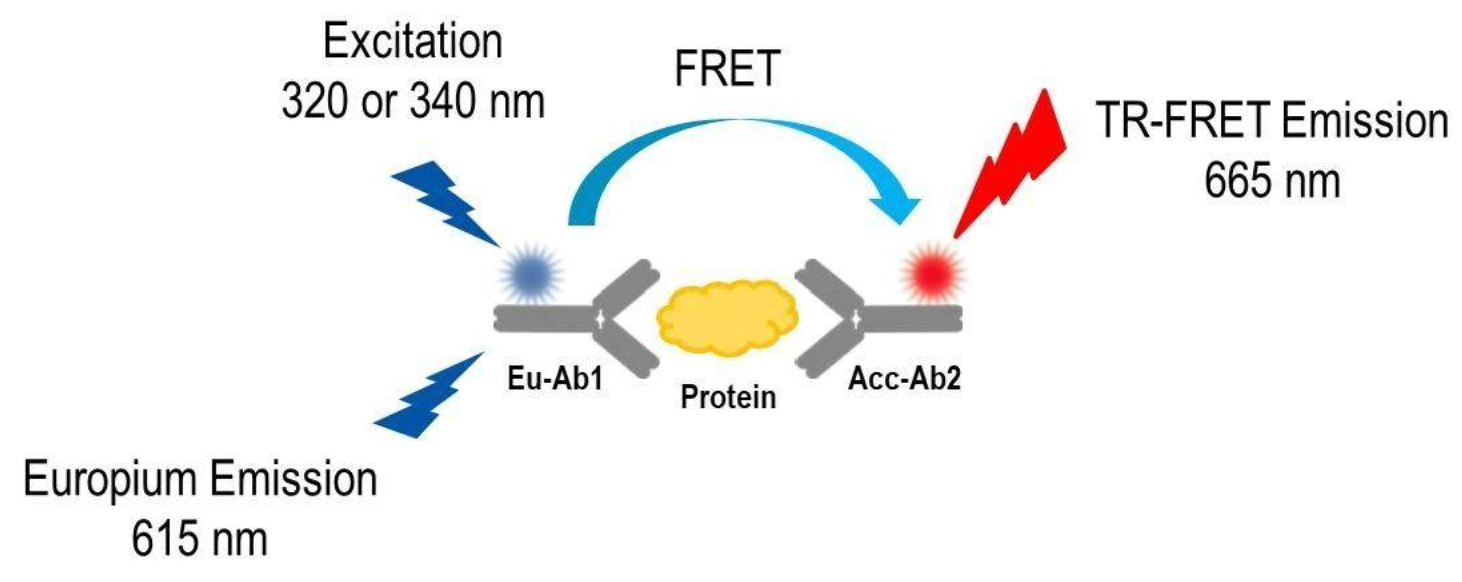
TR-FRET (Time-Resolved Fluorescence Resonance Energy Transfer) is a highly sensitive and widely used detection technology in drug development and biological research, primarily for studying protein-protein interactions, enzyme reaction kinetics, and receptor-ligand binding. The working principle involves detecting energy transfer between two fluorescent molecules (donor and acceptor): when the donor molecule is excited by a light source (typically at 340 nm wavelength), if the donor and acceptor molecules are within close proximity (usually 5 to 10 nm), energy is transferred from the donor to the acceptor via the FRET phenomenon. This distance-dependent energy transfer property makes TR-FRET a powerful tool for real-time monitoring of molecular interactions and proximity effects.
The principle of TR-FRET detection for induced proximity effects lies in: when two labeled molecules are brought close together through a biological recognition event (e.g., protein-protein interaction, receptor-ligand binding, or enzyme-substrate binding), the distance between the donor and acceptor is reduced to the effective FRET range, generating a detectable energy transfer signal. The signal intensity correlates positively with the degree of molecular binding, enabling quantitative analysis of biomolecular interactions.
II. Optical Properties of Lanthanide Donors and Delayed Detection Strategy
TR-FRET assays typically use lanthanides as donors, which exhibit large Stokes shifts and millisecond-level long fluorescence lifetimes, enabling delayed detection. The core advantages of lanthanide donors include: (1) Stokes Shift: The significant spacing between excitation and emission spectra of lanthanides effectively avoids interference from excitation light scattering on emission signals. (2) Fluorescence Lifetime: The millisecond-level fluorescence lifetime of lanthanides far exceeds the nanosecond-level lifetime of conventional fluorophores. This property provides the physical basis for time-resolved detection—by introducing a delay after excitation, short-lived background fluorescence decays before signal acquisition, minimizing interference from light scattering and autofluorescence from media components and proteins, thereby significantly improving detection accuracy. Additionally, lanthanide donors offer excellent photostability and batch-to-batch consistency, making them suitable for long-term high-throughput screening needs.
III. Application of TR-FRET Technology in Kinase Activity Assays
In kinase activity assays, TR-FRET technology enables quantitative analysis through two primary strategies. The first is an antibody-based strategy—using a fluorescently labeled antibody specific to phosphorylated substrates as the acceptor. When the kinase catalyzes substrate phosphorylation, the antibody binds to the phosphorylated substrate, forming a proximity effect that generates a FRET signal. The sensitivity of this strategy depends on the specificity and affinity of the phosphorylation antibody. The second is an ADP quantification strategy—kinases transfer phosphate groups from ATP to substrates, generating one ADP molecule per ATP consumed. By coupling an enzyme system to convert ADP into a detectable signal, universal quantitative analysis of kinase activity is achieved.
TR-FRET technology offers unique advantages in kinase inhibitor screening. Its homogeneous operation eliminates the need for washing or separation steps, making it compatible with high-throughput formats such as 96- and 384-well plates. The delayed detection mode significantly reduces interference from compound autofluorescence and media components. The stable signal allows batch processing and flexible time windows. These features make TR-FRET a widely adopted core technology platform in kinase-targeted drug discovery.
IV. Application Scenarios and Key Experimental Design Considerations for TR-FRET Technology
TR-FRET technology is applicable across multiple research areas. In protein-protein interaction studies, it enables quantitative analysis of receptor dimerization, signaling complex assembly, and binding affinity at protein interfaces. In enzyme kinetics studies, it allows real-time monitoring of enzyme activity over time and determination of kinetic parameters. In receptor-ligand binding studies, it measures binding affinity and competitive inhibitor activity. In drug screening, it facilitates high-throughput screening platforms for identifying active compounds from large libraries.
Key experimental design considerations include: optimizing the labeling ratio of donor and acceptor to balance signal intensity and signal-to-noise ratio; avoiding buffer components that interfere with FRET signals; setting detection wavelengths and delay times based on the optical properties of the donor-acceptor pair; and including positive and negative controls to validate the assay system.
V. Conclusion
In practical kinase activity assays, high-quality detection reagents are critical for ensuring data reliability and experimental reproducibility. To meet kinase activity detection needs, UA offers the UA-Glo® Kinase ADP Assay. This product is based on an optimized coupled-enzyme chemiluminescence system, quantifying ADP generated during kinase reactions to reflect kinase activity. The kit features: high sensitivity (detecting ADP at picomolar levels); broad substrate compatibility (supporting peptides, proteins, lipids, and carbohydrates); wide ATP concentration range (enabling differentiation of competitive and non-competitive inhibitors); homogeneous operation (no washing steps, compatible with high-throughput automation); and stable luminescence signals (flexible time windows). It is suitable for kinase inhibitor screening, structure-activity relationship analysis, kinase activity regulation studies, and other ADP-generating enzymatic reactions.
TR-FRET technology, leveraging its proximity-based FRET detection principle and the long fluorescence lifetime of lanthanide donors, has become a cornerstone high-sensitivity detection platform in drug development and biological research. From protein-protein interaction analysis to kinase activity assays, from receptor-ligand binding studies to high-throughput drug screening, TR-FRET continues to play an irreplaceable role. The UA-Glo® Kinase ADP Assay provides a reliable tool for kinase activity detection, driving further exploration in kinase-targeted drug development.












 Business license (three certificates in one)