

MHC tetramer: A key technological platform for antigen-specific T cell detection and immunological research
Author: Senior Product Manager of UA Views:9 


This article focuses on the principles of MHC tetramer technology and its applications in immunological research, systematically elucidating the central role of antigen-specific T cells in adaptive immune responses and the technical requirements for their detection. It analyzes the molecular mechanism by which MHC tetramers enhance TCR binding affinity through multivalent effects and explores their wide-ranging applications in viral infection studies, vaccine design, tumor immunology, and antigen epitope screening.
- Recent Advances
- Product Information
Recent Advances
MHC Tetramers: A Key Technological Platform for Antigen-Specific T Cell Detection and Immunological Research
Summary
This article systematically elaborates on the principles of MHC tetramer technology and its applications in immunological research, highlighting the central role of antigen-specific T cells in adaptive immune responses and the technical requirements for their detection. It analyzes the molecular mechanism by which MHC tetramers enhance TCR binding affinity through multivalent effects and explores their broad applications in viral infection research, vaccine design, tumor immunology, and antigen epitope screening.
This article systematically elaborates on the principles of MHC tetramer technology and its applications in immunological research, highlighting the central role of antigen-specific T cells in adaptive immune responses and the technical requirements for their detection. It analyzes the molecular mechanism by which MHC tetramers enhance TCR binding affinity through multivalent effects and explores their broad applications in viral infection research, vaccine design, tumor immunology, and antigen epitope screening.
I. The Immunological Significance and Technical Requirements for Antigen-Specific T Cell Detection.
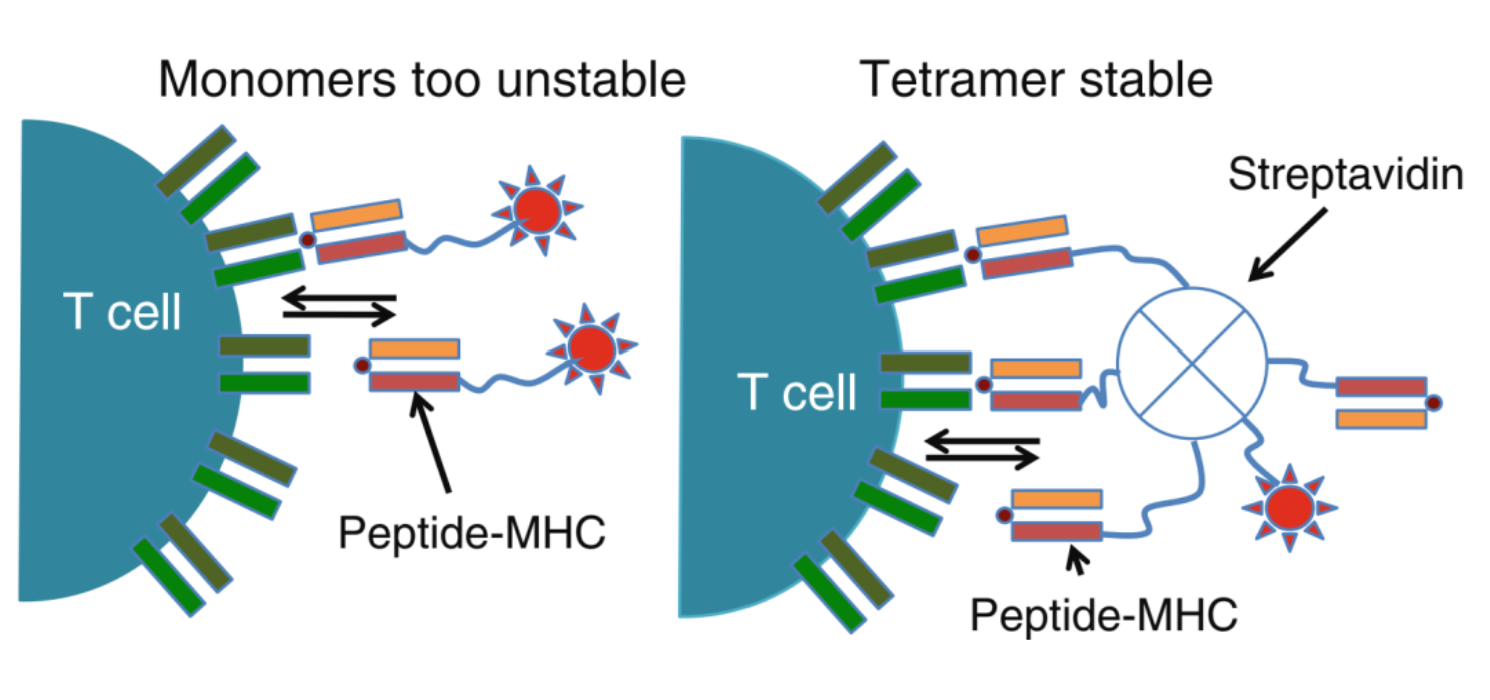
The COVID-19 pandemic has gradually spread globally, prompting researchers and companies worldwide to accelerate research on the virus's fundamentals, vaccines, and therapeutics. Antigen-specific T cells play a pivotal role in adaptive immune responses, and their study is crucial in vaccine design and efficacy monitoring, viral infections, cancer research, and antigen analysis. T cells recognize target cells or antigen-presenting cells through their surface T cell receptors (TCRs), which bind to specific peptide-MHC complexes, thereby initiating immune responses. However, the natural affinity between TCRs and single MHC-peptide complexes is low, and the dissociation rate is rapid, posing fundamental technical challenges for directly detecting antigen-specific T cells. How to stably label and quantify this rare cell population has become a critical issue in immunological research and clinical translation.
II. The Molecular Principles and Design Strategies of MHC Tetramer Technology.
MHC tetramers are a technology that enables direct detection of antigen-specific T cells. An MHC tetramer consists of four monomeric molecules of major histocompatibility complex (MHC) bound to antigen peptides and labeled with fluorescence. The core technology involves using the biotin-streptavidin system to assemble four biotinylated MHC-peptide monomers into a tetrameric complex. When monomeric MHC molecules form a tetramer, their affinity for TCRs can be significantly enhanced—a single tetramer molecule can simultaneously bind to multiple TCRs on the same T cell surface, markedly reducing the dissociation rate through multivalent effects, thereby stabilizing the complex for direct detection of specific T cells. Combined with flow cytometry, labeled cells can be precisely characterized and quantified. Additionally, when paired with other surface marker staining, it allows for in-depth exploration of the phenotypic features, differentiation states, and functional subsets of antigen-specific T cells.
III. Applications of MHC Tetramers in Viral Infection Research.
MHC tetramers play an indispensable role in viral infection research. In the detection of virus-specific T cell immunity, this technology can be used to quantitatively analyze the frequency and dynamic changes of antigen-specific CD8+ T cells in peripheral blood or tissues post-infection. In mechanistic studies, by combining memory and functional marker staining, it enables detailed analysis of the differentiation trajectories and functional states of virus-specific T cells. In COVID-19 research, MHC tetramer technology has been widely applied to detect SARS-CoV-2-specific T cells, providing a critical tool for understanding the immune response characteristics of viral infections and evaluating vaccine-induced T cell immunity.
IV. Applications of MHC Tetramers in Vaccine Design and Efficacy Monitoring.
In the field of vaccine development, MHC tetramers can be used to screen antigen epitopes for vaccine design—by detecting the strength of T cell responses induced by different candidate epitopes, the most immunodominant epitopes can be selected for vaccine design. In vaccine efficacy monitoring, this technology can assess the extent of expansion and persistence of specific T cells post-vaccination, providing direct evidence for evaluating vaccine immunogenicity. Additionally, MHC tetramers can be used to assess vaccine toxicity, safety, and other indicators, offering key data support for clinical translation of vaccines.
V. Applications of MHC Tetramers in Tumor Immunology and Antigen Epitope Research.
In tumor immunology research, MHC tetramers can be used to screen tumor-specific antigens, aiding in foundational studies for cell therapy. By detecting the presence and frequency of antigen-specific T cells in tumor-infiltrating lymphocytes, the immunogenicity of tumors and patients' potential responses to immunotherapy can be evaluated. In antigen epitope research, this technology can be used to screen immunodominant epitopes for peptide vaccines and TCR-T cell therapy development. Furthermore, MHC tetramers can be employed for peptide affinity testing, evaluating the binding strength of different epitope peptides to MHC molecules. In quantitative detection of specific T cells, this technology can isolate specific T cells via flow cytometry for in vitro expansion and functional analysis, providing high-quality cell sources for adoptive cell therapy.
VI. Conclusion.
In practical applications of tumor immunology and antigen-specific T cell detection, high-quality MHC tetramer reagents are key to ensuring detection specificity and data reliability. To meet this research need, UA offers the UA-MHC HLA-A1101/VVVGADGVGK KRAS G12D Tetramer-APC Labelled. This product is an APC-labeled tetrameric complex that specifically recognizes HLA-A1101-restricted KRAS G12D neoantigen-specific CD8+ T cells. It is suitable for screening and validating KRAS G12D-specific TCRs, quality control of TCR-T cell products, and detecting antigen-specific T cells in tumor immunotherapy research.
MHC tetramer technology, with its ingenious molecular design that enhances TCR binding affinity through multivalent effects, has become the gold standard method for detecting antigen-specific T cells. From viral infection immune monitoring to vaccine immunogenicity evaluation, from tumor-specific antigen screening to antigen epitope identification, MHC tetramers continue to play an irreplaceable supporting role in both basic immunological research and clinical translation. The UA-MHC HLA-A*1101/VVVGADGVGK KRAS G12D Tetramer-APC Labelled provides a reliable tool for detecting KRAS G12D-specific T cells and developing TCR-T cell therapies, driving innovation in the field of tumor immunotherapy.
This article is reviewed and published by the technical expert team of UA
Disclaimer: This article partially utilizes artificial intelligence assistance in its creation. If any content involves copyright or intellectual property issues, please let us know and we promise to verify and remove it as soon as possible.
Purchase recombinant protein, choose Nanjing UA-Bio
UA protein focuses on providing various protein reagents, raw materials, and services required for drug research and development, cell therapy, gene therapy, and basic scientific research, including drug target proteins, immune checkpoint proteins, cytokines, tool enzymes, customized protein expression, and full-length transmembrane protein development. Youai is committed to providing customers with high-quality products and professional services, and building a High-tech Biological Enterprise with International Competitiveness.
Target proteins | membrane proteins | cytokines | enzymes | viral antigens | protein customization
Nanjing UA Biotechnology Co., Ltd. Email:order@ua-bio.com Phone:+86-25-56221161

Product Information

Link:





©2021-2026 all rights reserved UA Biotechnology Co.,Ltd.
Privacy Policy 
网站备案号 浙ICP备2022019033号-2 浙公网安备33010202004867号
 Business license (three certificates in one)
 Tel:+86-25-56221161
E-mail:order@ua-bio.com
All products sold on this website shall not be used for clinical diagnosis or treatment of humans or animals, and shall only be used for non-medical purposes such as industrial or scientific research.