




Recombinant Protein: Core Technical Platform from Gene Cloning to Functional Research
Author: Senior Product Manager of UA Views:2 


This article focuses on the technical principles and preparation strategies of recombinant proteins, systematically elaborating on their central role in life science research and biopharmaceutical development. It analyzes key technical elements such as the selection of expression systems, tag design, and purification strategies, and explores the broad applications of recombinant proteins in structural and functional studies, drug screening, and the development of diagnostic reagents.
- Recent Advances
- Product Information
Recent Advances
Recombinant Proteins: Core Technical Platform from Gene Cloning to Functional Research
Overview
This article focuses on the technical principles and preparation strategies of recombinant proteins, systematically elaborating their central role in life science research and biopharmaceutical development. It analyzes key technical elements such as expression system selection, tag design, and purification strategies, and explores the wide applications of recombinant proteins in structural-functional studies, drug screening, and diagnostic reagent development.
This article focuses on the technical principles and preparation strategies of recombinant proteins, systematically elaborating their central role in life science research and biopharmaceutical development. It analyzes key technical elements such as expression system selection, tag design, and purification strategies, and explores the wide applications of recombinant proteins in structural-functional studies, drug screening, and diagnostic reagent development.
I. Technical Background and Core Significance of Recombinant Proteins
Recombinant proteins are functional proteins obtained by cloning the target gene into an expression vector through genetic engineering, introducing it into host cells, and then expressing and purifying the protein using the cell's protein synthesis machinery. As the primary executors of life activities, the study of protein structure and function is fundamental to understanding disease mechanisms and developing therapeutic approaches. However, naturally sourced proteins often have low abundance, are difficult to extract, and are challenging to obtain in high-purity forms, severely limiting progress in protein science. The advent of recombinant protein technology has fundamentally addressed this bottleneck—by introducing target genes into expression systems such as E. coli, yeast, insect cells, or mammalian cells, high-efficiency expression and large-scale preparation of target proteins can be achieved, providing ample material for subsequent structural analysis, functional research, and application development.
II. Selection Strategies for Recombinant Protein Expression Systems
The choice of expression system for recombinant proteins is the primary factor determining the success of preparation. Different expression systems have distinct characteristics in terms of protein folding, post-translational modifications, and yield. The E. coli expression system, with its simplicity of operation, low cost, and rapid growth, is the preferred platform for non-glycosylated proteins, suitable for structurally simple proteins that do not require complex post-translational modifications. However, E. coli lacks the folding assistance mechanisms of eukaryotic cells, making it prone to forming inclusion bodies when expressing complex proteins. Yeast expression systems combine the simplicity of single-celled organisms with the protein processing capabilities of eukaryotic cells, enabling partial glycosylation modifications and are suitable for moderately complex eukaryotic proteins. Mammalian cell expression systems (e.g., HEK293 and CHO cells) can perform complex post-translational modifications, including correct glycosylation, disulfide bond formation, and protein folding, making them suitable for complex proteins requiring native conformation and full biological activity, such as extracellular domains of membrane receptors, cytokines, and antibodies. Insect cell expression systems, mediated by baculovirus, enable high-yield eukaryotic protein expression and are suitable for viral proteins and some membrane proteins.
III. Tag Design and Purification Strategies for Recombinant Proteins
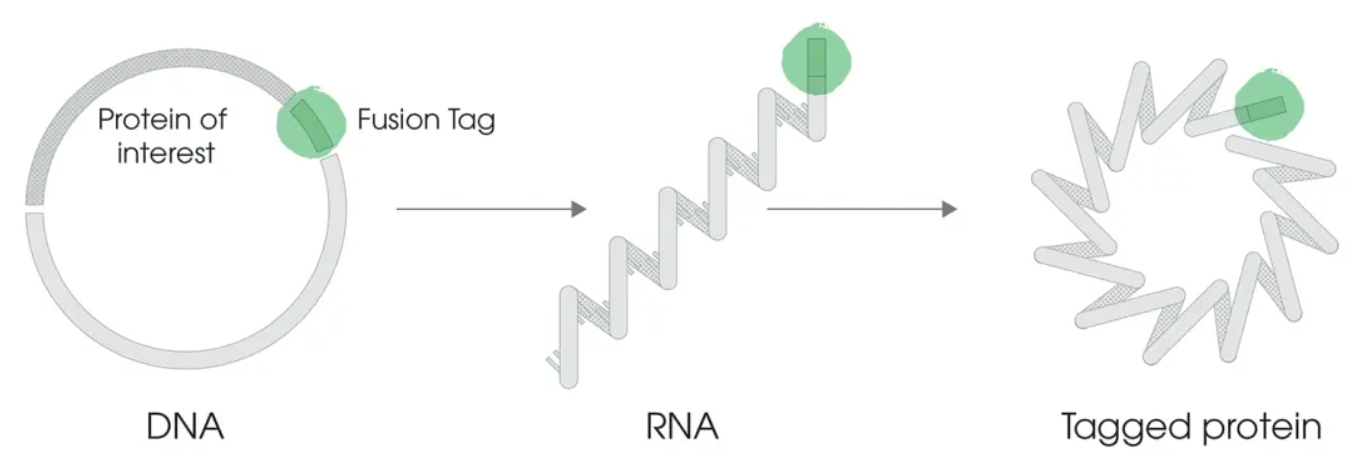
Fusion tag technology is a core tool in recombinant protein preparation. By fusing specific tags with the target protein, expression monitoring and affinity purification of the target protein can be achieved through detection of the fusion tag. The His tag, composed of six histidine residues with a molecular weight of only 0.84 kDa, can specifically bind to nickel-chelating media, enabling immobilized metal affinity chromatography purification, and is the most widely used purification tag. The GST tag, with a molecular weight of 26 kDa, enhances the solubility of the target protein and protects it from extracellular protease degradation, allowing purification via glutathione agarose affinity resin. The FLAG tag is an 8-amino-acid hydrophilic peptide with a small molecular weight and commercially available matching antibodies, making it a common tag for Western blot and immunoprecipitation experiments. The AviTag is a 15-amino-acid short peptide with a single biotinylated lysine site that can be specifically biotinylated by biotin ligase, used for protein separation, purification, and interaction studies. The SNAP-Tag can covalently bind benzylguanine derivatives, enabling labeling and detection of fusion proteins in living cells. When selecting tags, it is essential to consider the impact on target protein folding and function, the suitability of N-terminal or C-terminal labeling, and the specific requirements of downstream applications.
IV. Applications of Recombinant Proteins in Life Sciences and Drug Development
Recombinant proteins have broad application value in life science research and biopharmaceutical development. In structural biology research, recombinant proteins are the core materials for X-ray crystallography, cryo-electron microscopy, and NMR structure determination. In drug screening, recombinant receptor proteins and enzyme proteins are key tools for in vitro activity evaluation and high-throughput screening. In diagnostic reagent development, recombinant antigens are the foundational materials for establishing immunoassays and preparing standards. In cell therapy, recombinant cytokines are essential additives for the in vitro expansion and functional regulation of CAR-T cells and NK cells. In targeted protein degradation research, recombinant E3 ligase complex proteins are core tools for evaluating PROTAC molecule binding activity and analyzing ternary complex formation.
V. Conclusion
As a core technical platform in modern life science research, recombinant protein technology, with its diverse expression system options, flexible tag design, and efficient purification strategies, provides a systematic solution for protein structure determination, functional research, and drug development. From structural and functional exploration in basic research to diagnostic reagent and therapeutic drug development in clinical translation, recombinant proteins consistently play an irreplaceable supporting role. The Biotinylated CRBN/DDB1 Protein provides critical tool support for mechanism research and drug development in the field of targeted protein degradation, continuously driving the translational process from basic discoveries to clinical applications.
In targeted protein degradation research, high-quality recombinant CRBN/DDB1 complex proteins are core tools for evaluating PROTAC molecule binding activity, analyzing ternary complex formation, and conducting drug screening. To meet this research demand, Uni offers the Biotinylated CRBN/DDB1 Protein, which combines the CRBN/DDB1 complex with biotin labeling. The high specificity and sensitivity of the biotin-streptavidin system provide higher signal-to-noise ratios and faster detection speeds in PROTAC molecule screening and binding activity evaluation based on ELISA, SPR, and flow cytometry, making it suitable for applications such as PROTAC molecule binding activity screening, CRBN ligand competition experiments, and targeted protein degradation mechanism research.
This article is reviewed and published by the technical expert team of UA
Disclaimer: This article partially utilizes artificial intelligence assistance in its creation. If any content involves copyright or intellectual property issues, please let us know and we promise to verify and remove it as soon as possible.
Purchase recombinant protein, choose Nanjing UA-Bio
UA protein focuses on providing various protein reagents, raw materials, and services required for drug research and development, cell therapy, gene therapy, and basic scientific research, including drug target proteins, immune checkpoint proteins, cytokines, tool enzymes, customized protein expression, and full-length transmembrane protein development. Youai is committed to providing customers with high-quality products and professional services, and building a High-tech Biological Enterprise with International Competitiveness.
Target proteins | membrane proteins | cytokines | enzymes | viral antigens | protein customization
Nanjing UA Biotechnology Co., Ltd. Email:order@ua-bio.com Phone:+86-25-56221161

Product Information

Link:





©2021-2026 all rights reserved UA Biotechnology Co.,Ltd.
Privacy Policy 
网站备案号 浙ICP备2022019033号-2 浙公网安备33010202004867号
 Business license (three certificates in one)
 Tel:+86-25-56221161
E-mail:order@ua-bio.com
All products sold on this website shall not be used for clinical diagnosis or treatment of humans or animals, and shall only be used for non-medical purposes such as industrial or scientific research.
