pHAb Reactive Dyes: Intelligent pH-Sensing Tools for Antibody Internalization Studies
Summary
This article systematically elaborates on the molecular characteristics and biological applications of pHAb reactive dyes as pH-sensor dyes for antibody labeling, analyzing their chemical conjugation principles and intelligent response mechanisms in antibody internalization studies.
1. Molecular Characteristics and Chemical Basis of pHAb Reactive Dyes.
pHAb reactive dyes are a class of pH-sensor fluorescent dyes specifically designed for antibody labeling, with their core feature being the strong dependence of fluorescence intensity on solution pH. In neutral environments with pH greater than 7, the fluorescence intensity of pHAb dyes is extremely low; however, as the solution becomes more acidic, their fluorescence intensity increases significantly. The excitation wavelength maximum of these dyes is at 532 nm, and the emission wavelength maximum is at 560 nm, making them suitable for fluorescence detection instruments equipped with TAMRA or Cy3 filter settings.
A key chemical feature of pHAb reactive dyes is that each dye molecule contains two sulfonate groups. This structural design significantly enhances the solubility of the dye in water and reduces aggregation phenomena commonly observed in other non-sulfonated dyes. More importantly, even after conjugation with antibodies, pHAb dyes retain their fluorescence response capability to pH changes.
2. Chemical Conjugation Principles and Workflow of pHAb Reactive Dyes.
pHAb reactive dyes are available in two active forms to meet different antibody conjugation needs. The pHAb amine-reactive dye contains a succinimidyl ester group, which can react with the primary amines of lysine amino acid residues on antibodies. The pHAb thiol-reactive dye, on the other hand, contains a maleimide group that can react with thiols. When the disulfide bonds in the hinge region of an antibody are reduced to thiols by reducing agents (such as DTT or TCEP), the maleimide group binds to the antibody.
Regarding the conjugation workflow, pHAb reactive dyes can be conjugated to antibodies in two different ways. The first is the traditional solution-phase chemical conjugation process, which requires purified antibody concentrations between 1.0 and 5.0 mg/ml and involves multiple buffer exchange steps. The second is a magnetic bead-based conjugation method, which uses magnetic protein A and protein G affinity beads to selectively capture antibodies from purified antibody solutions or directly from biological samples expressing antibodies (such as cell culture media). The conjugation steps are then performed on the beads, followed by elution of the pHAb-conjugated antibodies using low-pH buffers and rapid neutralization. The advantages of the bead-based conjugation method include: no need for purified antibodies, as antibody purification and conjugation can be achieved in a single workflow; the beads support parallel conjugation of multiple antibody samples; diluted samples containing 50 μg/ml antibodies can be easily conjugated with excellent recovery rates; and sample volumes ranging from 1.0 to 50 ml can be easily processed.
3. Intelligent Response Mechanism of pHAb Dyes and Antibody Internalization Studies.
The core application of pHAb reactive dyes lies in monitoring receptor-mediated antibody internalization. When antibodies conjugated with pHAb dyes bind to antigens on the cell membrane, their fluorescence intensity is very low. However, during receptor-mediated internalization, the antibody-pHAb conjugates undergo internalization and enter the lysosomal system, where the pH becomes more acidic, causing the antibody-pHAb conjugates to fluoresce. This increase in fluorescence intensity after internalization can be detected using various techniques, including cell imaging, flow cytometry, and fluorescence-based plate readers.
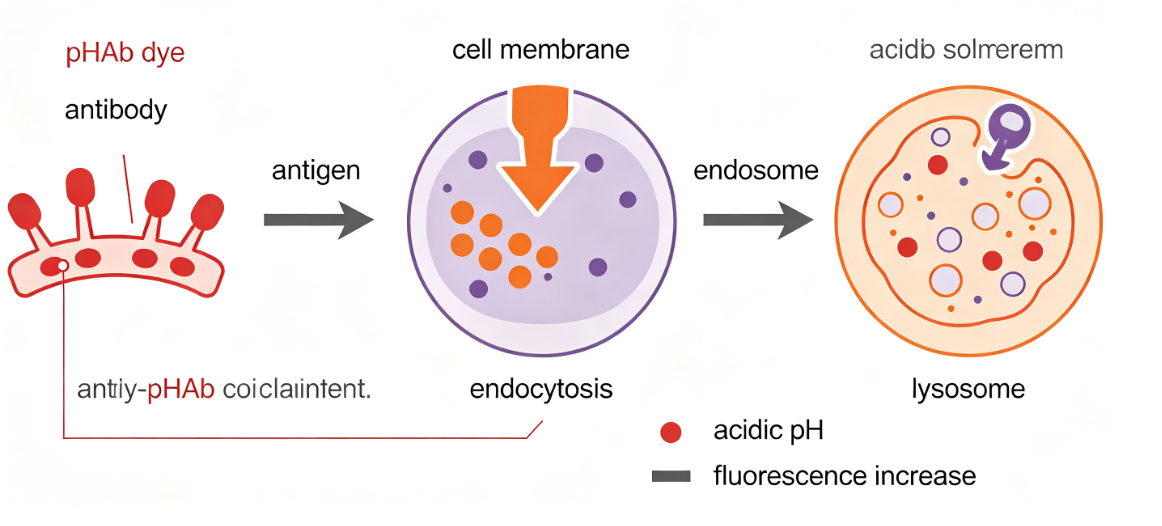
This mechanism works based on the natural pH difference between the intracellular and extracellular environments: the extracellular environment maintains a neutral pH (approximately 7.4), while the interior of endosomes and lysosomes presents an acidic environment (pH 5.0-6.0). The fluorescence signal of pHAb dyes is extremely low at pH greater than 7 but increases significantly as the pH drops to around 5.0, enabling precise reporting of whether antibodies have entered the acidic vesicles of cells. After conjugation with antibodies, the pH-responsive properties of the dyes remain unchanged, and the conjugation chemistry (amine or thiol) does not affect the pH-responsive behavior of the dyes.
4. Application Value of pHAb Dyes in ADC Drug Development.
Receptor-mediated internalization is a key mechanism of action for antibody-drug conjugates (ADCs). ADC drugs require antibodies to efficiently bind to target cells and be internalized, followed by the intracellular release of toxic drug molecules. However, traditional internalization research methods suffer from limitations such as multi-step operations unsuitable for screening, low signal-to-background ratios, and incompatibility with kinetic measurements.
The application of pHAb dyes effectively addresses these issues. This method includes water-soluble, bright, and photostable pH-sensor dyes for studying internalization, as well as optimized conjugation methods that allow direct conjugation of pHAb dyes to antibodies from cell culture media. More importantly, this technology enables real-time internalization measurements and screening with high signal-to-background ratios in 96-well plate formats, making large-scale screening of internalization properties in antibody libraries possible and potentially improving the efficiency of identifying ADC candidate molecules.
5. Conclusion.
To meet the demand for pH-sensor dyes in antibody internalization research and ADC drug development, Uni offers pHAb Thiol Reactive Dye. This product uses a maleimide group for specific covalent conjugation with thiols in the reduced hinge region of antibodies, facilitating the preparation of antibody-pHAb conjugates and fluorescence detection of receptor-mediated internalization. It provides reliable tool support for screening the internalization activity of ADC candidate antibodies.