




The Three Waves of Astrocyte Calcium Signaling Evolution: From Discovery to Controversy and New Mechanisms
Author: Senior Product Manager of UA Views:9 


This article systematically elaborates on the three waves of evolution in astrocyte calcium signaling research. It details the discovery of calcium transients and gliotransmitter release in the first wave, analyzes the core evidence of the functional controversies surrounding calcium signaling in the second wave, and introduces the new mechanisms of calcium transients in fine astrocyte processes revealed by the third wave, along with their regulatory effects on neuronal function.
- Recent Advances
- Product Information
Recent Advances
The Three Waves of Astrocyte Calcium Signaling: From Discovery to Controversy to New Mechanisms
Summary
This article systematically reviews the three waves of research on astrocyte calcium signaling, detailing the discovery of calcium transients and gliotransmitter release in the first wave, analyzing the core evidence of controversies over calcium signaling functions in the second wave, and introducing new mechanisms of calcium transients in fine astrocyte processes revealed by the third wave, along with their regulatory effects on neuronal function.
This article systematically reviews the three waves of research on astrocyte calcium signaling, detailing the discovery of calcium transients and gliotransmitter release in the first wave, analyzing the core evidence of controversies over calcium signaling functions in the second wave, and introducing new mechanisms of calcium transients in fine astrocyte processes revealed by the third wave, along with their regulatory effects on neuronal function.
I. Background of Astrocyte Calcium Signaling Research
Previous studies found that calcium ion concentrations in astrocytes transiently increase and can release "gliotransmitters" that act on neurons and vascular smooth muscle, leading to the hypothesis that astrocytes are the primary regulators of neuronal spikes, synaptic plasticity, and cerebral blood flow. However, these findings were challenged by the second wave of research, which argued that astrocyte calcium transients do not mediate gliotransmitter functions and are too slow to account for rapid blood flow increases. Notably, research trends have now shifted again—the most significant calcium transients occur in fine astrocyte processes not resolved in earlier studies, and new mechanisms by which intracellular calcium ion concentrations are elevated and exert their effects have been discovered. Researchers review how the third wave of discoveries has transformed our understanding of astrocyte calcium signaling and its impact on neuronal function.
II. The First Wave of Calcium Signaling: Gliotransmitter Release and Neuronal Regulation
The first wave of research established the fundamental framework of astrocyte calcium signaling. Glutamate activates G protein-coupled receptors, leading to increased intracellular calcium ion concentrations in astrocytes. It has been reported that GABA and ATP (or ADP) can promote the release of gliotransmitters such as ATP, glutamate, D-serine, and GABA. These gliotransmitters can modulate postsynaptic neuronal activity, particularly by inducing NMDA receptor-mediated currents through glutamate and D-serine. They can also regulate neurotransmitter release probability by acting on presynaptic receptors. P2X and NMDA receptors in astrocytes represent additional sources of channel-mediated calcium ion concentration increases. Calcium waves can propagate through astrocyte processes to the cell body and its vascular endfeet, where vasoactive messengers are released. The morphology of astrocytes is distorted to determine the location of signal transmission processes.
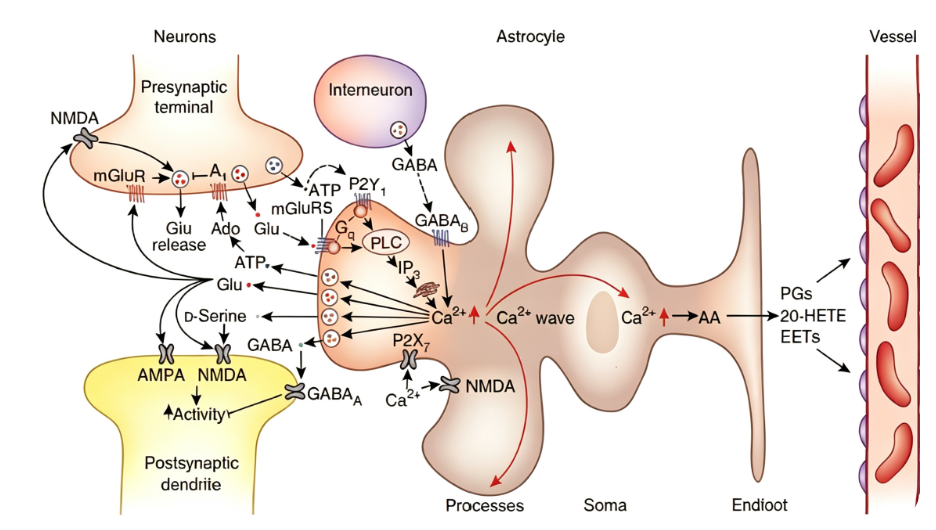
III. The Second Wave of Calcium Signaling: Controversies and Challenges
The second wave of research systematically questioned the core conclusions of the first wave. The main points of controversy include the following six aspects. First, mGluR5 is absent in adult astrocytes, yet they still exhibit glutamate-evoked calcium transients. Second, knocking out the IP3R2 receptor gene on astrocyte calcium stores suppresses calcium transients in the cell body but does not affect many functions of calcium-driven gliotransmitter release. Third, increasing astrocyte calcium concentrations using DREADDs does not induce the release of calcium-driven gliotransmitters. Fourth, calcium transients appear too slow to explain rapid blood flow increases. Fifth, there is debate over whether astrocytes express VGAT and VGLUT to package glutamate and GABA into vesicles for exocytosis. Sixth, inhibiting SNARE-driven exocytosis in astrocytes with a dominant-negative construct (dnSNARE) suppresses gliotransmitter release effects, but dnSNARE may also be expressed in neurons and inhibit neurotransmitter release. These controversies prompted researchers to re-examine the sources, kinetic characteristics, and functional significance of astrocyte calcium signaling.
IV. The Third Wave of Calcium Signaling: New Mechanisms in Fine Processes
The third wave of research shifted focus to fine astrocyte processes unresolved in earlier studies, revealing new mechanisms of calcium signaling. Spatially, calcium transients in astrocyte processes differ significantly from those in the cell body in terms of frequency, kinetics, and spatial propagation. Mechanistically, calcium transients in processes rely roughly equally on calcium entry from extracellular space through ion channels (~40%) and calcium release from intracellular stores (~60%), whereas transients in the cell body primarily depend (~90%) on calcium release from intracellular stores. Activation pathways include calcium entry through spontaneously opening TRPA1 channels or neurotransmitter-gated channels, activation via mGluR2 or mGluR3, and increased intracellular sodium concentrations through neurotransmitter uptake, reversing Na+/Ca2+ exchange. In terms of effector mechanisms, elevated calcium concentrations may release transmitters through ion channels like Best-1 and exocytosis, and alter the surface expression of neurotransmitter transporters. Calcium-activated Na+/Ca2+ exchange increases intracellular sodium concentrations, activating sodium pumps, reducing extracellular potassium concentrations, and hyperpolarizing nearby neurons, thereby increasing the probability of action potential-driven vesicle release and reducing synaptic failure rates. ATP released by calcium transients may act on P2X or P2Y receptors, elevating calcium concentrations further along the cell, propagating calcium waves, or being converted to adenosine to act on presynaptic receptors to increase or decrease neurotransmitter release. Norepinephrine released by locus coeruleus neurons and acetylcholine released by basal forebrain neurons induce substantial calcium transients in astrocytes.
V. Conclusion
From the first wave's discovery of gliotransmitter release, to the second wave's systematic questioning of calcium signaling functions, to the third wave's revelation of new sources and effector mechanisms of calcium transients in fine astrocyte processes, research on astrocyte calcium signaling has undergone a spiraling process of understanding. The third wave not only reaffirmed the central role of calcium transients in astrocyte function but also provided a new molecular framework for understanding astrocyte-neuron interactions by revealing the精细分工 of calcium channels, transporters, and exchangers in calcium signal generation and effects. The Fluo-8 No-Wash Calcium Assay Kit offers reliable experimental support for in-depth analysis of the spatiotemporal dynamics of astrocyte calcium signaling.
In astrocyte calcium signaling and related neurobiological research, efficient and sensitive calcium detection tools are essential for resolving the spatiotemporal dynamics of calcium transients. To meet this research need, U-Ai provides the Fluo-8 No-Wash Calcium Assay Kit, suitable for real-time monitoring of astrocyte calcium transients, neuron-astrocyte interaction studies, and exploration of calcium signaling pathways.
This article is reviewed and published by the technical expert team of UA
Disclaimer: This article partially utilizes artificial intelligence assistance in its creation. If any content involves copyright or intellectual property issues, please let us know and we promise to verify and remove it as soon as possible.
Purchase recombinant protein, choose Nanjing UA-Bio
UA protein focuses on providing various protein reagents, raw materials, and services required for drug research and development, cell therapy, gene therapy, and basic scientific research, including drug target proteins, immune checkpoint proteins, cytokines, tool enzymes, customized protein expression, and full-length transmembrane protein development. Youai is committed to providing customers with high-quality products and professional services, and building a High-tech Biological Enterprise with International Competitiveness.
Target proteins | membrane proteins | cytokines | enzymes | viral antigens | protein customization
Nanjing UA Biotechnology Co., Ltd. Email:order@ua-bio.com Phone:+86-25-56221161

Product Information

Link:





©2021-2026 all rights reserved UA Biotechnology Co.,Ltd.
Privacy Policy 
网站备案号 浙ICP备2022019033号-2 浙公网安备33010202004867号
 Business license (three certificates in one)
 Tel:+86-25-56221161
E-mail:order@ua-bio.com
All products sold on this website shall not be used for clinical diagnosis or treatment of humans or animals, and shall only be used for non-medical purposes such as industrial or scientific research.
