

The next golden target for autoimmune diseases: How far is DR3 from market approval?
Author: Senior Product Manager of UA Views:136 


DR3 (Death Receptor 3), also known as TNFRSF25, is a member of the tumor necrosis factor receptor superfamily (TNFRSF). It is a type I transmembrane protein with a cysteine-rich domain (CRD) in its extracellular region and a death domain (DD) in its intracellular region.
- Recent Advances
- Product Information
- Reference
Recent Advances
The Next Golden Target in Autoimmune Diseases: How Far Is DR3 from Market Approval?
1. Introduction
DR3 (Death Receptor 3), also known as TNFRSF25, is a member of the tumor necrosis factor receptor superfamily (TNFRSF). It is a type I transmembrane protein with an extracellular region containing cysteine-rich domains (CRD) and an intracellular region featuring a death domain (DD). The sole natural ligand of DR3 is TL1A (TNF-like cytokine 1A, also known as TNFSF15). The binding of TL1A to DR3 triggers intracellular signaling cascades in T cells, regulating the expression of pro-inflammatory genes or inducing apoptosis.
2. DR3 Signaling Mechanism

Upon binding with TL1A, DR3 activates two distinct signaling pathways:
Pro-inflammatory signaling pathway: The death domain of DR3 first binds to the adaptor protein TRADD (TNFR-associated death domain protein), which then recruits TRAF2 and RIP1. These complexes further activate the MAPK (ERK, p38, and JNK), NF-κB, and PI3K signaling pathways, ultimately promoting the expression of pro-inflammatory factors. Studies indicate that TL1A-DR3 interaction preferentially induces pro-inflammatory rather than apoptotic pathways in lymphocytes.
Apoptosis/necroptosis pathway: TRADD can also bind to FADD and RIP3, activating caspase-8, which in turn activates downstream caspase-3 and caspase-7, inducing apoptosis. When caspase-8 activity is blocked, FADD, RIP3, RIP1, and MLKL form a "necrosome" complex, leading to necroptotic cell death.
The ultimate outcome of DR3 signaling depends on cell type, microenvironment, and the协同作用 of various signaling molecules. Additionally, DR3 has multiple isoforms and a decoy receptor, DcR3 (TNFRSF6B), which competitively binds TL1A as a soluble receptor, further complicating signal regulation.
3. Role of DR3 in Diseases
3.1 Autoimmune and Inflammatory Diseases
Abnormal activation of the DR3/TL1A signaling axis is a key driver of multiple autoimmune and inflammatory diseases. This axis is dysregulated in rheumatoid arthritis (RA), inflammatory bowel disease (IBD), systemic lupus erythematosus (SLE), ankylosing spondylitis (AS), and allergic asthma, among others.
In inflammatory bowel disease (IBD), the TL1A-DR3 pathway has been most extensively studied. Overexpression of TL1A can drive Crohn's-like ileitis, epithelial barrier disruption, and fibrosis. DR3 signaling plays a central role in initiating and maintaining mucosal immunity in the gut. TL1A stimulates Th1 and Th17 pathways, which are closely associated with the location and severity of intestinal inflammation, while also activating fibroblasts—the primary source of fibrosis. Thus, the TL1A-DR3 axis is regarded as a hub linking immune activation, epithelial barrier dysfunction, and fibrogenesis.
In rheumatoid arthritis, DR3 gene variants have been identified, including a 14-nucleotide deletion in exon 5 and intron 5 that results in truncated DR3 protein. DR3 also regulates the expression of key molecules in rheumatoid synovial fibroblasts.
3.2 Dual Role in Cancer
DR3 exhibits a complex and contradictory dual role in tumorigenesis. Pan-cancer analysis reveals that DR3 expression is highly tumor-type specific: it is overexpressed in 7 cancer types (e.g., bladder urothelial carcinoma) and underexpressed in 16 others (e.g., adrenocortical carcinoma).
In its anti-tumor role, DR3 can directly induce cancer cell death via caspase-8-dependent apoptosis and RIP/MLKL-mediated necroptosis. It also inhibits tumor angiogenesis and activates anti-tumor immunity by NK cells and CD8⁺ T cells. DR3 expression correlates with CD8⁺ T cell and NK cell infiltration, as well as tumor mutational burden (TMB).
Conversely, DR3 may promote metastasis in certain cancers. Its interaction with NF-κB exhibits directional differences across cancer types, differentially regulating cell death. The existence of DR3 isoforms and the decoy receptor DcR3 further complicates its signaling regulation.
4. Drug Development Targeting DR3
4.1 DR3-Blocking Antibodies—Exemplified by SL-325
Currently, the most prominent DR3-targeting drug in development is SL-325, a fully human, Fc-silent, high-affinity DR3-blocking monoclonal antibody developed by Shattuck Labs. Unlike strategies targeting its ligand TL1A, SL-325 directly targets the DR3 receptor.
Preclinical studies show that SL-325 binds human DR3 with picomolar affinity, effectively blocking TL1A binding without inducing DR3 agonism. In PBMCs from healthy donors and IBD patients, SL-325 inhibited TL1A-induced pro-inflammatory cytokine secretion. In ex vivo human intestinal inflammation models, SL-325 suppressed TL1A-driven cytokine production and protected epithelial barrier integrity. In non-human primates, SL-325 demonstrated safety and tolerability at doses up to 100 mg/kg, exhibiting dose-proportional pharmacokinetics and sustained DR3 receptor occupancy.
4.2 Other Investigational Drugs
Beyond SL-325, multiple pharmaceutical companies are developing TL1A/DR3-targeting therapies:
TL1A-targeting antibodies (indirectly blocking DR3 signaling):
- PRA023 (tulisokibart): A TL1A-blocking antibody showing clinical/endoscopic remission in IBD trials.
- RVT-3101 (duvakitug): Also targets TL1A, with Phase III trials underway.
- GR2303: A fully human anti-TL1A monoclonal antibody developed by Zhixiang Jintai, approved for clinical trials by China's NMPA.
- SSGJ-627: A TL1A monoclonal antibody developed by Sansheng Guojian, the first domestically developed TL1A antibody to enter clinical trials in China.
Bispecific antibodies:
- SL-846 (DR3×IL-23R): A bispecific antibody by Shattuck Labs, now in IND-enabling toxicology studies.
- BA2201 (TL1A/IL-23): A bispecific antibody by Boan Biotech, with preclinical data showing superior efficacy to single-target antibodies in colitis models.
4.3 Exploration of DR3 Agonists
In cancer immunotherapy, DR3 agonist strategies are also being explored. Studies show that DR3 is highly expressed on FoxP3⁺ regulatory T cells (Tregs) in their resting state. Agonistic DR3 antibodies can induce rapid, selective Treg expansion. In mouse models, DR3 agonist-induced Treg expansion prevented allergic lung inflammation and alleviated graft-versus-host disease (GVHD).
PTX-35 is a potential first-in-class TNFRSF25 agonistic monoclonal antibody that modulates T-cell immune responses by specifically activating TNFRSF25 signaling, reducing Treg suppressive activity in the tumor microenvironment while enhancing CD4⁺ effector T-cell responses to tumor antigens.
4.4 Screening of Small-Molecule Modulators
Due to the lack of small-molecule modulators for the DR3/TL1A pathway, researchers have established cell-based high-throughput screening methods. Screening 8,000 compounds identified 12 antagonists but no agonists, laying the groundwork for future small-molecule drug development.
5. Summary and Outlook
As a drug target, DR3 is unique in its dual pro-inflammatory and pro-apoptotic functions, offering potential in both autoimmune diseases and cancer therapy. However, this duality also poses challenges—how to precisely modulate DR3 signaling in different disease contexts is key to maximizing therapeutic benefits.
Current DR3/TL1A-targeting drug development is advancing rapidly. DR3-blocking antibodies like SL-325 have entered Phase II trials, showing promise over TL1A antibodies. Meanwhile, bispecific antibodies represent the next-generation approach, aiming for superior efficacy through协同 targeting of multiple pathways. In oncology, DR3 agonists are emerging as a novel immunotherapy strategy.
Recommended Products
DR3/TNFRSF25 His Tag Protein, Human, Cat. No. UA016194
ELISA:

Immobilized DR3/TNFRSF25 His Tag Protein, Human (Cat. No. UA016194) at 5µg/mL(100µL/well) can bind Biotinylated Human TL1A/TNFSF15 Protein, His,Avi Tag with EC50 of 3.70-20.00ng/mL.
SPR:

DR3/TNFRSF25 His Tag Protein, Human (Cat. No. UA016194) immobilized on CM5 Chip can bind Human TL1A/TNFSF15 Protein, His Tag (Cat. No. S0A4083) with an affinity constant of 51.50nM as determined in a SPR assay.
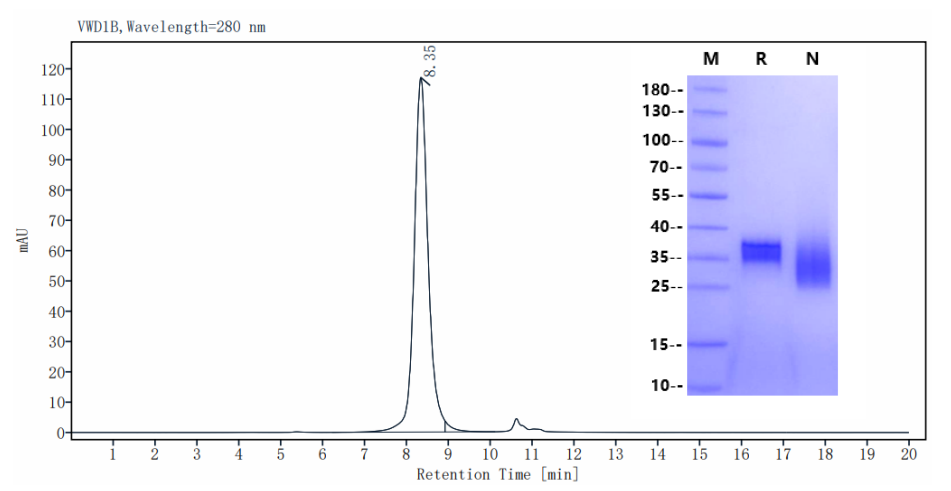
Purity:
| Cat. No. | Product Name |
|---|---|
| UA016194 | DR3/TNFRSF25 His Tag Protein, Human |
| UA040184 | TL1A/TNFSF15 Protein, Human |
| UA100036 | TL1A/TNFSF15 His Tag Protein, Human |
| UA019076 | DcR3 His Tag Protein, Human |
| UA040502 | IL-23 His Tag Protein, Human |
| UA016005 | IL-23 R Fc Chimera Protein, Human |
Related article: https://mp.weixin.qq.com/s/ACTrM8IP0s1Hd3FH_fXBIQ
This article is reviewed and published by the technical expert team of UA
Disclaimer: This article partially utilizes artificial intelligence assistance in its creation. If any content involves copyright or intellectual property issues, please let us know and we promise to verify and remove it as soon as possible.
Purchase recombinant protein, choose Nanjing UA-Bio
UA protein focuses on providing various protein reagents, raw materials, and services required for drug research and development, cell therapy, gene therapy, and basic scientific research, including drug target proteins, immune checkpoint proteins, cytokines, tool enzymes, customized protein expression, and full-length transmembrane protein development. Youai is committed to providing customers with high-quality products and professional services, and building a High-tech Biological Enterprise with International Competitiveness.
Target proteins | membrane proteins | cytokines | enzymes | viral antigens | protein customization
Nanjing UA Biotechnology Co., Ltd. Email:order@ua-bio.com Phone:+86-25-56221161

Product Information
Reference
Wang-Dong Xu; Rong Li; An-Fang Huang. Role of TL1A in Inflammatory Autoimmune Diseases: A Comprehensive Review. Frontiers in Immunology,2022.
Giorgos Bamias; Paola Menghini; Theresa T Pizarro; Fabio Cominelli. Targeting TL1A and DR3: the new frontier of anticytokine therapy in IBD. BMJ,2024.

Link:





©2021-2026 all rights reserved UA Biotechnology Co.,Ltd.
Privacy Policy 
网站备案号 浙ICP备2022019033号-2 浙公网安备33010202004867号
 Business license (three certificates in one)
 Tel:+86-25-56221161
E-mail:order@ua-bio.com
All products sold on this website shall not be used for clinical diagnosis or treatment of humans or animals, and shall only be used for non-medical purposes such as industrial or scientific research.