




PDE4B: A Key Regulator of Cardiac cAMP Signaling Homeostasis and a Novel Therapeutic Target for Heart Failure
Author: Senior Product Manager of UA Views:4 


This article focuses on the molecular characteristics and biological functions of phosphodiesterase 4B (PDE4B), systematically elucidating its central role as a cAMP-specific hydrolase in regulating β-adrenergic signaling in cardiomyocytes, and analyzing its downregulated expression in the hearts of patients with heart failure and its impact on pathological remodeling.
- Recent Advances
- Product Information
Recent Advances
PDE4B: A Key Regulator of Cardiac cAMP Signaling Homeostasis and a Novel Therapeutic Target for Heart Failure
Summary
This article focuses on the molecular characteristics and biological functions of phosphodiesterase 4B (PDE4B), systematically elaborating its central role as a cAMP-specific hydrolase in regulating β-adrenergic signaling in cardiomyocytes and analyzing its downregulation in the hearts of heart failure patients and its impact on pathological remodeling.
This article focuses on the molecular characteristics and biological functions of phosphodiesterase 4B (PDE4B), systematically elaborating its central role as a cAMP-specific hydrolase in regulating β-adrenergic signaling in cardiomyocytes and analyzing its downregulation in the hearts of heart failure patients and its impact on pathological remodeling.
I. Molecular Characteristics and Enzymatic Functions of PDE4B
Phosphodiesterase 4B (PDE4B) is an important member of the PDE4 family within the cyclic nucleotide phosphodiesterase superfamily, encoded by the PDE4B gene. In mammals, the PDE4 family comprises four genes: PDE4A, PDE4B, PDE4C, and PDE4D, with PDE4A, PDE4B, and PDE4D expressed in the hearts of humans and rodents. PDE4B is a cAMP-specific hydrolase that precisely regulates intracellular cAMP concentration and distribution by hydrolyzing cAMP into AMP. The PDE4B protein contains multiple functional domains: the N-terminal regulatory region is responsible for subcellular localization and activity regulation, the catalytic domain hydrolyzes cAMP, and the C-terminal region mediates protein-protein interactions. PDE4B's catalytic activity is positively regulated by PKA phosphorylation and negatively regulated by ERK phosphorylation, a complex regulatory mechanism that allows it to dynamically adjust cAMP hydrolysis rates based on cellular signaling states.
II. Downregulation of PDE4B in Heart Failure and Its Pathological Significance
Heart failure is the end-stage of various cardiovascular diseases, characterized by overactivation of the sympathetic nervous system and elevated plasma catecholamine levels. While catecholamine-mediated β-adrenergic receptor stimulation is beneficial for short-term cardiac function maintenance, persistent sympathetic stimulation promotes myocardial hypertrophy, cardiomyocyte death, fibrosis, and arrhythmias. In the pathological progression of heart failure, PDE4B expression and activity are significantly reduced in pressure overload-induced pathological hypertrophy rat models. Similarly, PDE4B protein levels are markedly downregulated in heart tissues of heart failure patients. Compared to controls, PDE4B expression is significantly lower in hearts of patients with myocardial ischemia or dilated cardiomyopathy, suggesting that PDE4B downregulation contributes to the development and progression of heart failure.
III. Regulatory Mechanisms of PDE4B Overexpression on Cardiac Function
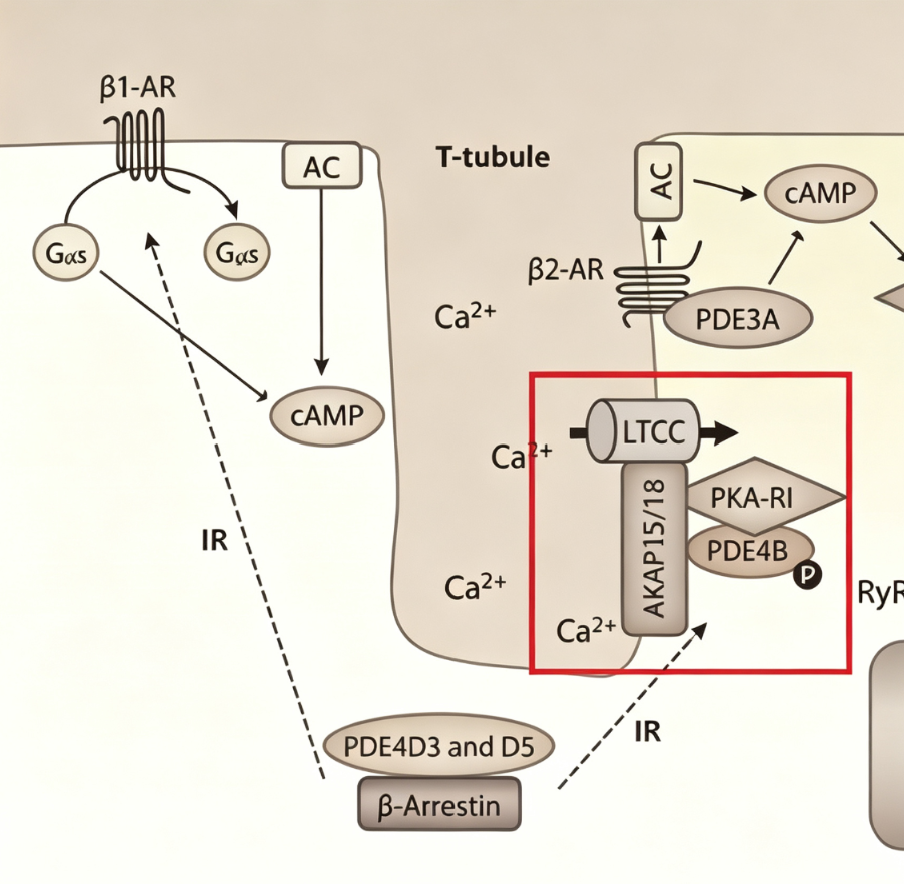
In the heart, PDE4B precisely regulates β-AR modulation of calcium current through physical association with the CaV1.2 subunit of L-type calcium channels. Studies show that PDE4B knockout mice exhibit excessive β-AR stimulation responses in calcium current and calcium transients, leading to increased spontaneous calcium waves and enhanced susceptibility to ventricular tachycardia. PDE4B overexpression effectively attenuates β-AR stimulation of cardiac function—PDE4B-overexpressing mice show significantly lower increases in heart rate and cardiac contractility under isoproterenol stimulation compared to wild-type mice, with markedly reduced elevations in cAMP and PKA activity in isolated cardiomyocytes. PDE4B overexpression also protects against β-AR stimulation-induced proarrhythmic events.
IV. Protective Effects of PDE4B Overexpression on Pathological Cardiac Remodeling
PDE4B overexpression demonstrates protective effects under chronic pressure overload and sustained β-AR stimulation. In PDE4B-overexpressing mice, chronic isoproterenol infusion-induced declines in cardiac function, myocardial hypertrophy, and pulmonary edema are significantly alleviated. In the aortic constriction pressure overload model, PDE4B overexpression similarly suppresses TAC-induced myocardial hypertrophy and pulmonary congestion, reducing fibrosis and apoptosis. Notably, the impact of PDE4B expression levels on cardiac function exhibits dose dependency—moderate PDE4B overexpression causes only mild reversible myocardial hypertrophy without significant mortality increase, while excessive PDE4B expression leads to severe cardiac dysfunction and premature death.
V. Therapeutic Potential of AAV9-Mediated PDE4B Gene Therapy
AAV9-mediated PDE4B cardiac gene therapy shows therapeutic potential in preclinical models. In pressure overload models, PDE4B overexpression delays TAC-induced cardiac systolic dysfunction. In chronic isoproterenol stimulation models, PDE4B gene therapy partially inhibits myocardial hypertrophy and effectively prevents fibrosis and apoptosis. These studies suggest that PDE4B cardiac gene therapy may emerge as a novel approach for treating heart failure.
VI. Conclusion
As a core regulator of cAMP signaling homeostasis in cardiomyocytes, PDE4B is significantly downregulated in heart failure patients, and its deficiency exacerbates β-AR overstimulation-induced myocardial hypertrophy and arrhythmias. Moderate PDE4B overexpression effectively attenuates β-AR stimulation, alleviates pressure overload-induced adverse cardiac remodeling, and suppresses fibrosis and apoptosis. Recombinant human PDE4B protein provides essential support for PDE4B enzymatic function research and the development of novel cardiovascular drugs.
In PDE4B-related basic research and drug screening, high-quality recombinant human PDE4B protein is a key tool for PDE4B enzyme activity assays, inhibitor screening, and protein interaction studies. To meet this research demand, UniLove offers PDE4B2 His Tag Protein, Human, suitable for establishing and validating PDE4B activity assays, high-throughput screening of PDE4B inhibitors, and binding analysis of PDE4B with interacting proteins.
This article is reviewed and published by the technical expert team of UA
Disclaimer: This article partially utilizes artificial intelligence assistance in its creation. If any content involves copyright or intellectual property issues, please let us know and we promise to verify and remove it as soon as possible.
Purchase recombinant protein, choose Nanjing UA-Bio
UA protein focuses on providing various protein reagents, raw materials, and services required for drug research and development, cell therapy, gene therapy, and basic scientific research, including drug target proteins, immune checkpoint proteins, cytokines, tool enzymes, customized protein expression, and full-length transmembrane protein development. Youai is committed to providing customers with high-quality products and professional services, and building a High-tech Biological Enterprise with International Competitiveness.
Target proteins | membrane proteins | cytokines | enzymes | viral antigens | protein customization
Nanjing UA Biotechnology Co., Ltd. Email:order@ua-bio.com Phone:+86-25-56221161

Product Information

Link:





©2021-2026 all rights reserved UA Biotechnology Co.,Ltd.
Privacy Policy 
网站备案号 浙ICP备2022019033号-2 浙公网安备33010202004867号
 Business license (three certificates in one)
 Tel:+86-25-56221161
E-mail:order@ua-bio.com
All products sold on this website shall not be used for clinical diagnosis or treatment of humans or animals, and shall only be used for non-medical purposes such as industrial or scientific research.
