




STAT6: A Key Transcription Factor Aberrantly Activated in Lymphoma and a Novel Therapeutic Target
Author: Senior Product Manager of UA Views:3 


This article focuses on the molecular characteristics and biological functions of STAT6, systematically elaborating its central role in the JAK/STAT signaling pathway as a member of the STAT family, analyzing its constitutive activation and high-frequency mutation features in various lymphomas, and exploring inhibitor screening strategies targeting STAT6 as well as clinical research progress.
- Recent Advances
- Product Information
Recent Advances
STAT6: A Key Transcription Factor with Aberrant Activation in Lymphoma and a Novel Therapeutic Target
Summary
This article focuses on the molecular characteristics and biological functions of STAT6, systematically elaborating its central role in the JAK/STAT signaling pathway as a member of the STAT family. It analyzes its constitutive activation and high-frequency mutation features in various lymphomas and explores inhibitor screening strategies and clinical research progress targeting STAT6.
This article focuses on the molecular characteristics and biological functions of STAT6, systematically elaborating its central role in the JAK/STAT signaling pathway as a member of the STAT family. It analyzes its constitutive activation and high-frequency mutation features in various lymphomas and explores inhibitor screening strategies and clinical research progress targeting STAT6.
I. Molecular Structure and Functional Localization of STAT6
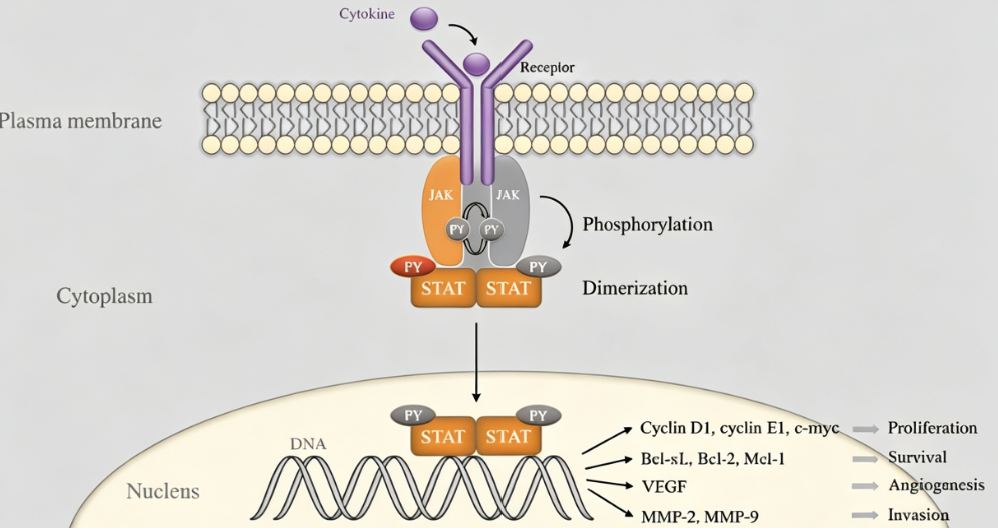
Signal Transducer and Activator of Transcription 6 (STAT6) is a key member of the STAT family, which includes seven members: STAT1, STAT2, STAT3, STAT4, STAT5a, STAT5b, and STAT6. The STAT6 protein contains six conserved domains: an N-terminal domain involved in STAT dimerization and nuclear localization; a coiled-coil domain mediating protein-protein interactions; a DNA-binding domain responsible for binding to specific target gene sequences; a linker domain maintaining protein conformational stability; an SH2 domain responsible for STAT6 phosphorylation activation and dimerization; and a C-terminal transactivation domain containing multiple phosphorylation sites that promote transcription of target genes upon activation. The Y641 site of STAT6 is a critical activation site. After phosphorylation, STAT6 forms homodimers that translocate to the nucleus, bind to DNA, and promote the expression of downstream target genes, including those related to cell proliferation, survival, and immune regulation.
II. Aberrant Activation and Mutation Features of STAT6 in Lymphoma
STAT6 exhibits constitutive activation and high-frequency mutations in various lymphomas. In classical Hodgkin's lymphoma, the STAT6-N417Y high-frequency mutation has been widely detected. In primary effusion lymphoma, STAT6 undergoes constitutive activation under cytokine stimulation, shuttling between the nucleus and cytoplasm to continuously drive the transcription of downstream target genes. Abnormal activation of STAT6 has also been observed in diffuse large B-cell lymphoma. Studies have shown that aberrant activation of STAT6 not only promotes the proliferation and survival of lymphoma cells but also participates in the formation of an immune escape microenvironment, further driving disease progression.
III. Inhibition Strategies and Screening Methods Targeting STAT6
Inhibition of STAT6 activity primarily focuses on the following levels: reducing STAT6 phosphorylation levels, inhibiting the activation of clinical point mutations, preventing STAT6 dimerization, and blocking STAT6-DNA binding. Inhibitor screening strategies targeting STAT6 mainly include: peptide and peptidomimetic inhibitors that competitively bind to the SH2 domain of STAT6, blocking its dimerization and interaction with cytokine receptors; artificially synthesized small-molecule compounds targeting the DNA-binding domain or SH2 domain of STAT6; natural product-derived inhibitors, screening lead compounds with STAT6 inhibitory activity from plants or microorganisms; and using PROTAC technology to design STAT6 degraders, achieving targeted degradation of STAT6 protein through the ubiquitin-proteasome pathway. Multiple strategies are being pursued in parallel to improve inhibitor selectivity and in vivo efficacy.
IV. Clinical Research Progress of STAT6 Inhibitors
TNX-650 is a monoclonal antibody targeting IL-13 that reduces the levels of phosphorylated STAT6 and IL-13Rα1 in Hodgkin's lymphoma tumor tissues by blocking the IL-13/IL-13Rα1 signaling axis. A study on the safety and efficacy of TNX-650 for the treatment of refractory Hodgkin's lymphoma has completed Phase I/II clinical trials (NCT00441818), with preliminary results showing some therapeutic potential.
V. Conclusion
As a key member of the JAK/STAT signaling pathway, STAT6 exhibits constitutive activation and high-frequency mutations in various lymphomas, serving as a critical driver of lymphoma development and progression. Inhibitor screening strategies targeting STAT6 are advancing from multiple dimensions, including SH2 domain inhibitors, DNA-binding inhibitors, and PROTAC degraders. Human recombinant STAT6 protein, as an essential tool for basic research and drug development, will continue to provide critical support for in-depth analysis of the STAT6 signaling network and optimization of targeted therapy strategies for lymphoma.
In STAT6-related basic research and drug screening, high-quality human recombinant STAT6 protein is a key tool for STAT6 inhibitor screening, protein-protein interaction analysis, and signaling pathway studies. To meet this research demand, UniScience offers STAT6 His Tag Protein, Human, suitable for applications such as screening and evaluation of STAT6-SH2 domain-binding peptides, STAT6-DNA binding activity analysis, and STAT6 signaling pathway mechanism studies.
This article is reviewed and published by the technical expert team of UA
Disclaimer: This article partially utilizes artificial intelligence assistance in its creation. If any content involves copyright or intellectual property issues, please let us know and we promise to verify and remove it as soon as possible.
Purchase recombinant protein, choose Nanjing UA-Bio
UA protein focuses on providing various protein reagents, raw materials, and services required for drug research and development, cell therapy, gene therapy, and basic scientific research, including drug target proteins, immune checkpoint proteins, cytokines, tool enzymes, customized protein expression, and full-length transmembrane protein development. Youai is committed to providing customers with high-quality products and professional services, and building a High-tech Biological Enterprise with International Competitiveness.
Target proteins | membrane proteins | cytokines | enzymes | viral antigens | protein customization
Nanjing UA Biotechnology Co., Ltd. Email:order@ua-bio.com Phone:+86-25-56221161

Product Information

Link:





©2021-2026 all rights reserved UA Biotechnology Co.,Ltd.
Privacy Policy 
网站备案号 浙ICP备2022019033号-2 浙公网安备33010202004867号
 Business license (three certificates in one)
 Tel:+86-25-56221161
E-mail:order@ua-bio.com
All products sold on this website shall not be used for clinical diagnosis or treatment of humans or animals, and shall only be used for non-medical purposes such as industrial or scientific research.
